
Avoid Permit Surprises: A2L MAQ & Logs for HVAC Refrigerant Storage


Confirm your local fire code authority before you stack a single cylinder, calculate your maximum allowable quantity including any pre-charged equipment on site, secure and label the storage area, install active sensors where flammable refrigerants are present, and start a digital inventory log the same day. Consult the IFC, NFPA 55, ASHRAE, and EPA Section 608 before you assume your current setup passes inspection.
TL;DR:
- Most violations happen due to missing or inaccurate MAQ calculations, especially when including refrigerant in pre-charged equipment and on service trucks, not just cylinders on shelves.
- Installing active sensors that trigger mechanical ventilation and de-energize equipment if leaks are detected is now a standard expectation, with proper placement near the floor and in dead zones.
- Cylinders must be recertified periodically, stored upright without gauges, and inspected for rust or damage, with proper tracking across warehouse, truck, and job sites using digital logs.
- Confirm whether your local authority requires a storage permit based on your total refrigerant quantity, internal control measures, and refrigerant class, especially for flammable (A2L, A3) substances.
- Organize all documentation preemptively, including hazard signage, SDS, MAQ calculations, and sensor logs, and maintain good facility layout and habits to prevent violations before inspections.
Table of Contents
- Quick Compliance Checklist for Refrigerant Storage Requirements
- What IFC, NFPA, ASHRAE, EPA, and OSHA Each Require
- How to Calculate MAQ Without Getting It Wrong
- Active Sensors and Ventilation: What the Code Actually Expects
- Cylinder Handling Rules That Prevent Violations
- Documents to Have Ready Before an Inspector Shows Up
- Facility Layout and Daily Habits That Keep You Compliant
- What Most Facilities Get Wrong About Storage Compliance
- Sourcing Compliant Refrigerant and Documentation Through Hvac-Prime
- Codes and Guidance Worth Bookmarking
- Sources
- FAQ
Quick Compliance Checklist for Refrigerant Storage Requirements
Run this the same day you suspect a gap. Most violations trace back to one of these five items.
- Call your local fire marshal or building department to confirm whether a storage permit applies to your quantity and refrigerant class.
- Total every cylinder plus every pre-charged unit sitting in the warehouse or on trucks. OSHA counts pre-charged equipment toward your storage total, not just bulk cylinders.
- Post the correct hazard signage and make Safety Data Sheets accessible at the storage point, not filed in an office three buildings away.
- Test that any installed sensors actually trigger ventilation or shutdown, not just an audible alarm.
- Assign a unique ID to every cylinder and log its location. A spreadsheet beats a clipboard, and a tracking system beats both.
What IFC, NFPA, ASHRAE, EPA, and OSHA Each Require
Five different bodies govern refrigerant storage, and each covers a different slice of the problem. Knowing which one answers your specific question saves hours of searching the wrong document.
- IFC 608.12 ties refrigerant storage to the building services chapters that already govern compressed-gas storage and fire-safety controls, meaning your local fire code inspector will cross-reference storage against general hazardous-materials rules, not a standalone refrigerant clause.
- NFPA 55 sets the maximum allowable quantity and control-area framework, and sprinkler coverage or fire-rated separations can raise how much you’re permitted to store in one space.
- ASHRAE guidance covers cylinder condition: refillable tanks need periodic retesting and recertification, plus specific PPE for handling.
- EPA Section 608 and the AIM Act govern recordkeeping, technician certification, and recovery equipment, with recent threshold changes under 40 CFR § 84.106 affecting certain substitute refrigerants.
- OSHA interpretations require secure, ventilated enclosures for flammable refrigerants, explicitly ruling out lockers or confined closets as adequate storage.
How to Calculate MAQ Without Getting It Wrong
Maximum allowable quantity is where most facilities get flagged, usually because they forgot to count something. The MAQ isn’t just what’s sitting in cylinders on a shelf. It includes every pound of refrigerant charged into equipment staged for installation, plus anything on a service truck parked at the dock. Skip that count and your actual on-site total can run well past what your permit allows, even though the cylinder count alone looked fine.
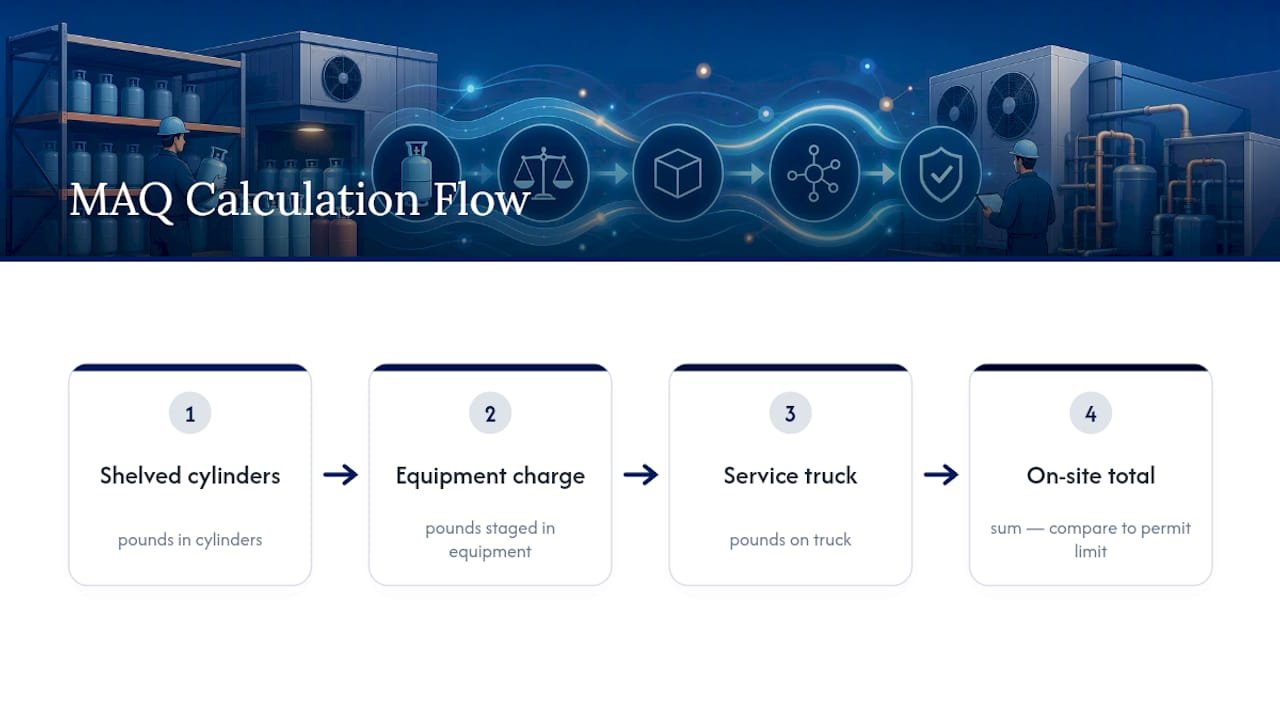
Control areas change the math. A fire-rated separation or automatic sprinkler system can increase how much you’re allowed to store in a given zone under NFPA 55’s control-area framework, and refrigerant classification matters just as much as volume. A2L refrigerants carry lower flammability than A3 substances, which sometimes earns higher storage allowances, but the exact numbers vary by jurisdiction and building type. If your facility sits close to a limit, don’t guess. Ask your AHJ whether an equivalency or increased allowance applies before you order another pallet of cylinders.
Active Sensors and Ventilation: What the Code Actually Expects
An alarm that just makes noise no longer satisfies most inspectors. Standards now expect active sensors that respond mechanically, not passively.
- The sensor should trigger mechanical ventilation automatically when it detects a leak above threshold.
- It should be capable of forcing a pump-down cycle on connected equipment.
- In higher-risk configurations, it should de-energize equipment that could ignite an accumulated vapor cloud.
Placement matters as much as the hardware. Sensors belong low, near the floor, since most refrigerants are heavier than air and pool before they rise. Corner dead zones in warehouses and near loading docks deserve their own sensor, not just one unit covering the whole room. Keep a maintenance log showing calibration dates and test results. Inspectors ask for this record almost as often as they ask about the sensor itself.
Pro Tip: Link your sensor test logs to the same digital record you use for cylinder inventory. When an inspector asks for both at once, which they usually do, you pull one file instead of two.
Cylinder Handling Rules That Prevent Violations
Cylinder condition and handling generate more citations than almost anything else on this list, mostly because the rules are simple and frequently ignored.
- Retest and recertify refillable cylinders at the intervals ASHRAE guidance specifies. Visual inspection alone doesn’t confirm structural integrity.
- Never store a cylinder with a gauge still attached. A left-on gauge invites valve damage and slow leaks you won’t notice until the tank is empty.
- Store upright, always, with the relief valve sitting in the vapor space rather than submerged in liquid refrigerant.
- Discard any cylinder showing visible rust or corrosion. Weakened steel fails under pressure, and damp storage areas accelerate the damage.
- Track cylinders across three tiers: warehouse stock, vehicle stock, and job-site stock, then reconcile the count weekly so a truck full of tanks doesn’t disappear from your records. Moving that reconciliation to timestamped digital logs closes the gaps a paper clipboard always misses.
For cylinders that fail inspection outright, follow proper disposal procedures rather than setting them aside indefinitely.
Documents to Have Ready Before an Inspector Shows Up
Every inspection moves faster when the paperwork is already organized instead of assembled on the spot.
- Hazardous Materials Inventory Statement, current and matched to what’s actually on the shelf.
- SDS binder or digital access point, matched to every refrigerant type stored on site.
- MAQ calculations with a floor plan showing control-area boundaries and sprinkler coverage.
- Sensor and ventilation test logs, dated and signed.
- Refrigerant service records and technician certification files, retained for the period EPA references, generally three years.
Export digital records into a single folder organized by date and location before the inspection, not during it. An auditor who has to wait while you dig through three systems forms an impression before they’ve checked a single number.
Facility Layout and Daily Habits That Keep You Compliant
Good layout decisions prevent most violations before they happen, and they cost less than fixing a citation after the fact.
- Keep refrigerant storage away from furnaces, water heaters, and any open-flame equipment. Heat sources near flammable refrigerants are a standing invitation to a much worse problem.
- Post NFPA hazard placards and “No Smoking” signage at every entry point to the storage area.
- Control humidity and temperature. Damp, uninsulated storage sheds shorten cylinder life and accelerate corrosion.
- Segregate refrigerants by flammability class rather than storing A2L and A3 cylinders on the same rack.
- Keep SDS and emergency contact numbers posted at the storage point itself, and notify your local fire department of on-site quantities so their response plan matches reality. Practical routine inspection habits catch small problems before an inspector does.
Facilities running larger cold-storage or commercial refrigeration operations often benefit from comparing notes with dedicated refrigeration service resources, like the practical field guidance on the Conexcool blog, which covers day-to-day storage and handling issues from a service-technician angle.
What Most Facilities Get Wrong About Storage Compliance
The blind spot we see most often isn’t the warehouse shelf, it’s the truck parked outside it. Technicians load vehicles with pre-charged units and spare cylinders and nobody counts that toward the site’s MAQ until an inspector does the math for them. The fix isn’t complicated: sweep every vehicle and job-site trailer the same week you audit the warehouse, then log what you find.
Digital tracking changes the pace of an audit more than any single code update does. Facilities that move from paper logs to timestamped digital records stop buying duplicate stock they didn’t know they already had, and they stop scrambling when someone asks for last quarter’s inventory. Run the checklist above against your current permit documents this week. The gap, if there is one, usually shows up in the first ten minutes.
— Planet
Sourcing Compliant Refrigerant and Documentation Through Hvac-Prime
Meeting these storage requirements starts with knowing exactly what’s in your inventory, and that means having current SDS and TDS documents for every refrigerant type on the shelf, not just the ones you remember to check. Many refrigerant suppliers keep SDS and TDS downloads available for their catalogs, so safety managers can pull documentation the moment an inspector asks rather than hunting through old supplier emails.
Beyond documentation, many suppliers stock virgin refrigerants across the common HVAC and automotive classes, including A2L options, with shipping options to help you replace stock without stretching your storage timeline while you wait on a backordered cylinder. Catalogs often also cover HVAC tools for handling and verification, useful when you’re auditing cylinder condition against the checklist above. Suppliers provide materials and paperwork; your AHJ still issues the permit. Browse the refrigerant catalog and place an order before your next scheduled inspection.
Codes and Guidance Worth Bookmarking
- IFC 608.12 storage requirements
- ASHRAE safe storage and handling guidance
- EPA Section 608 refrigerant management
- OSHA interpretation on pre-charged equipment
This article is general information, not a substitute for advice from a qualified lawyer. Consult a qualified legal professional about your own circumstances before acting on anything here.
Sources
- Safe Storage of Flammable Refrigerants — HVAC Insider
- 2024 International Fire Code (IFC) – 608.12 Storage, use and …
- O&M Guidance Sheet 1: Safe Storage and Proper Handling of Refrigerants — ASHRAE
- Managing refrigerant in stationary refrigeration and air-conditioning equipment — EPA Section 608
- Storage of pre-charged air conditioners and heat pumps in … — OSHA interpretation
FAQ
What Do OSHA Regulations Say About Refrigerant Storage?
OSHA requires secure, ventilated enclosures for flammable refrigerants rather than lockers or confined spaces, and it counts refrigerant in pre-charged equipment toward your total on-site storage quantity.
What New Refrigerant Regulations Take Effect in 2026?
Regulatory requirements under the AIM Act and 40 CFR § 84.106 affect the handling of certain substitute refrigerants; consult the EPA’s current guidance for the latest information before assuming prior rules still apply.
How Should Refrigerant Cylinders Be Stored?
Store cylinders upright with the relief valve in the vapor space, never with a gauge attached, in a ventilated area segregated by flammability class and away from heat sources.
How Should R-410A Be Stored Specifically?
Non-flammable A1 refrigerants do not require the active sensors mandated for A2L or A3 classes, but they still need upright storage, gauge-free cylinders, and protection from temperature extremes that raise internal pressure.
Do Pre-Charged Units Count Toward My Storage Limit?
Yes. OSHA interpretations and NFPA 55’s MAQ framework both count refrigerant sealed inside pre-charged equipment toward your facility’s maximum allowable quantity, not just refrigerant held in standalone cylinders.




 HVAC
HVAC Automotive
 Refrigerant Diagnostics Kit
 Water Heaters