
Stock One Blend: R448A vs R449A for HVAC Techs, GWP Near 1,400


For most commercial refrigeration retrofits, treat R448A and R449A as functionally interchangeable and default to whichever your OEM specifies. Both carry a GWP near 1,400, both are A1 rated, and both replace R404A with better efficiency. R449A shows a slight heat transfer edge in lab testing, but that rarely decides a real job. Convert to POE oil, charge by liquid, and you’re covered either way.
TL;DR:
- Both R448A and R449A have a similar GWP near 1,400 and are classified as low-toxicity, nonflammable refrigerants, making their regulatory and safety profiles nearly identical.
- R449A offers about 8% better heat transfer performance in lab conditions, but both blends generally provide higher system COP than R404A in real-world applications.
- Converting to either blend requires full system recovery, switching to POE oil, and charging in liquid to prevent fractionation, with OEM guidance taking precedence if specified.
- Availability and long-term regulation favor stocking R448A or R449A over R404A, as both are approved by EPA under phasedown policies and face no imminent restrictions.
- The choice between blends should follow OEM recommendations or, when unspecified, favor R449A for medium-temperature applications due to its slight thermal advantages.
Table of Contents
- R448A vs R449A: The Truck-Side Comparison
- What’s Actually in These Blends, and Why It Matters
- How R448A and R449A Actually Perform on the Bench
- Retrofit Checklist: Converting a System to R448A or R449A
- Where EPA Regulation Leaves These Blends
- The Bottom Line on Choosing Between Them
- An Editorial Take: Stop Treating This Like a Bigger Decision Than It Is
- Where to Source R448A and R449A Without the Wait
- Sources
R448A vs R449A: The Truck-Side Comparison
Pull up to a job needing a fast decision and here’s what actually separates these two blends:
- GWP: Both R448A and R449A have global warming potentials near 1,400, with differences too small to give either a regulatory advantage at present.
- Safety class: Both are ASHRAE A1, meaning low toxicity and nonflammable. No special ventilation rules beyond standard refrigerant handling.
- Temperature glide: Both blends exhibit temperature glide in the single-digit Fahrenheit range, which technicians need to consider when reading superheat and sizing equipment.
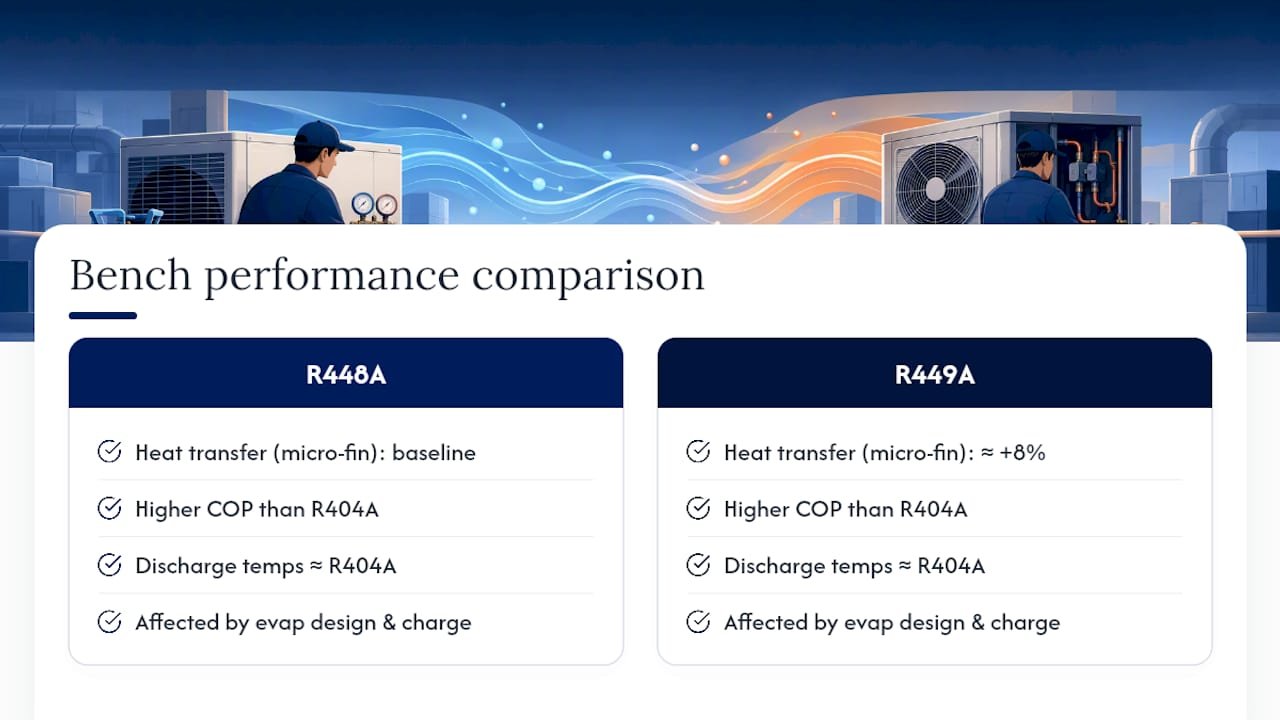
- Efficiency: R449A measured roughly 8% higher local heat transfer than R448A in a controlled micro-fin tube study, though both beat R404A on system COP in many test configurations.
- Service actions: Convert to POE oil on any retrofit, charge in liquid phase to avoid fractionation, and confirm the OEM’s blend preference before you commit a cylinder.
None of these differences are large enough to justify carrying both blends in every truck. Most shops pick one as their default and keep the other on hand for jobs where the equipment nameplate says otherwise.
What’s Actually in These Blends, and Why It Matters
R448A is a quinary blend, five components mixed to hit a specific pressure and capacity target close to R404A. R449A is a quaternary blend, four components, engineered for the same general purpose through a slightly different formulation. Neither is a single-compound refrigerant, so both behave like zeotropic mixtures: they don’t boil and condense at one fixed temperature the way R134A does.
That glide, the temperature spread between the dew point and bubble point at a given pressure, is the property technicians need to respect most. If you’re used to reading a single saturation temperature off a P/T chart for a pure refrigerant, glide throws that off. You need to account for it when sizing evaporators or interpreting superheat, especially in low temperature cases where a few degrees of error changes your read on system health.
Vapor pressure on both blends tracks closely with R404A, which is exactly why thermodynamic property studies recommend them as R404A replacements in the first place. Existing R404A system components, compressors, valves, line sets, generally tolerate the pressure profile without redesign. That’s not true going the other direction from R22, where the pressure and capacity mismatch is much larger.
Both blends carry the ASHRAE A1 classification: lower toxicity, no flame propagation. ASHRAE’s position on refrigerant selection treats safety class as one factor among several, alongside efficiency and environmental impact, and A1 status means neither blend adds handling restrictions beyond what you already follow for R404A.
How R448A and R449A Actually Perform on the Bench
The most cited data point in this comparison comes from a micro-fin tube boiling study that measured local heat transfer coefficients for both blends across a range of vapor qualities. R449A came out roughly 8% ahead of R448A in that test case, likely tied to its slightly higher thermal conductivity and marginally tighter glide. That’s a real, measured difference, but it’s a lab number generated in a specific tube geometry and quality range. Your rooftop unit with standard finned tubing won’t necessarily show the same spread.
What matters more for day to day work: both blends generally deliver higher COP than R404A in equivalent systems, according to the same thermodynamic analysis. Lower power draw for the same cooling load is the headline efficiency story here, not the R448A versus R449A gap.
Evaporator design changes the picture further. Micro-fin tubes amplify small thermophysical differences between refrigerants because the enhanced surface area interacts differently with each blend’s viscosity and conductivity. Charge level matters too, since undercharged or overcharged systems mask whatever thermodynamic advantage a blend has on paper.
One practical note for your service calls: expect compressor discharge temperatures on both blends to run close to what you saw on R404A, sometimes slightly lower thanks to the efficiency gain. If you see unusually high discharge temps after a retrofit, that’s a charge or superheat problem, not a blend mismatch.
Retrofit Checklist: Converting a System to R448A or R449A
Neither blend is a drop-in for anything. If you’re coming from R22, the pressure and capacity mismatch requires expansion device changes and equipment-level work, not just an oil swap. Coming from R404A is more straightforward, but still not a simple gas-and-go.
- Confirm OEM guidance first. If the equipment manufacturer specifies one blend over the other, that overrides any lab comparison in this article.
- Recover the full system charge. Never top off an existing charge with a different refrigerant. Cross-contamination ruins both blends and complicates recovery down the line.
- Flush and convert to POE oil. If the system ran mineral oil or alkylbenzene, a full oil change is mandatory, not optional.
- Charge by liquid, not vapor. Pulling vapor from the cylinder during a partial charge risks fractionation, which shifts the blend’s composition and throws off performance.
- Verify superheat and subcooling against the new P/T chart. Glide means your old R404A targets won’t map directly.
- Check oil return and discharge temperature after startup and again on a follow-up call.
Pro Tip: Skipping the POE conversion is the single most common cause of early compressor failure after a retrofit. If a tech tells you “it ran fine on the old oil for a week,” that week is exactly how long it takes for lubrication starvation to show up as a bearing failure.
Red flags that make a system a poor retrofit candidate: heavily worn compressors already near end of life, systems with unknown or mixed refrigerant history, and any unit where the manufacturer explicitly prohibits blend conversion. Walk away from those rather than force a retrofit that fails in six months. For deeper background on retrofit complexity in a related refrigerant pair, the R407C to R410A conversion guide covers similar oil and expansion device issues.
Where EPA Regulation Leaves These Blends
Both R448A and R449A were approved by the EPA as lower GWP alternatives under HFC phasedown policy, and neither is currently scheduled for phase-out. That’s a meaningful distinction from R404A, which faces mounting restriction as the AIM Act phasedown tightens HFC allowances through 2036.
For contractors, that means stocking either blend today is a safe long-term bet, not a stopgap. Document which refrigerant goes into which system on your equipment records now. As the phasedown schedule advances, having accurate records saves you from guessing what’s in a customer’s system five years from now, and from ordering the wrong replacement charge on a service call.
The Bottom Line on Choosing Between Them
Follow OEM specification when one exists. That single rule resolves the vast majority of retrofit and new-install decisions, and it beats any lab number in this article.
When the OEM is silent, lean toward R449A for medium temperature applications where the modest heat transfer edge might translate to marginally better case temperatures. For low temperature work, either blend performs comparably, and availability or price should break the tie.
Practically, most shops stock one blend as their primary R404A replacement and keep a few cylinders of the other on hand for jobs where a manufacturer’s plate specifies it. Trying to inventory both at scale rarely pays off.
An Editorial Take: Stop Treating This Like a Bigger Decision Than It Is
The refrigerant industry loves a good technical debate, and R448A versus R449A generates plenty of forum chatter about which one is “better.” Most of that chatter overstates the stakes. The blend choice itself is a rounding error next to those steps.
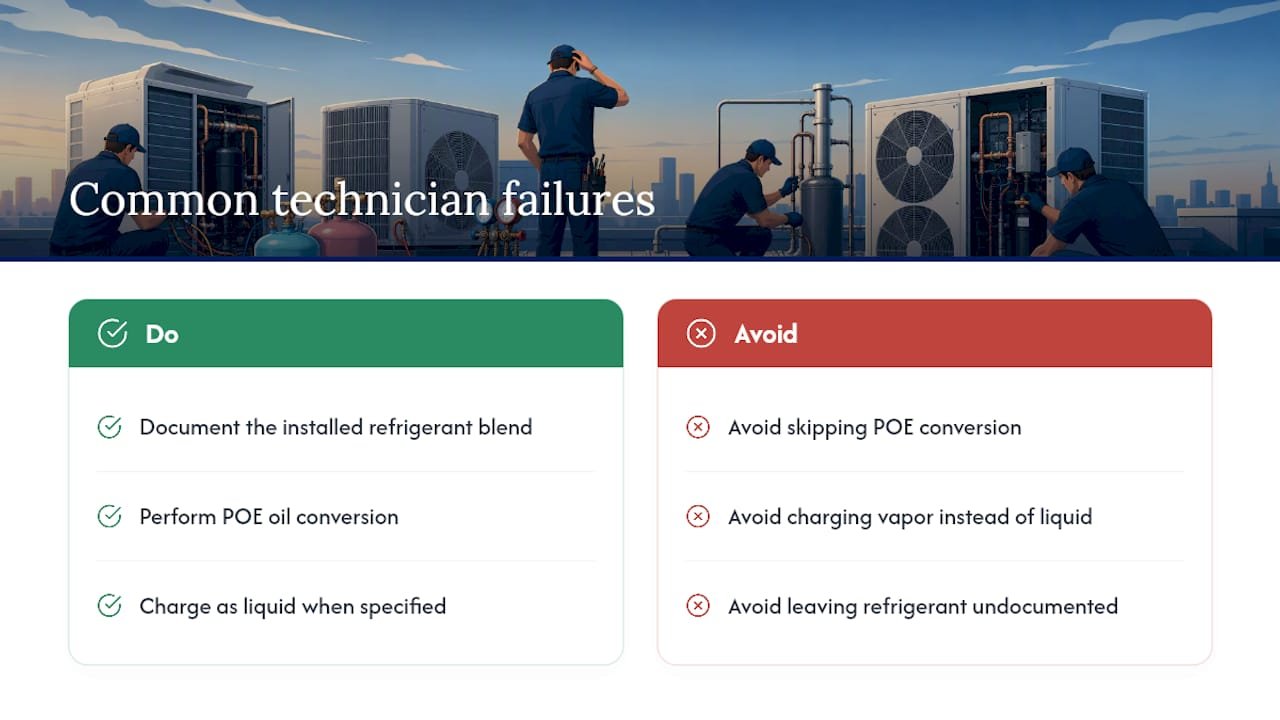
Where technicians actually get burned isn’t picking the wrong blend, it’s skipping the POE conversion or charging vapor instead of liquid. Those mistakes cause callbacks.
If there’s a real blind spot in how contractors approach this comparison, it’s documentation. Techs will debate glide and GWP for twenty minutes, then forget to log which blend went into a walk-in cooler. Five years from now, when that system needs a top-off or a repair, someone’s going to be guessing, and guessing wrong on refrigerant identity is far more expensive than guessing wrong on which of these two blends had marginally better lab numbers.
— Planet
Where to Source R448A and R449A Without the Wait
There are distributors who make you call for a quote and wait on freight. Hvac-prime skips that: wholesale pricing on virgin refrigerant, fast shipping, and stock depth on both R448A and R449A so you’re not stuck substituting a blend because your usual supplier ran short.

Every cylinder ships with access to SDS and TDS documentation so you can hand a customer or inspector the paperwork on the spot, no digging through a manufacturer’s website mid-job. Hvac-prime also carries the gauges, vacuum pumps, and diagnostic kits from the professional HVAC tools line you need to run a clean retrofit from recovery through final charge.
Browse the full refrigerant catalog and place your order before your next scheduled retrofit, so the right cylinder is on the truck instead of on backorder.
Sources
- Horizontal convective boiling of R448A, R449A, and R452B within a micro‑fin tube (PMC)
- Thermodynamic properties of R448A and R449A (ScienceDirect)
- EPA — Frequent questions about HFC phasedown
- ASHRAE position document on refrigerants and their responsible use




 HVAC
HVAC Automotive
 Refrigerant Diagnostics Kit
 Water Heaters