
Vacuum Pump Oil Types: A Technician’s Selection Guide

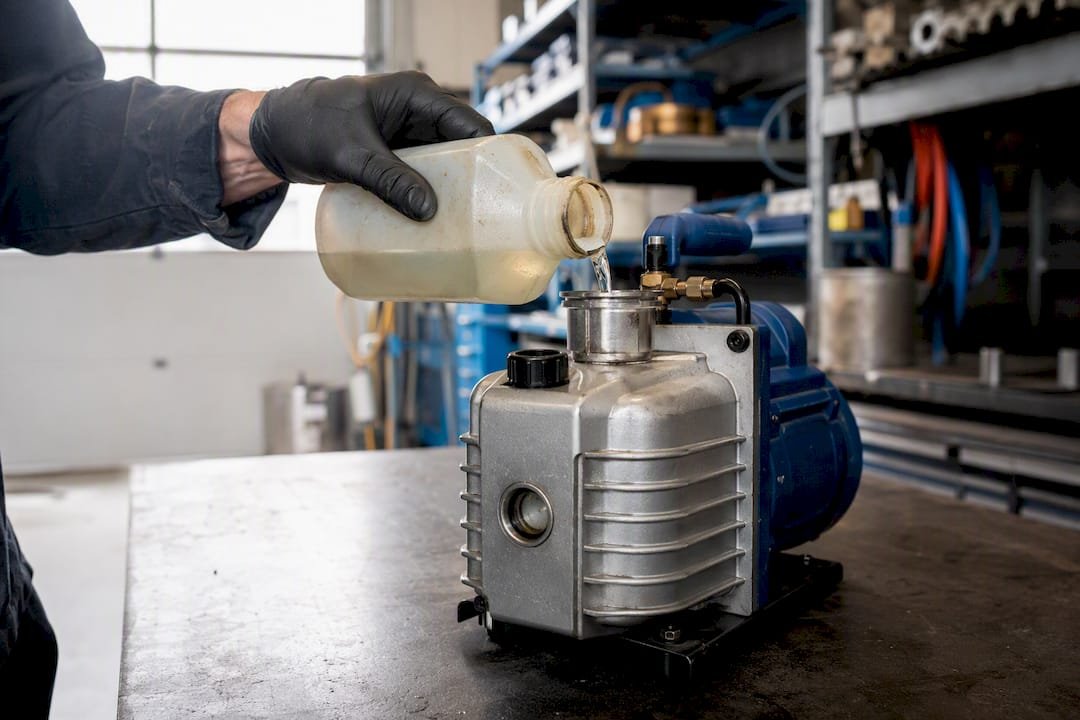
Vacuum pump oil breaks down into five practical families: mineral, PAO synthetic, ester synthetic, silicone, and PFPE (perfluoropolyether). The one-line rule technicians use in the field is simple. Match the oil’s chemical family and ISO viscosity grade (ISO 22, 32, 68, 100, or 220) to the pump design and the gas it’s pumping, then confirm both against the manufacturer’s spec sheet. Leybold’s oil selection guidance backs this up: no single lubricant covers every job.
Oil-sealed rotary vane pumps still dominate HVAC and lab work because they reach deeper vacuums than most oil-free alternatives, but that performance comes with a maintenance obligation, since oil is also the most common contamination source in these systems. Getting the oil family right up front saves you a callback.
- Mineral oil: general-purpose HVAC and refrigeration evacuation, moderate cost, moderate thermal stability.
- Synthetic (PAO/ester): higher heat loads, longer service intervals, better oxidation resistance.
- Silicone or PFPE: oxygen service, reactive gases, or chemically aggressive processes.
Pro Tip: Never substitute automatic transmission fluid or engine oil in a pump, even temporarily. Their vapor pressure is too high, and they will vaporize and backstream right into your process.
Key Takeaways
Matching oil chemical family and ISO viscosity grade to pump design and process gas is the single decision that determines vacuum pump reliability and service life.
| Point | Details |
|---|---|
| Match chemistry to process | Use mineral or synthetic oil for general work, PFPE for oxygen or reactive-gas service. |
| Get viscosity right | Confirm ISO grade against the pump manual before ordering or substituting oil. |
| Watch for backstreaming | Clean foreline traps on schedule since surface creep can bypass them over time. |
| Read oil color as diagnostic | Milky oil means moisture, dark oil means oxidation, both signal a change is due. |
| Source oil and refrigerant together | Hvac-prime stocks vacuum pumps, tools, and virgin refrigerants for the same job. |
Table of Contents
- Types of Vacuum Pump Oil and Where Each One Fits
- Which Oil Properties Actually Determine Suitability
- Matching Oil Type to Pump Design
- How Oil Backstreaming Contaminates Your Vacuum System
- Common Vacuum Pump Oil Mistakes to Avoid
- Reading Your Oil for Maintenance and Change Timing
- A Procurement Checklist for Ordering the Right Oil
- What Twenty Years of Service Calls Teaches You About Oil
- The Right Oil, Sourced Fast, With the Refrigerants You Already Need
- Frequently Asked Questions
- Sources
Types of Vacuum Pump Oil and Where Each One Fits
Every oil family trades cost against chemical toughness. Mineral oil, refined from petroleum, is the workhorse for general vacuum service. It’s affordable and widely stocked, but it oxidizes faster under heat and has less inertness against reactive gases.
PAO and ester synthetics step up thermal and oxidative stability. PAO handles heat cycling well and resists sludge formation; ester oils (diesters and polyol esters, often called POEs) add better solvency for varnish and are common where oil needs to stay cleaner longer between changes. Both cost more than mineral oil, sometimes two to three times as much, but stretch service intervals enough to offset that.
Silicone-based oils bring extreme thermal stability and low volatility, making them useful in some diffusion-pump and high-temperature applications, though their sealing performance in mechanical pumps can lag behind hydrocarbon-based oils. PFPE fluids are the most chemically inert option available and the only real choice for oxygen-rich or halogen-reactive processes, since ultra-clean and oxygen environments generally require PFPE’s chemical inertness despite the higher price tag.
| Oil family | Strength | Trade-off |
|---|---|---|
| Mineral | Low cost, wide availability | Faster oxidation, shorter life |
| PAO synthetic | Strong thermal stability | Higher upfront cost |
| Ester synthetic | Good varnish resistance | Moderate cost, needs compatible seals |
| Silicone | High thermal tolerance | Weaker mechanical lubricity |
| PFPE | Chemically inert, oxygen safe | Most expensive by far |
Pro Tip: If the process involves oxygen concentration above ambient air or a reactive halogen gas, don’t improvise. PFPE is the only category built for that risk.
Which Oil Properties Actually Determine Suitability
Vapor pressure is the property that separates vacuum pump oil from every other lubricant on the shelf. A vacuum pump oil needs a vapor pressure low enough that it doesn’t boil off inside the pump and travel backward into your chamber. This is exactly why ATF and engine oil are disqualified. Their vapor pressure is too high for vacuum service, and they vaporize and contaminate the system instead of just lubricating it.
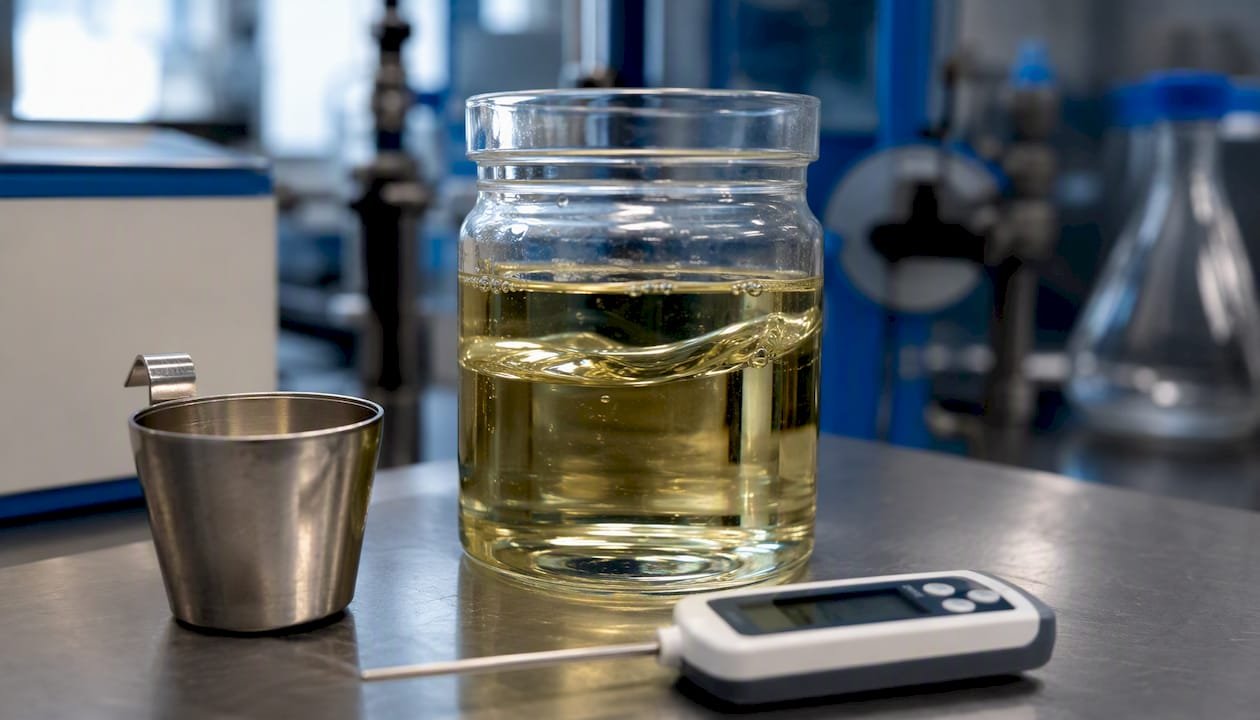
Viscosity, expressed as ISO grade, is the second gatekeeper. Guidance from Blower & Vacuum Best Practices is blunt about this: too high an ISO grade and the pump overheats and strains; too low and you lose sealing and accelerate wear. Liquid ring pumps typically run ISO 22 or 32. Rotary vane pumps usually call for ISO 68 or 100. Gear-driven process pumps can need ISO 220.
Thermal and oxidative stability determine how long oil stays usable under heat cycling before it varnishes. Chemical inertness determines whether the oil reacts with your process gas at all.
When you pull a technical data sheet, read these numbers first:
- Vapor pressure at operating temperature
- Kinematic viscosity at 40°C (this maps to ISO grade)
- Pour point (cold-start behavior)
- Flash point (fire safety margin)
Matching Oil Type to Pump Design
Pump geometry dictates oil chemistry as much as the process gas does. A liquid ring pump doesn’t work the oil the same way a rotary vane pump does, and the viscosity numbers reflect that.
- Rotary vane and backing pumps: ISO 68 or ISO 100, mineral or PAO depending on duty cycle.
- Liquid ring pumps: ISO 22 or 32, lighter viscosity for the ring-seal design.
- Gear-driven or process pumps: ISO 220, heavier film for higher mechanical loads.
- Diffusion pumps: purpose-built low-vapor-pressure diffusion fluid, not a general vacuum oil at all.
- Turbomolecular backing: matched to whatever roughing pump sits behind it, usually mineral or synthetic at standard ISO grades.
| Pump type | Typical ISO grade | Common oil family |
|---|---|---|
| Rotary vane | 68 or 100 | Mineral or PAO |
| Liquid ring | 22 or 32 | Mineral or synthetic |
| Gear-driven process | 220 | Synthetic |
| Diffusion pump | N/A (specialty fluid) | Diffusion-specific silicone/hydrocarbon |
| Oxygen or halogen service | Manufacturer-specified | PFPE or silicone |
Oxygen service, plasma processes, and corrosive gas handling override the standard viscosity chart entirely. If the process gas can react with hydrocarbon oil, you need PFPE regardless of what viscosity the pump geometry would otherwise suggest.
Pro Tip: Before you substitute any oil, pull the pump manual and confirm the OEM viscosity spec in writing. A cheaper oil that’s one ISO grade off can cost you a rebuild. A pump like the Bolton 7 CFM dual-stage vacuum pump lists its required grade directly in the documentation, which is where this check should start.
How Oil Backstreaming Contaminates Your Vacuum System
Backstreaming happens when oil vapor migrates from the pump back into the vacuum chamber against the intended flow of gas. Surface creep is the quieter cousin: oil films crawl along interior surfaces even when vapor pressure is under control. Both mechanisms degrade oil-sealed pump systems over time and they matter most in thin-film deposition, R&D chambers, and any refrigerant work where chamber cleanliness affects the final result.
Mitigation comes down to three tools used consistently:
- Foreline traps, cryogenic, adsorption, or absorption type, placed between pump and chamber.
- Cold traps for condensable vapor capture ahead of sensitive equipment.
- Scheduled trap maintenance, since surface creep can bypass an otherwise functional trap if sorbent material isn’t replaced on schedule.
- Clean or replace foreline trap media every 3 to 6 months under normal duty, sooner under heavy use.
- Inspect check valve placement during routine service calls.
- Watch for a water-drop bead test failure on trap surfaces as an early contamination signal.
Pro Tip: A quick visual check of your foreline trap during every oil change catches creep contamination before it reaches the chamber, not after.
Common Vacuum Pump Oil Mistakes to Avoid
The most expensive mistakes are avoidable ones. Using ATF, engine oil, or any lubricant not rated for vacuum service tops the list, since these fluids vaporize and backstream almost immediately. Mixing incompatible oil chemistries, say, blending mineral oil into a system that’s been running ester synthetic, causes varnish and clouding. Ignoring the viscosity spec because “close enough” oil was in stock leads to slow, expensive wear.
Running the wrong oil family in an oxygen-service pump isn’t a performance problem. It’s a safety incident waiting to happen. Reactive-gas incompatibility can escalate fast, and no cost savings on oil justifies that risk.
- Never substitute high-pressure gearbox oil for vacuum pump oil.
- Never assume “vacuum-rated” on a label means it’s rated for your specific gas.
- Never skip the manufacturer’s compatibility note for oxygen or halogen service.
Reading Your Oil for Maintenance and Change Timing
Oil color tells you most of what you need to know before you even open a data sheet. Milky or cloudy oil signals moisture contamination, while dark or black oil points to oxidation or particulate loading that’s usually past the point of reclaiming.
- Check the sight glass on every service call, not just when a problem is reported.
- Track pull-down time and motor current. A slowing pull-down curve is often the first measurable sign of oil degradation.
- Run a controlled overnight full-vacuum boil-off if moisture is suspected. Persistent murkiness after that diagnostic means the oil needs replacing, not just monitoring.
- Dispose of used vacuum pump oil per local hazardous waste rules, never down a drain.
- Log oil-change dates and oil family for each pump to catch cross-contamination early.
Pro Tip: Pumps with tool-free oil-change ports cut service time dramatically on multi-pump routes, worth factoring into your next equipment purchase.
A Procurement Checklist for Ordering the Right Oil
Get this checklist next to whoever places your parts orders. It removes the guesswork before the wrong oil ships.
- Confirm the exact pump model and its OEM viscosity spec.
- Identify the process gas and operating temperature range.
- Pull the datasheet and check vapor pressure and chemical compatibility.
- Select the oil family, mineral, PAO, ester, or PFPE, based on that compatibility.
- Confirm packaging size and shelf life against your usage rate.
- Ask suppliers whether a current TDS is available on request.
- Ask whether the oil carries oxygen-service certification if that applies.
- Request a sample quantity before committing to a bulk order on an unfamiliar oil.
For sourcing specialized fluids outside standard catalog options, a chemical supplier that handles custom formulations can help track down PFPE or ester oils that aren’t stocked everywhere.
What Twenty Years of Service Calls Teaches You About Oil
Every experienced tech has a story about a pump that “just wasn’t pulling down right,” and the answer was sitting in the sight glass the whole time. Moisture contamination shows up fast if you’re looking. Cloudy oil after a humid-day job usually clears with an overnight boil-off; oil that stays cloudy needs to come out.
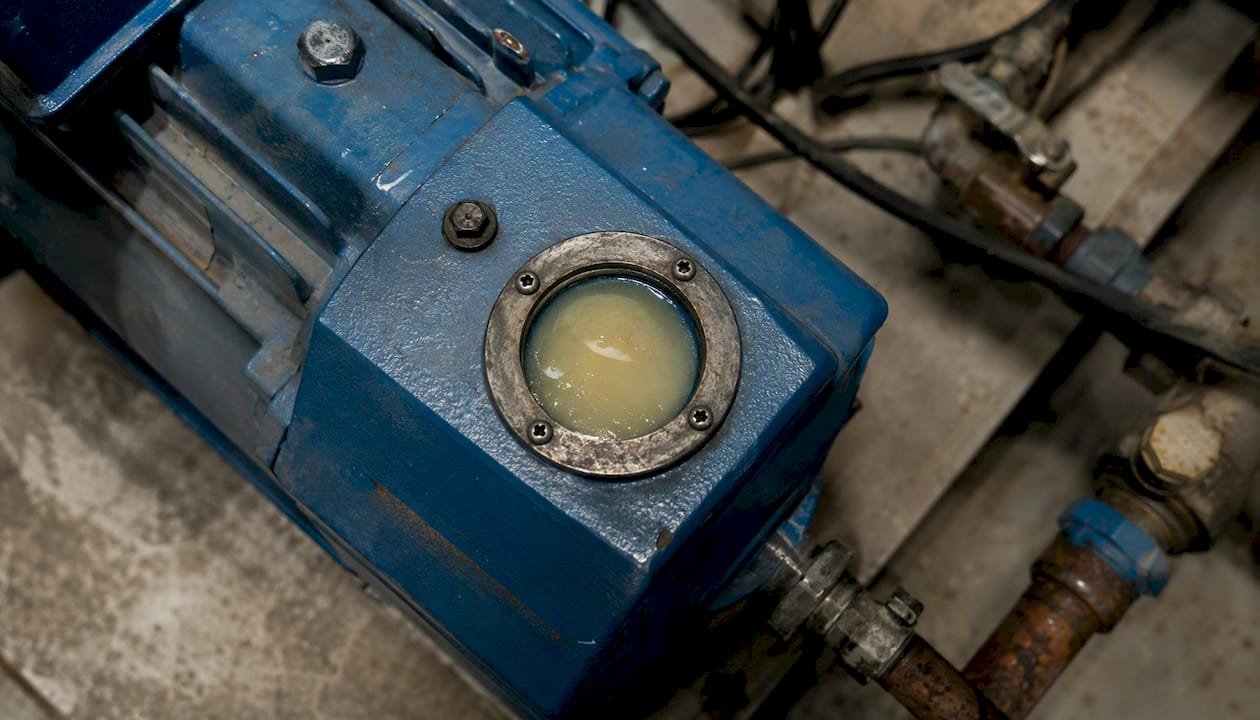
The bigger lesson is that oil selection isn’t a one-time decision. Process gases change, ambient conditions shift, and the oil that worked last year might not be the right fit for this year’s job. Check it every time.
The Right Oil, Sourced Fast, With the Refrigerants You Already Need
Getting vacuum pump oil selection right protects the pump, but the rest of the evacuation job still depends on getting clean refrigerant and reliable tools on-site without delay. Hvac-prime supplies wholesale virgin refrigerants alongside vacuum pumps, gauges, and diagnostic kits, so a technician who just nailed down the correct ISO grade and oil family doesn’t have to place a second order elsewhere to finish the job.
That matters most on multi-stop days when a stalled evacuation can’t wait on a slow supplier. Hvac-prime ships fast and stocks the refrigerants and professional-grade tools that pair with the pump maintenance covered above, at wholesale pricing built for contractors running real volume, not one-off retail buyers. If you’re specifying oil for a rotary vane or liquid ring pump this week, check current stock and place your refrigerant order at Hvac-prime while you’re already thinking through the job.
Frequently Asked Questions
What is the most common type of vacuum pump oil used in HVAC work?
Mineral oil at ISO 68 or 100 covers most rotary vane pumps used in HVAC and refrigeration evacuation, though synthetic PAO oils are increasingly common where longer service intervals matter.
Can I mix different vacuum pump oil types?
No. Mixing mineral, synthetic, and silicone oils can cause varnishing, clouding, and reduced lubrication, and it makes contamination diagnosis far harder afterward.
How often should vacuum pump oil be changed?
Change intervals depend on duty cycle and process gas, but oil that turns milky, dark, or shows visible particles should be changed regardless of the calendar.
Why can’t I use automatic transmission fluid in a vacuum pump?
ATF has a vapor pressure too high for vacuum service, so it vaporizes inside the pump and backstreams into the chamber instead of staying put as a lubricant.
Is synthetic vacuum pump oil worth the extra cost?
For high-heat or long-duty-cycle applications, yes. PAO and ester synthetics resist oxidation longer, which often offsets their higher price through extended service intervals.
Sources
- Service V-log – How to choose the right vacuum pump oil?
- The importance of clean oil in a vacuum pump
- Contamination in Vacuum Systems: Sources and Remedies
- Understanding vacuum pump lubricants




 HVAC
HVAC Automotive
 Refrigerant Diagnostics Kit
 Water Heaters
One thought on “Vacuum Pump Oil Types: A Technician’s Selection Guide”