
Recovery Cylinder Selection: Sizing & Safe-Fill Math

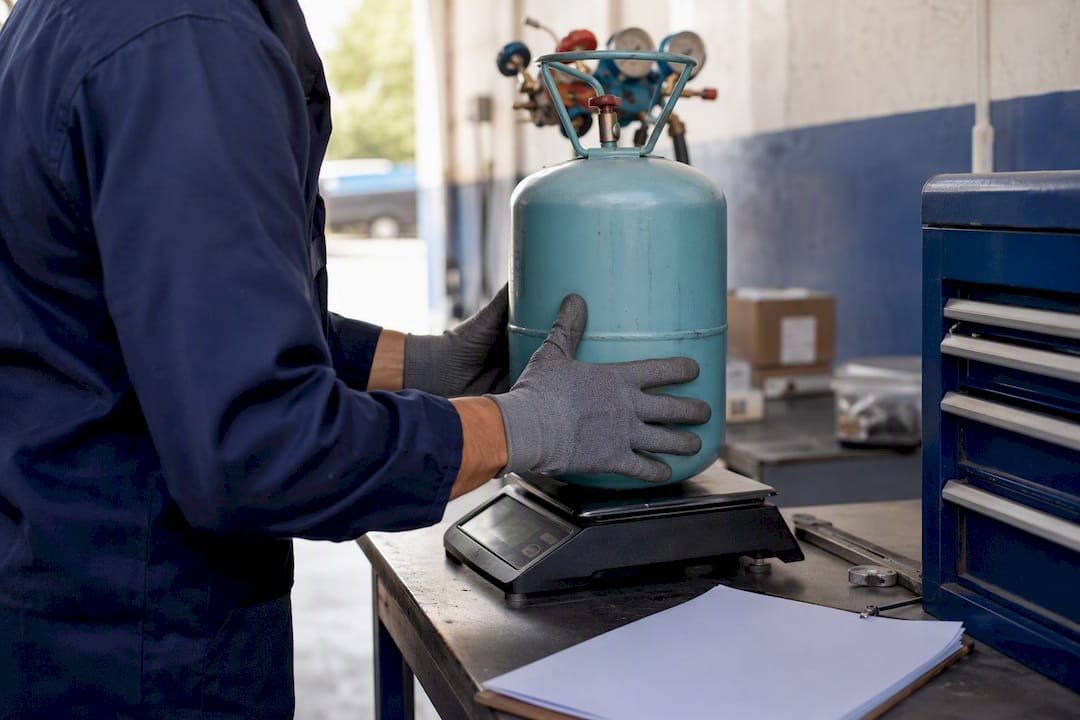
Safe fill weight = WC × refrigerant multiplier × 0.80, then add TW for the maximum gross weight your scale should read. Recovery cylinder selection comes down to that one formula, verified with a scale before the tank ever leaves the truck.
Worked example: a 50 lb DOT cylinder stamped WC 47.6 lbs, filled with R-410A (multiplier ≈ 1.05), allows 47.6 × 1.05 × 0.80 = about 40 lbs of liquid refrigerant. Add the stamped TW (often around 34 to 36 lbs) and you get your target gross weight on the scale.
Before you connect a hose, confirm four things:
- A calibrated scale is on site and zeroed.
- The tank’s TW stamp is legible and matches what the scale reads empty.
- The WC stamp is legible, not just painted over.
- You have the correct multiplier or specific gravity value for the refrigerant you’re recovering.
This method follows AHRI Guideline K’s 80% liquid-fill standard, respects DOT/PHMSA marking requirements, and matches the field approach documented by HVAC School.
Key Takeaways
Safe recovery cylinder selection depends on applying WC, the refrigerant multiplier, and the 80% headspace rule, then verifying gross weight on a scale before transport.
| Point | Details |
|---|---|
| Use the core formula | Safe liquid weight = WC × multiplier × 0.80; add TW for target gross weight. |
| Verify stamps physically | Weigh the empty cylinder to confirm TW rather than trusting a worn collar stamp. |
| Never treat WC as a weight cap | WC is a volume reference; skipping the multiplier and 0.80 factor causes overfills. |
| Check DOT and hydro status | Confirm the DOT spec number and hydrostatic test date before every transport. |
| Source refrigerant and cylinders reliably | HVAC Prime supplies DOT-rated refrigerant, including 25LBS R407C, with fast shipping and technical documentation. |
Table of Contents
- How do you calculate safe fill for a recovery cylinder?
- What do the numbers stamped on a cylinder actually mean?
- Why does the 80% headspace rule matter?
- What multipliers should you use for common refrigerants?
- What DOT and PHMSA rules apply to recovery cylinders?
- What’s the field workflow for handling recovery cylinders? Learn how mobile services streamline this process with Mobile Aircon Regas Brisbane, Gold Coast, Ipswich & Logan | MedAuto.
- Sources
How do you calculate safe fill for a recovery cylinder?
Two methods get you there: the formal AHRI calculation and a faster multiplier shortcut. Both start from the same stamped numbers.
The full AHRI method. AHRI Guideline K uses the cylinder’s stamped Water Capacity (WC, in pounds of water at 60°F) and the refrigerant’s specific gravity at 77°F to convert internal volume into refrigerant weight. Water has a known density, so WC tells you exactly how much space is inside the cylinder. Divide WC by water’s density to get internal volume, multiply that volume by the refrigerant’s liquid density, then cap the result at 80% to leave headspace for thermal expansion. It’s precise, but it requires pulling density values for whatever refrigerant you’re recovering that day.
The multiplier shortcut. Most techs use a simplified version: WC × refrigerant multiplier × 0.80. The multiplier already bakes in the specific gravity conversion, so you skip a step. HVAC School’s published multipliers work fine for common refrigerants, but they’re conservative approximations, not lab-grade constants. Use the full AHRI method when you’re dealing with a refrigerant blend you don’t recover often, or when a client needs documented precision.
Two worked examples:
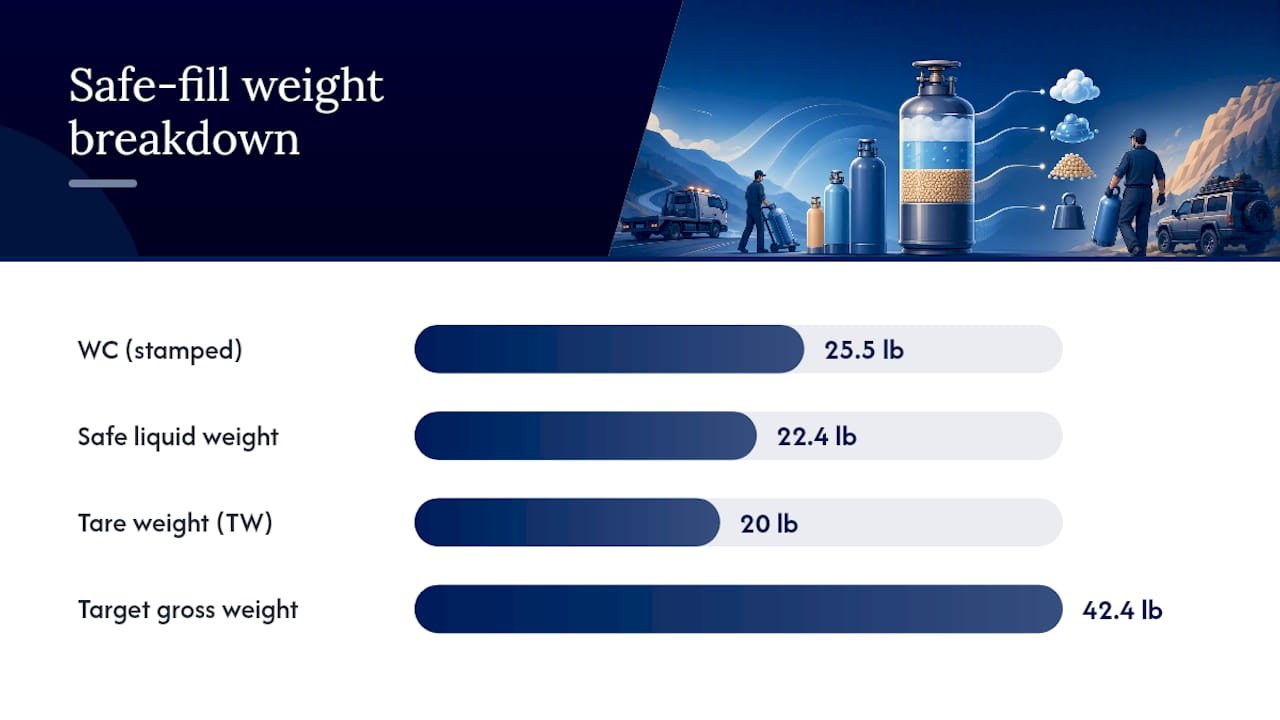
- 30 lb DOT tank, R-22: WC stamped at 25.5 lbs. Multiplier for R-22 is roughly 1.1. Safe liquid weight = 25.5 × 1.1 × 0.80 = 22.4 lbs. Add a typical TW of 20 lbs, and your target gross weight reads about 42.4 lbs on the scale.
- 50 lb DOT tank, R-410A: WC stamped at 47.6 lbs. Multiplier for R-410A is about 1.05. Safe liquid weight = 47.6 × 1.05 × 0.80 = 40 lbs. Add TW (commonly 35 lbs) for a gross target near 75 lbs.
At higher ambient temperatures, liquid density drops and refrigerant occupies more volume per pound. If you’re working in a hot attic or a parked service van in July, round your safe fill target down another pound or two rather than pushing to the calculated maximum.
Pro Tip: Keep a laminated card in your recovery kit with WC-to-safe-weight math for your three most-used cylinder sizes. Doing algebra on a rooftop in 95°F heat is how mistakes happen.
What do the numbers stamped on a cylinder actually mean?
The collar carries everything you need, if you know where to look:
- WC — water capacity in pounds, the number your entire calculation is based on.
- TW — tare weight, the empty cylinder’s weight, stamped by the manufacturer.
- DOT spec number — confirms the cylinder meets 49 CFR § 178.35 design standards.
- Working pressure — the maximum rated PSI, tied to the relief valve setting.
- Hydrostatic test date — shows when the cylinder was last requalified.
Don’t confuse WC with a “nominal” size like “30 lb tank.” That label refers to typical refrigerant capacity, not the stamped WC number, and painted-over collars can hide or distort the actual figures. Pro Tip: Weigh the empty cylinder on your scale before every job and compare it to the stamped TW. A gap of more than a pound or two means the stamp is unreliable or the tank has been modified.
Why does the 80% headspace rule matter?
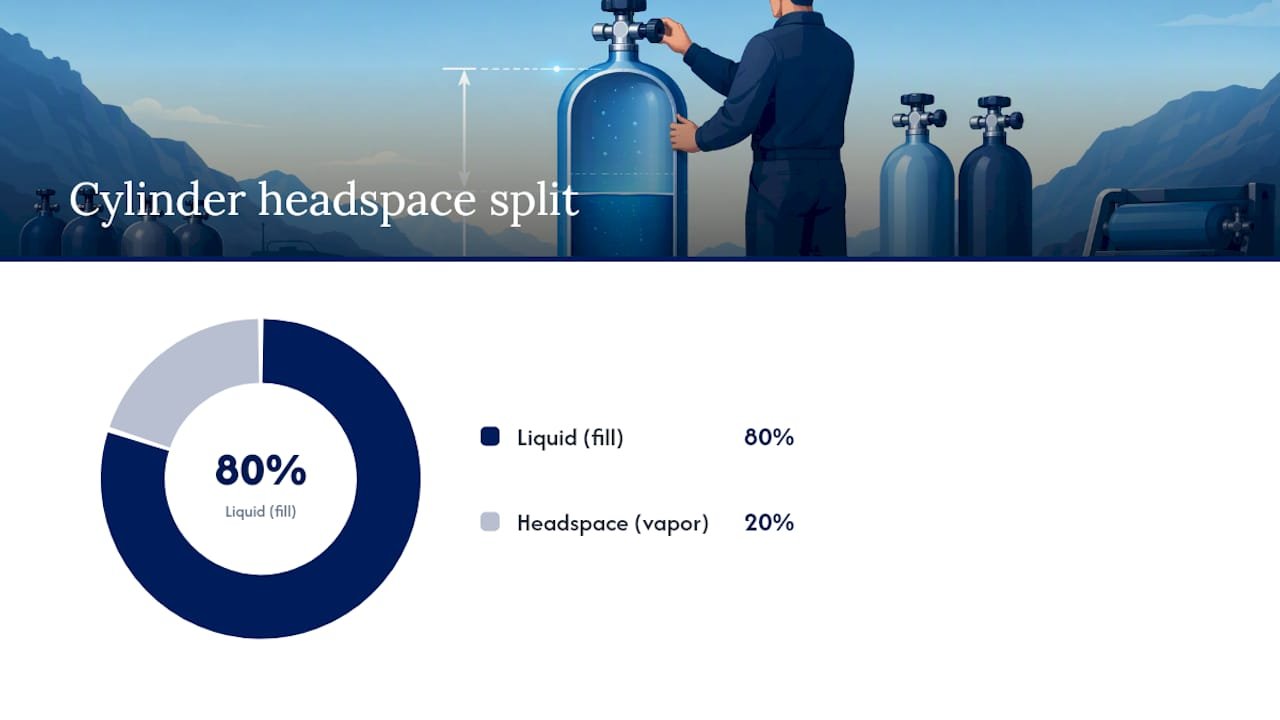
AHRI Guideline K caps liquid fill at 80% of calculated capacity, leaving 20% headspace for vapor expansion. Refrigerant liquid expands significantly as temperature rises, and a cylinder filled too close to full can build dangerous internal pressure with only a modest temperature swing, a real risk sitting in a hot truck bed. Filling to the stamped WC as if it were a weight target, rather than calculating from it, is the single most common overfill mistake technicians make, according to reporting in ACHR News.
Can you mix refrigerants in a recovery cylinder? No. Mixed refrigerant is effectively unusable without expensive lab separation, and it can create unpredictable pressure behavior. If cross-contamination is unavoidable on a job, label the cylinder immediately and segregate it from clean stock.
A pound of refrigerant does not take up the same space as a pound of water. Treating WC as a straight weight limit, instead of running it through the density calculation, is what turns a routine recovery into an overpressure incident.
Pro Tip: Set your recovery machine’s auto shutoff to your calculated safe weight, not the cylinder’s stamped WC. Never bypass or tape over a pressure relief device.
What multipliers should you use for common refrigerants?
Multipliers are derived from each refrigerant’s specific gravity at 77°F, run through the AHRI calculation and rounded conservatively for field use. Lighter refrigerants like R-32 and R-454B have lower liquid density, so their multipliers run smaller than legacy refrigerants like R-22, a distinction HVAC School flags explicitly for techs still using old cheat sheets.
Treat these as starting points, not gospel. Always verify with a scale, add the stamped TW for your actual gross target, and round down when working in high heat. For sourcing 25LBS R407C refrigerant or checking current density datasheets, go with a supplier that documents specific gravity values rather than a generic multiplier chart.
What DOT and PHMSA rules apply to recovery cylinders?
Before a cylinder goes anywhere near a vehicle, confirm:
- The DOT specification number is legible and matches an approved design under 49 CFR § 178.35.
- The hydrostatic test date falls within the requalification interval, since expired cylinders can’t legally be filled or transported.
- Valve protection is intact, and relief devices haven’t been altered.
- You’ve checked placarding thresholds if you’re transporting multiple cylinders or larger quantities in one vehicle.
PHMSA’s pressure vessel program governs which cylinder designs are approved, and the current M-number listing lets you verify an unfamiliar cylinder’s approval status before you trust it with a fill. Keep recovery records for recovered refrigerant, and route contaminated or mixed loads to reclamation rather than treating them as clean stock.
What’s the field workflow for handling recovery cylinders? Learn how mobile services streamline this process with Mobile Aircon Regas Brisbane, Gold Coast, Ipswich & Logan | MedAuto.
- Pre-job: Confirm WC and TW stamps, inspect the valve and relief device, and grab a cylinder sized for the expected recovery volume, not just whatever’s on the truck.
- During recovery: Watch the scale continuously, use vapor and liquid ports correctly, and stop at your calculated safe weight rather than the point the machine shuts off on its own.
- Post-job: Tag the cylinder with refrigerant type, gross weight, source equipment, and date.
Secure cylinders upright during transport, store them in an approved area, and flag any tank nearing its hydrostatic retest interval before it goes back into rotation.
The mistakes that actually cause overfills
The recurring error isn’t bad math. It’s assuming the stamped WC is a safe weight limit instead of a volume figure that still needs the multiplier and the 0.80 factor applied. Three habits fix most of it: always weigh TW yourself rather than trusting a faded stamp, round down on newer low-density refrigerants like R-32 until you’re confident in the multiplier, and grab a second smaller cylinder rather than pushing one tank past its calculated limit.
Where HVAC Prime fits into your recovery cylinder lineup
Getting the calculation right only matters if you’ve got the right cylinder and refrigerant stock on hand when the job starts. HVAC Prime carries DOT-rated refrigerant in the sizes and types techs actually use, along with the diagnostics kits to confirm refrigerant identity before it ever touches a recovery tank.
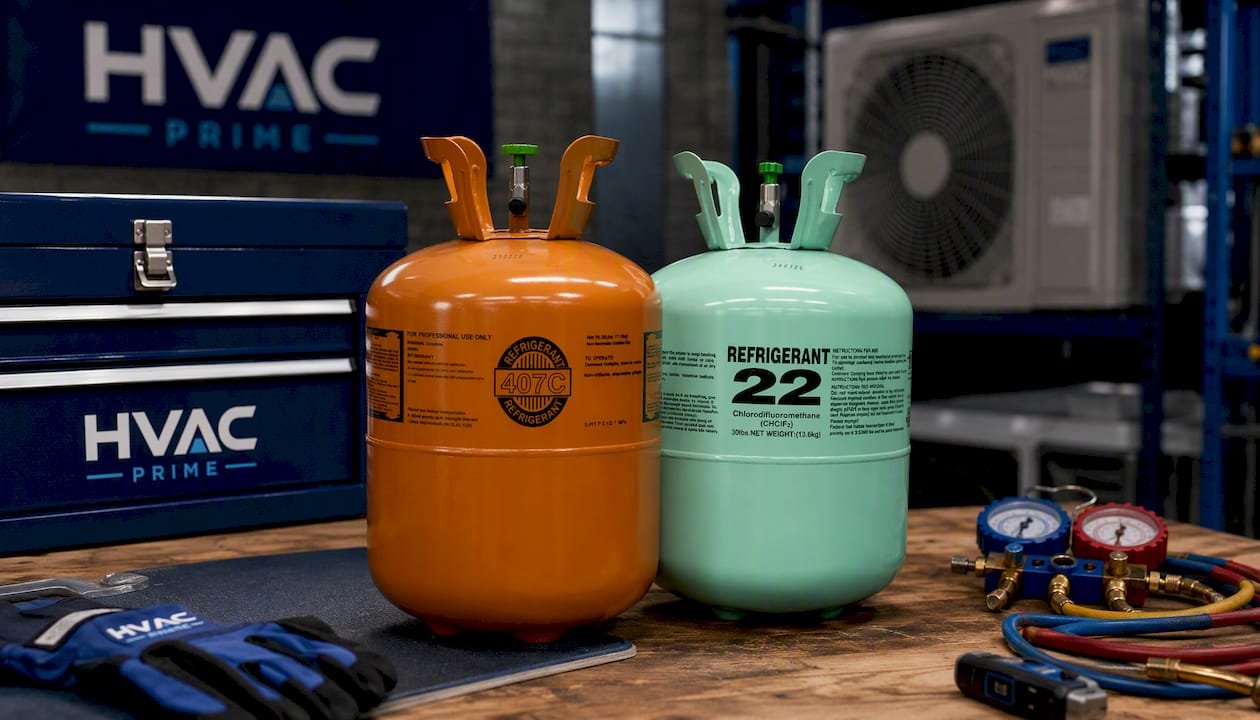
Wholesale pricing means you’re not paying retail markup every time a job calls for a fresh cylinder of 25LBS R407C refrigerant, and fast shipping keeps a slow supplier from stalling your schedule. Technical documentation ships alongside every order, so you’re not hunting for a datasheet mid-job. Check current stock and place an order before your next recovery job runs you short.
Sources
- AHRI Guideline K-2024 (I-P)
- PHMSA — Pressure vessels approvals: overview
- eCFR — 49 CFR § 178.35
- Refrigerant Recovery Cylinder Fill Calculations Simplified — HVAC School
- On the level: filling cylinders — ACHR News




 HVAC
HVAC Automotive
 Refrigerant Diagnostics Kit
 Water Heaters
One thought on “Recovery Cylinder Selection: Sizing & Safe-Fill Math”