
Avoid EPA 608 Fines: Refrigerant Recovery Field Tips for HVAC Techs

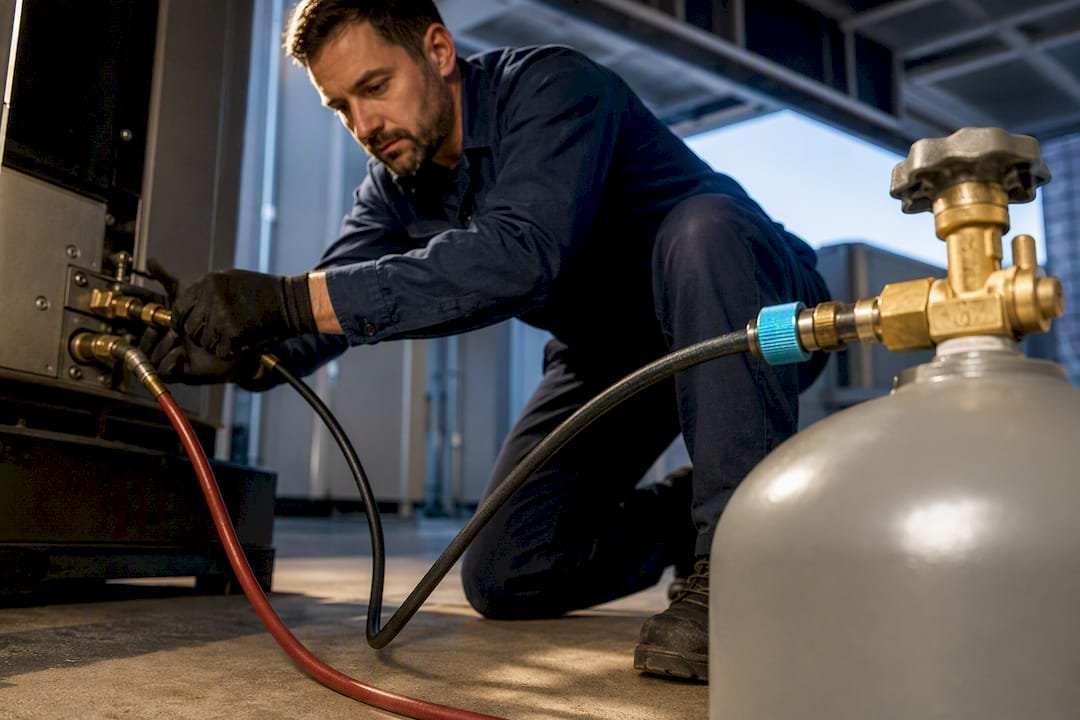
Recover the refrigerant. Never vent it. Everything else in this trade is detail work built on those five habits.
TL;DR:
- Confirm refrigerant identity and weigh the cylinder continuously to prevent overfilling during recovery, using a digital scale for accuracy.
- Use the appropriate recovery method—liquid, vapor, or push-pull—based on system size and access, avoiding unnecessary setup for small systems.
- Check hoses, recovery machine ratings, and cylinder hydrostatic test date before starting, and purge hoses of air to ensure efficiency.
- Always log recovery details immediately, including refrigerant type, recovered weight, and cylinder serial number, to comply with EPA requirements.
- Prioritize confirming refrigerant identity, proper cylinder weighing, and documentation over method details to prevent common recovery failures.
Table of Contents
- What Is Refrigerant Recovery, and What Does the Checklist Look Like?
- Recovery Methods: Liquid vs Vapor vs Push-Pull
- How Should You Set Up the Recovery Machine and Hoses?
- What Vacuum Level Should You Actually Target?
- What Are the Rules for Recovery Cylinders?
- Field Tricks That Cut Recovery Time Without Cutting Corners
- What Documentation Does the EPA Actually Require?
- Tools That Support Compliant, Efficient Recovery Work
- A Technician’s Take on What Actually Prevents Failed Recoveries
- Where to Get Compliant Supplies and Recovery Gear Fast
- Where to Verify These Rules Yourself
- Sources
What Is Refrigerant Recovery, and What Does the Checklist Look Like?
Refrigerant recovery means pulling refrigerant out of a system and storing it in an approved container instead of releasing it to the atmosphere. EPA Section 608 requires this on every stationary appliance before you open the system for repair, and it treats recovery as a distinct legal step from recycling or reclaiming the refrigerant afterward.
Before you connect a single hose, run through this sequence:
- Put on gloves and goggles, then lock out and tag electrical power to the unit.
- Confirm your EPA 608 certification covers the equipment type and that your recovery machine and cylinder ratings match the refrigerant.
- Identify the refrigerant from the nameplate or service history, using a refrigerant identifier if there’s any doubt.
- Select the right DOT recovery cylinder, connect it, and purge your hoses before opening any valves.
- Weigh the tank continuously, pull liquid first when the system allows access, then switch to vapor recovery as pressure drops.
- Self-purge the recovery machine, close the cylinder valve before disconnecting, run a short decay check, and log the results on the service ticket.
That last step gets skipped more than any other on this list, and it’s usually the one that saves you from a callback.
Recovery Methods: Liquid vs Vapor vs Push-Pull
Not every system calls for the same recovery method, and picking the wrong one costs you time you don’t have.
- Liquid recovery. This is the fastest option when the system gives you access to liquid refrigerant. You invert the recovery machine’s process, pumping liquid out and returning vapor to the system’s high side, or you pull liquid directly into an inverted cylinder. Use it whenever the system design allows it.
- Vapor recovery. Slower, but it’s the method you’ll reach for most often, especially once liquid has already been pulled or the system won’t give you liquid access. Connect to the low side with vacuum-rated hoses, and apply gentle external heat if the tank pressure stalls out. Never use an open flame.
- Push-pull recovery. Reserved for large systems carrying 15 pounds or more of refrigerant. It uses the system’s own head pressure to push liquid through the recovery machine and into the cylinder, with a sight glass showing when liquid flow stops. Skip it on small residential systems or heat pumps. It’s overkill there and adds setup time you don’t need.
How Should You Set Up the Recovery Machine and Hoses?
Setup mistakes are the single biggest reason recoveries drag on longer than they should. Check your recovery unit’s UL and A2L rating before you plug it in, and inspect the inlet screens for debris that will choke flow halfway through the job. Confirm the machine’s oil level and that its high-pressure and CPR cutouts are functioning; a tripped cutout mid-recovery on a hot afternoon is not something you want to diagnose from scratch.
For hoses, go bigger and shorter. Vacuum-rated hoses at the largest diameter your fittings support cut recovery time noticeably, and removing the Schrader cores before you start (rather than trying to recover through a restricted valve core) makes a real difference.
- Use vacuum-rated hoses, remove Schrader cores, and purge hoses of air before connecting.
- Place your micron gauge at a system-side port, not at the pump, to avoid a falsely deep reading.
- Confirm the recovery cylinder’s hydrostatic test date before you fill it, and use a calibrated digital scale rather than eyeballing the tank.
Pro Tip: Keep a spare set of Schrader cores and a core removal tool in your bag. Losing five minutes hunting for a core tool on a rooftop in July is the kind of delay that adds up across a full service day.
What Vacuum Level Should You Actually Target?
Recovery and evacuation are two different jobs, and mixing them up is a common source of confusion for newer technicians. Recovery removes refrigerant from the system into a cylinder. Evacuation happens afterward, once repairs are done, and it pulls a deep vacuum to strip out moisture and non-condensable gases before recharge.
EPA Section 608 sets minimum evacuation levels that vary by equipment type and refrigerant charge size, and those numbers are legal floors, not performance goals. Field-tested best practice pushes well past that minimum: industry guidance points to roughly 500 microns as the target for a service-grade evacuation that actually protects compressor life and system efficiency.
To verify you’re really there, not just reading it on the gauge:
- Isolate the vacuum pump and watch for rise over 10 to 15 minutes; a stable reading under 500 microns confirms a dry, tight system.
- A quick climb back toward atmospheric pressure usually means a leak, not moisture.
- A slow, steady rise that levels off points to trapped moisture rather than a leak; a nitrogen purge or a repeat pump-down usually clears it.
- Always read the micron gauge from a system-side port, never right at the pump, or you’ll get a falsely optimistic number.
What Are the Rules for Recovery Cylinders?
Cylinder handling is where a lot of otherwise careful technicians get caught. Disposable virgin cylinders are not built for recovery and using one is both unsafe and a compliance violation. DOT-rated recovery cylinders, the gray-and-yellow ones, are stamped with their own spec and retest interval, and that stamp is the first thing to check before you connect a hose.
- Check the stamped DOT spec and hydrostatic retest date before every fill; an out-of-date cylinder should not go into service.
- Never exceed 80% of the cylinder’s water capacity by refrigerant weight, and confirm that limit with a scale, not a guess.
- Label the cylinder’s contents immediately, and keep any contaminated or unidentified refrigerant in a separate, clearly marked container rather than mixing it into a clean recovery tank.
Weighing continuously rather than checking periodically catches a fast-filling cylinder before it becomes a transport hazard.
Field Tricks That Cut Recovery Time Without Cutting Corners
A few habits separate a two-hour recovery from a forty-minute one. Changing your vacuum pump’s oil while it’s still warm pulls contaminated oil out before it cools and re-absorbs moisture, and it’s one of the most commonly cited time-savers among working technicians. Purging the system with nitrogen before you pull vacuum knocks a meaningful chunk off your evacuation time, and removing Schrader cores does the same on the recovery side.
- Purge with nitrogen before evacuation, and remove valve cores to eliminate flow restriction.
- Use the largest-diameter hoses your fittings allow, run the shortest practical length, and apply gentle heat, never an open flame, if recovery stalls.
- If a hose or the pump inlet freezes, a small nitrogen purge will thaw it faster than waiting it out.
- If the recovery cylinder overheats in direct sun, cool it with water rather than pushing through; check for trapped oil at low points in the line if flow drops unexpectedly.
Pro Tip: A hose that’s too long feels like a convenience until you’re timing a recovery. Every extra foot adds volume the machine has to pull vacuum through twice.
What Documentation Does the EPA Actually Require?
Every recovery job needs a paper trail, and it’s shorter than most technicians think, but skipping it is one of the most common violations inspectors catch. Record the date, refrigerant type, recovered weight, the recovery cylinder’s ID or serial number, and what happened to the refrigerant afterward, whether it was stored, sent for reclamation, or destroyed.
- Log date, refrigerant type, recovered weight, cylinder serial number, and final disposition on every service ticket.
- If you’re recovering HFCs above the 15-pound threshold set under the AIM Act’s Subpart C chain-of-custody rules, keep the extra transfer records that regulation requires.
- The most common violations are venting, using a disposable cylinder for recovery, and simply not logging the job. All three are avoidable with a five-minute habit at the end of the ticket.
Tools That Support Compliant, Efficient Recovery Work
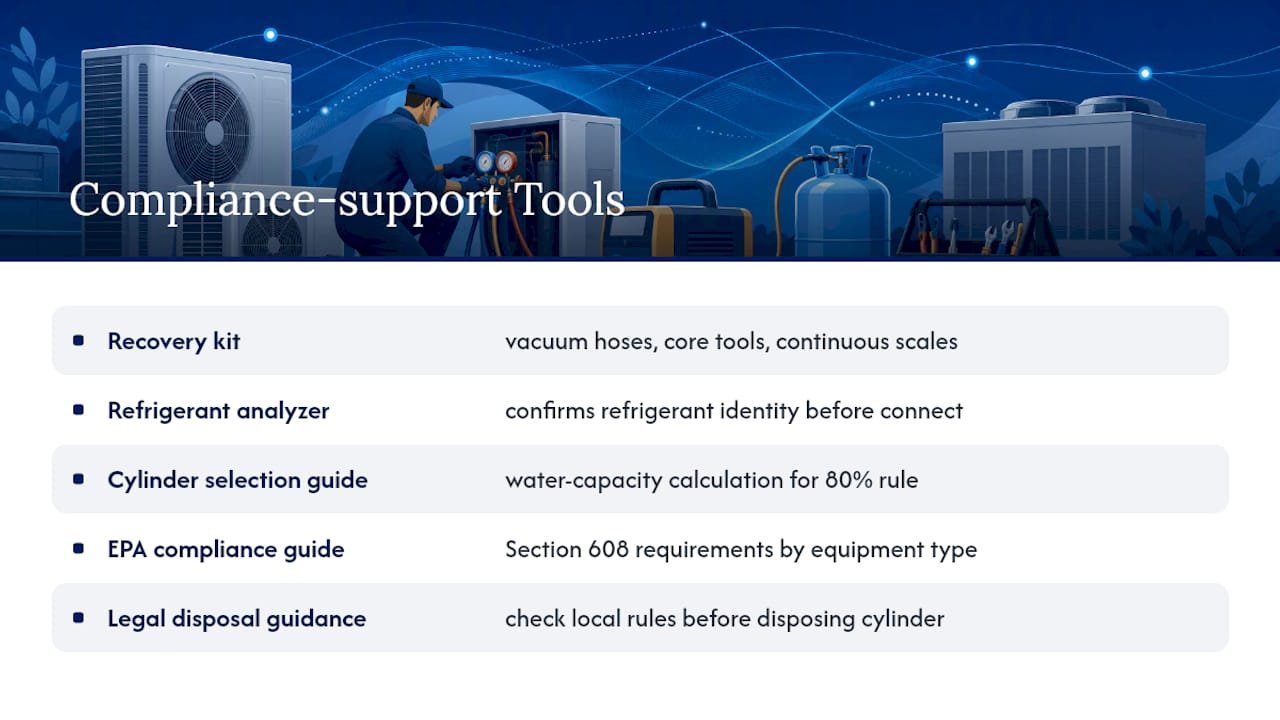
A recovery job runs smoothly when you show up with the right gear already in the truck. Hvac-prime stocks the recovery kits technicians need for a clean setup, including vacuum-rated hoses, core removal tools, and digital scales built for continuous weighing rather than spot checks.
When refrigerant identity is in question, a refrigerant analyzer settles it before you connect a hose, which matters more than most technicians give it credit for, since cross-contaminated refrigerant is expensive to fix after the fact. For cylinder sizing and the safe-fill math behind the 80% rule, the recovery cylinder selection guide walks through the water-capacity calculation step by step, and the EPA compliance guide covers what Section 608 actually requires by equipment type. Before disposing of a spent or damaged cylinder, check the legal disposal guidance rather than guessing at local rules.
A Technician’s Take on What Actually Prevents Failed Recoveries
Most botched recoveries trace back to skipping one of three things: confirming refrigerant identity, weighing the cylinder as you go, and writing down what happened before the truck leaves the driveway. Everything else, the method you choose, the hose diameter, the micron target, matters, but those three habits are what keep a routine job from turning into a liability.
The techs who never get burned aren’t necessarily faster. They’re just harder to rush past those three checks, even on the fifth call of a long day.
— Planet
Where to Get Compliant Supplies and Recovery Gear Fast
Sourcing the right refrigerant on short notice is its own kind of headache, especially when a job calls for a cylinder you didn’t stock this month. There are suppliers that sell virgin refrigerants across common HVAC and automotive types, including R22, R410A, R134A, R32, R454B, and more, often at wholesale pricing for contractors who need product shipped quickly.
Beyond the refrigerant itself, Hvac-prime carries the field gear this article just walked through: refrigerant kits with hoses and core tools, refrigerant analyzers for identity checks, and SDS and TDS downloads for the documentation your compliance file needs. Check your current cylinder’s hydrostatic test date, then browse the refrigerant catalog to get the next job’s supplies ordered before you’re standing on a rooftop without them.
Where to Verify These Rules Yourself
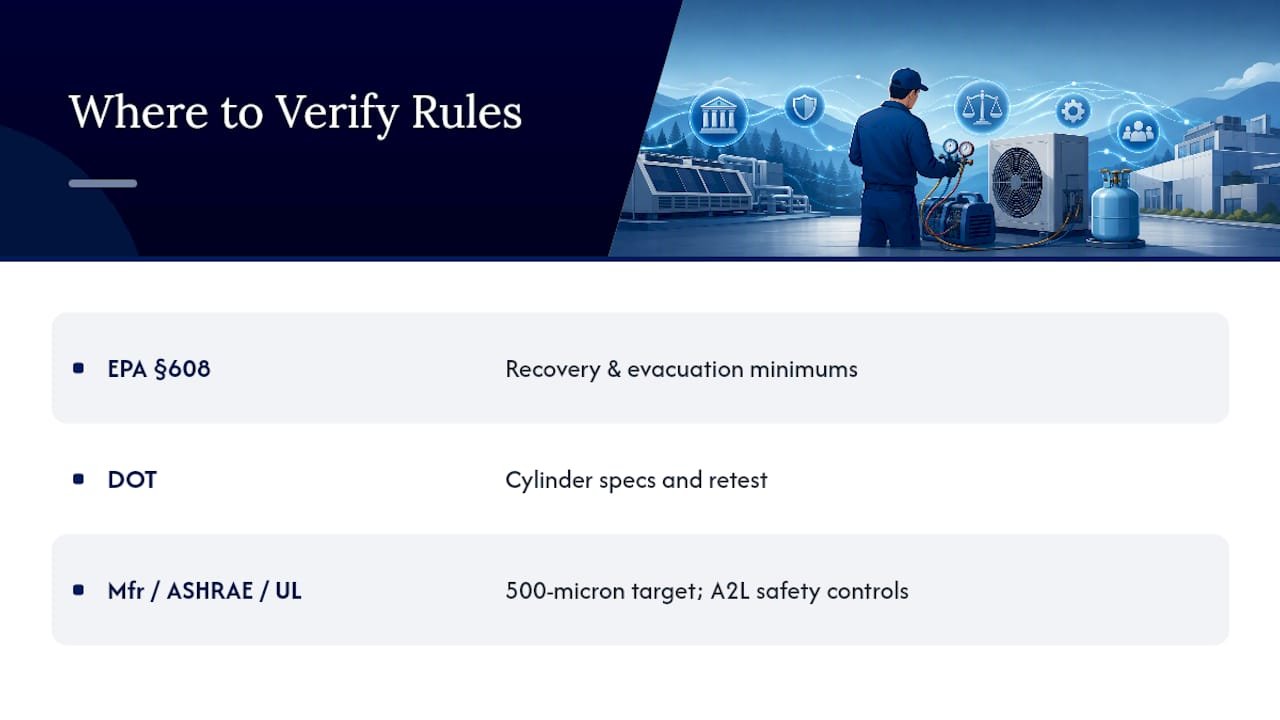
For the legal baseline on recovery and evacuation minimums, EPA’s Section 608 page is the primary source, and it’s worth bookmarking rather than relying on secondhand summaries. DOT sets the cylinder specification and hydrostatic retest requirements that determine which recovery tank is legal to fill. For the 500-micron field target and A2L handling practices, manufacturer and ASHRAE/UL guidance lays out the safety controls flammable refrigerants require beyond the standard recovery setup.
Sources
- Recovering, recycling, and reclaiming refrigerants | US EPA
- Recovery cylinder filling limits and safety checks | SkillCat
- Service clinic: Effective refrigerant recovery techniques | Contracting Business




 HVAC
HVAC Automotive
 Refrigerant Diagnostics Kit
 Water Heaters