
R407C vs R410A: Technician Guide to Retrofits and New Systems


For an R22 retrofit, use R-407C. For new, high-pressure equipment, use R-410A. That’s the short answer, and it comes down to three numbers: R-407C carries a temperature glide near 5°C and runs at pressures close to R-22, while R-410A behaves as a near-azeotropic blend with glide under 0.17K and much higher operating pressure. Both carry high GWPs under the Kigali Amendment (R-407C at 1,774, R-410A at 2,088), so neither is a permanent answer for new installs.
Quick rules to keep in your head on the truck:
- Never mix the two refrigerants or charge one into hardware built for the other.
- Charge R-407C as a liquid at the service valve, never as vapor.
- Always check the equipment nameplate before pulling a hose to any port.
Key Takeaways
R-407C fits R-22 retrofits because it mimics legacy pressure behavior, while R-410A suits new high-pressure equipment built for its higher capacity and near-zero glide.
| Point | Details |
|---|---|
| Never mix refrigerants | R-407C and R-410A require different compressors, oils, and pressure-rated components. |
| Charge R-407C as liquid | Vapor charging causes fractionation and permanent blend drift on zeotropic refrigerants. |
| Check nameplate first | Confirm the equipment’s rated refrigerant and pressure before connecting any hose. |
| Plan for phase-down | Kigali-driven regulations are shrinking supply of both R-407C (GWP 1,774) and R-410A (GWP 2,088). |
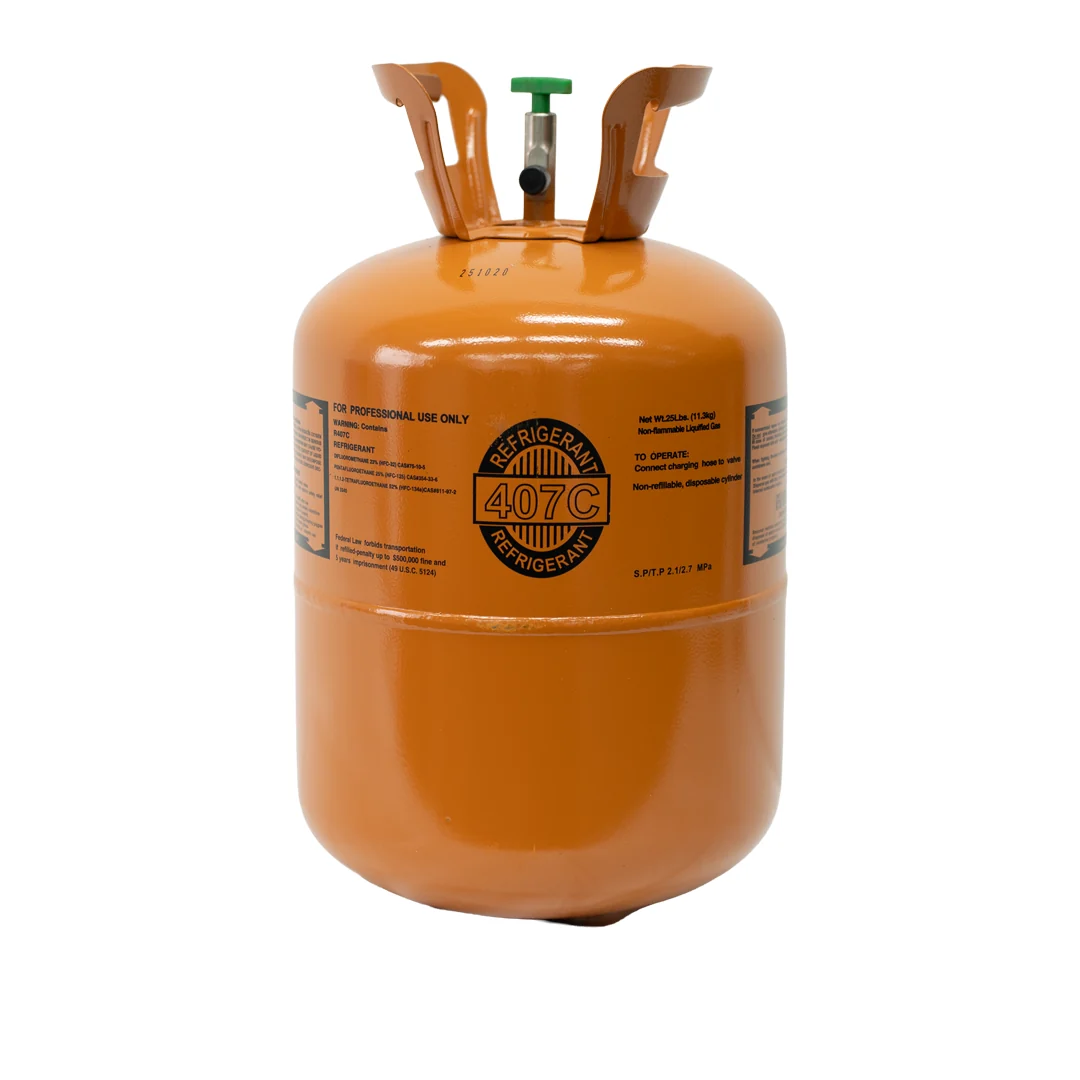
| Source virgin refrigerant reliably | Hvac-prime supplies 25LBS R407C Refrigerant cylinders with documentation for retrofit jobs. |
Table of Contents
- R407C vs R410A: Comparing the Core Technical Differences
- Why Do R407C and R410A Perform So Differently?
- Can You Retrofit Between R407C and R410A Systems?
- How Do R407C and R410A Handle High Ambient Conditions?
- What Are the GWP and Regulatory Realities for R407C and R410A?
- Field Tips for Charging and Troubleshooting Both Refrigerants
- Which Refrigerant Should You Actually Choose?
- Where to Buy R407C Refrigerant for Your Next Retrofit
- Sources
R407C vs R410A: Comparing the Core Technical Differences
| Dimension | R-407C | R-410A |
|---|---|---|
| Designed use | R-22 retrofit and legacy equipment | New, high-efficiency equipment |
| Typical operating pressure | Close to R-22 levels | Significantly higher than R-407C |
| Temperature glide | About 5°C (zeotropic) | Very low (near-azeotropic) |
| Capacity / efficiency | Comparable to R-22, slightly lower | Higher relative cooling capacity |
| Lubricant compatibility | POE oil, similar to R-22 retrofit oils | POE oil, but not shared with R-407C systems |
| Charging method | Liquid charge only, to avoid fractionation | Standard charging, less fractionation risk |
| GWP / regulatory status | 1,774, transitional HFC | 2,088, transitional HFC |
| Availability outlook | Available, but being phased down | Available, also facing phase-down pressure |
The pressure gap is the one that bites technicians who get complacent. Two service implications stand out above the rest:
- You cannot swap R-407C into a system built for R-410A pressures, or the reverse, without replacing compressor, valves, and often the metering device.
- Composition-sensitive charging means R-407C mistakes (vapor charging, slow leaks) degrade performance in ways R-410A rarely does.
Why Do R407C and R410A Perform So Differently?
The blends aren’t close cousins despite sitting next to each other on the shelf. R-407C is 23% R-32, 25% R-125, and 52% R-134a, a mix engineered to mimic R-22’s pressure curve for drop-in retrofit work. R-410A skips the R-134a entirely and runs a near 50/50 split of R-32 and R-125, which is what pushes its pressure and capacity so much higher.
Glide is where the real service difference lives. R-407C’s components boil at different temperatures, producing a glide of roughly 5°C, while R-410A’s glide stays under 0.17K, essentially behaving like a single-component refrigerant for practical purposes. That gap changes how you match evaporator and condenser coils, and it changes how carefully you have to charge the system. Vapor-charge a bottle of R-407C and you pull the lighter components first, shifting the blend’s ratio and leaving your system running on an off-spec mix for good.
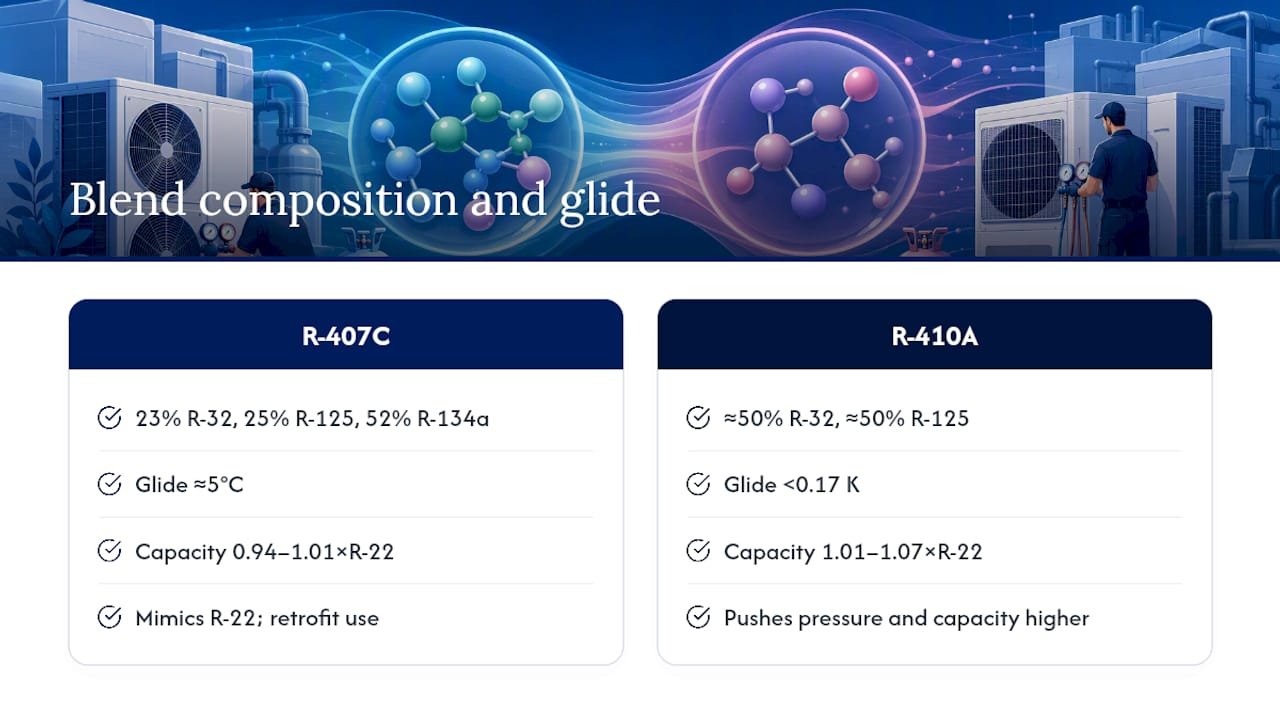
Pressure differences follow from the same chemistry. Manufacturer technical bulletins show R-410A running noticeably higher discharge and suction pressures than R-407C, which is why R-410A equipment needs heavier-duty compressors, thicker-walled lines, and gauges rated for the higher range. Lab comparisons put R-410A’s relative cooling capacity around 1.01 to 1.07 times that of R-22, versus 0.94 to 1.01 for R-407C, depending on coil configuration, so R-410A systems typically squeeze more capacity out of a similarly sized unit.
Pro Tip: When you’re gauging a R-407C system, remember your manifold reading reflects a blend average, not a single saturation point. Always cross-check against the manufacturer’s pressure-temperature chart for that specific blend rather than eyeballing it against R-22 habits.
Can You Retrofit Between R407C and R410A Systems?
No. These two refrigerants are not interchangeable, and treating them as such is one of the more expensive mistakes a technician can make. The pressure ratings alone rule it out. R-410A hardware is built to handle far higher operating pressures, so dropping R-407C into it leaves you with an oversized, underperforming system. Reversing it, forcing R-410A into R-22-era hardware built for R-407C service, risks a compressor failure or a blown gasket. Oil compatibility and glide-driven fractionation compound the problem, since R-407C requires careful liquid-phase charging to keep its blend intact, something that has no equivalent concern with R-410A.
Run this checklist before you commit to any retrofit conversation with a customer:
- Confirm the nameplate refrigerant designation and rated pressure.
- Inspect the compressor’s pressure rating against the target refrigerant’s operating range.
- Verify or replace the lubricant with the oil type specified for the new refrigerant.
- Replace the expansion device sized for the original refrigerant’s flow characteristics.
- Confirm your charging method (liquid for R-407C, standard practice for R-410A).
- Run a full leak test before and after charging to catch fractionation-prone slow leaks.
Field reports consistently show capacity loss when technicians pair mismatched compressors with a refrigerant they weren’t rated for, sometimes enough to trigger nuisance high-pressure trips or short-cycling. Fractionation adds a second layer of risk with R-407C specifically: once a chunk of the lighter component vents off through a slow leak or an improper vapor charge, the remaining blend behaves differently on the pressure-temperature chart than what your gauge set expects.
Treat both refrigerants as ASHRAE A1, nonflammable under normal conditions, but don’t get casual with PPE. High-pressure R-410A work calls for gauges and hoses rated for the job, and any decomposition byproducts from either refrigerant in a fire scenario are toxic. Pull the manufacturer’s TDS and MSDS before working on unfamiliar equipment, especially older systems where the nameplate refrigerant might not match what’s actually in the lines.
How Do R407C and R410A Handle High Ambient Conditions?
R-410A holds capacity better as ambient temperatures climb, largely because its higher operating pressure and near-azeotropic behavior give it more thermodynamic headroom before discharge temperatures spike. R-407C, still doing its best impression of R-22, tends to lose capacity faster once outdoor temperatures push past design conditions, particularly on undersized condensers.
Field adjustments worth making on hot days:
- Check condenser coil cleanliness first. Dirty coils punish R-407C’s already tighter margin harder than they punish R-410A.
- Verify subcooling against the manufacturer’s target, since glide shifts the saturation curve on R-407C systems.
- Watch discharge line temperatures closely on R-410A systems, since its higher pressure translates into higher discharge temps when the condenser is marginal.
What Are the GWP and Regulatory Realities for R407C and R410A?
Neither refrigerant is a long-term answer, and the numbers explain why. R-407C carries a GWP of 1,774 and R-410A sits at 2,088, both with zero ozone depletion potential but both squarely in the crosshairs of the Kigali Amendment’s HFC phase-down schedule.
That regulatory pressure translates into real procurement risk. EPA’s SNAP program and related phase-down rules are steering the market toward lower-GWP options, which means supply for both R-407C and R-410A will tighten and prices will likely climb as production allowances shrink. For retrofit work on existing R-22 equipment, R-407C remains the practical choice today. For new installs, banking on R-410A without a future-proofing plan is a bet against where the regulations are headed.
Refrigerants technicians should expect to see more of in the field:
- R-32: Lower GWP than R-410A, simpler single-component behavior, but classified A2L (mildly flammable), which changes handling and equipment design.
- R-454B: Positioned as a lower-GWP R-410A replacement for new equipment, also A2L classified.
- R-454C: Even lower GWP, again A2L, seeing increased use in specific equipment categories.
Replacements are already mandatory for some new equipment categories under phase-down schedules, while for existing R-407C and R-410A systems, sticking with the original refrigerant remains standard practice until the equipment reaches end of life.
Field Tips for Charging and Troubleshooting Both Refrigerants
Charge R-407C only as a liquid, drawn from the bottom of the cylinder, and monitor for signs of composition drift on systems with known slow leaks. R-410A tolerates more conventional charging practices thanks to its low glide, but its higher pressures mean your hoses, gauges, and recovery equipment all need the correct pressure rating.
- Confirm cylinder identification and color coding before connecting hoses.
- Weigh in charge by the manufacturer’s specified amount rather than “charging to pressure.”
- Set superheat and subcooling targets based on that specific refrigerant’s PT chart, not habit from R-22 days.
- Recheck for leaks after 24 hours, since fractionation symptoms on R-407C systems often show up gradually.
Pro Tip: If a R-407C system’s suction pressure looks fine but capacity is dropping, suspect fractionation from a slow leak before you blame the compressor. Pull a liquid sample and compare it against a fresh cylinder if you have the equipment.
Which Refrigerant Should You Actually Choose?
I’d stick with R-407C for R-22 retrofits every time. It’s the closest match to existing pressure ratings and keeps the job simple. For new installs, R-410A still makes sense today, but only if you’re already planning for its eventual replacement by lower-GWP options down the road. Whatever you pick, the nameplate and current regulations get the final word, not personal preference.
Where to Buy R407C Refrigerant for Your Next Retrofit
Retrofit jobs move fast when the right refrigerant is already on the truck. Hvac-prime stocks 25LBS R407C Refrigerant as a virgin, wholesale-priced cylinder built for exactly the R-22 conversion work covered above, with certification and labeling you can verify before it ever reaches the job site.
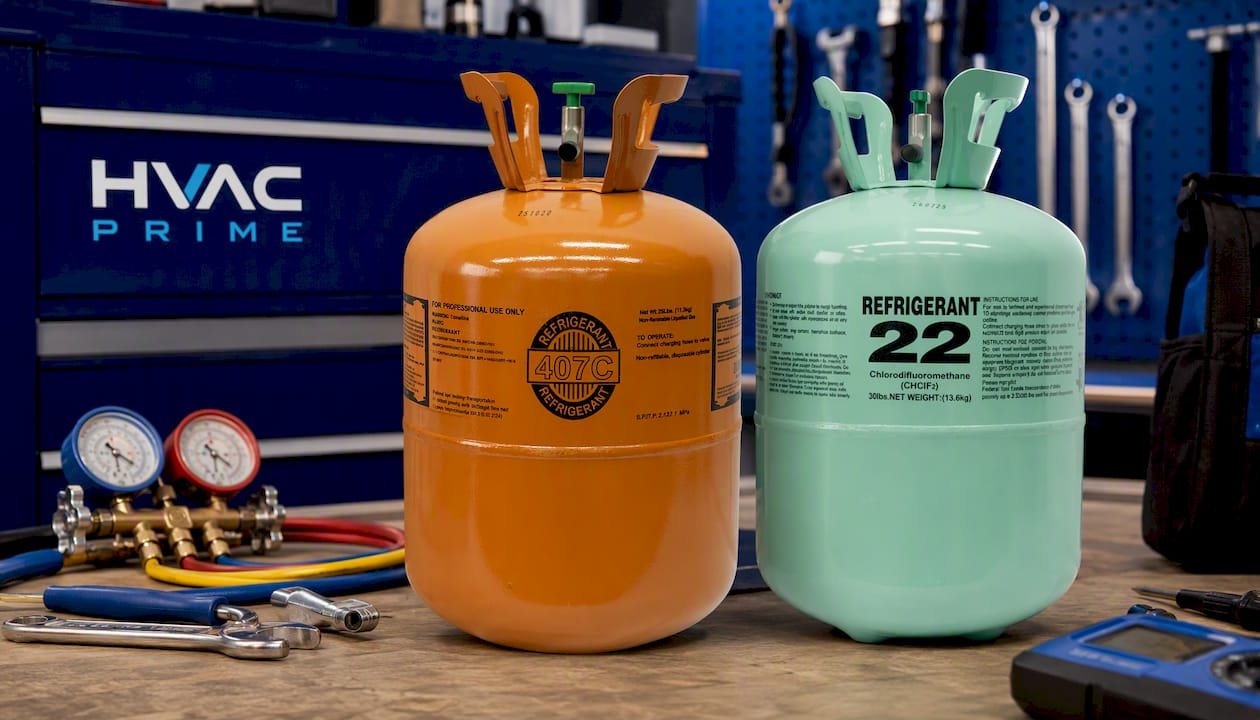
Given how phase-down rules are tightening supply on both R-407C and R-410A, ordering ahead rather than scrambling mid-job is worth building into your routine. Hvac-prime also carries the broader refrigerants lineup and lower-GWP R-32 options for technicians already planning their next equipment generation. Head to the Hvac-prime shop to check current 25-lb R-407C cylinder availability and get it shipped to your shop before your next retrofit call comes in.
Sources
- Hydrofluorocarbons and the Kigali Amendment to the Montreal Protocol — EELP (Harvard)
- Comparison of R-407C and R-410A with R-22 in a 10.5 kW system — Purdue/IRACC
- REFRIGERANT GAS R407C — NOAA CAMEO
- Freon™ 407C and 410A Refrigerants bulletin (manufacturer technical bulletin)




 HVAC
HVAC Automotive
 Refrigerant Diagnostics Kit
 Water Heaters
One thought on “R407C vs R410A: Technician Guide to Retrofits and New Systems”