
Facility Managers: Numbers First Commercial HVAC Maintenance Checklist

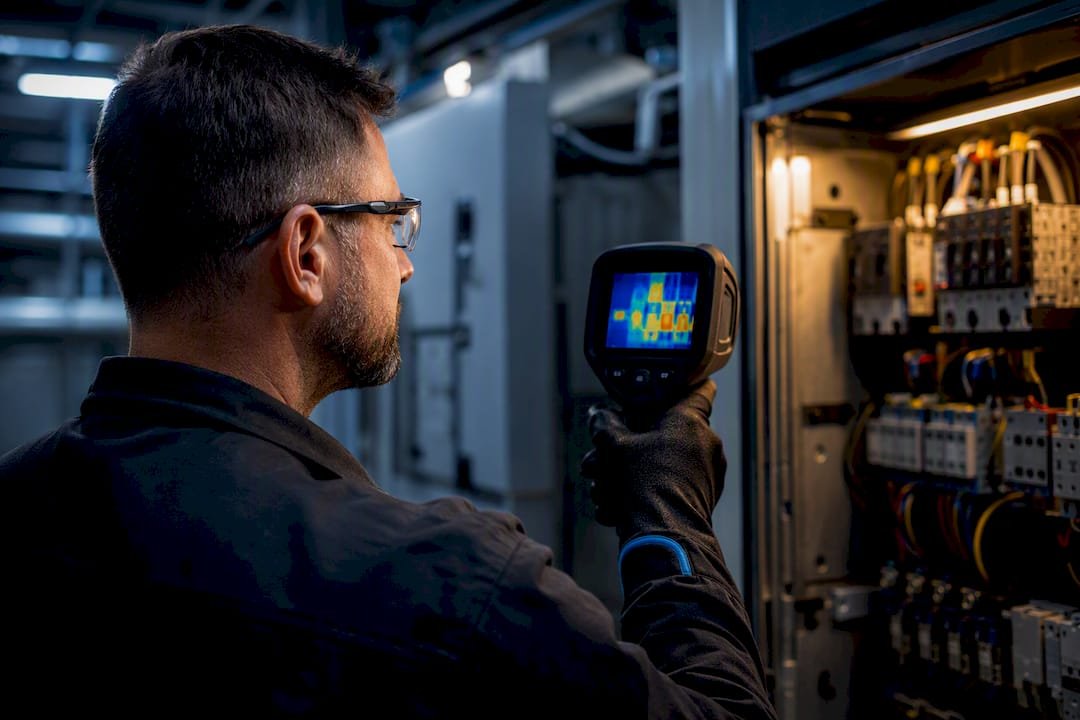
A commercial HVAC maintenance checklist works only when it forces measured readings, not checkmarks: filter differential pressure, amp draw, refrigerant pressures, and condensate flow, each logged against a pass/action/critical threshold. The three moves that matter most this week are inspecting filters and coils, clearing condensate drains, and confirming no refrigerant leaks near suspect fittings. Schedule the next preventive maintenance cycle now, and require every technician to record their ID and the actual numbers they measured, not just a signature.
TL;DR:
- Measuring and logging specific readings such as filter differential pressure, refrigerant pressures, and amp draws is crucial for effective maintenance and legal protection.
- Monthly checks should include thresholds for filters, motors, belts, and refrigerant pressures, with records of actual numbers and photos for critical or action items.
- Quarterly tasks require deeper access, including coil cleaning, electrical torque checks, capacitor testing, and refrigerant leak detection, with visual evidence documented.
- Building a maintenance program within a CMMS that records baseline data, technician credentials, and triggers escalation for critical findings ensures follow-through.
- Service agreements should specify response times, detailed documentation, transparent pricing, and credentialed technicians to prevent delays and hidden costs.
Table of Contents
- What Belongs on a Commercial HVAC Maintenance Checklist by Frequency?
- What Should You Check on Each Type of Commercial HVAC System?
- How Do You Build a PM Program That Actually Gets Followed?
- What Should You Look for in a Commercial HVAC Service Agreement?
- Which HVAC Prime Resources Support a PM Program?
- Why Measured Readings Beat Checkbox Audits
- Where Can You Find Primary Guidance on HVAC Compliance?
- Sources
What Belongs on a Commercial HVAC Maintenance Checklist by Frequency?
A checklist organized by frequency turns abstract “maintenance” into work orders your team can actually schedule and audit. Industry PM guides recommend numeric acceptance criteria and photo verification for anything marked Action or Critical, which is the difference between a checklist that protects you legally and financially and one that’s just paperwork.
Daily and weekly checks
These catch the failures that turn into 2 AM emergency calls.
- Visually inspect for unusual noise, vibration, or odor near air handlers and rooftop units.
- Check thermostat and building automation system (BAS) setpoints against occupied/unoccupied schedules.
- Walk condensate lines in high-humidity zones for standing water or slow drainage.
- Confirm filters aren’t visibly clogged on high-traffic units (kitchens, labs, dense occupancy areas).
Monthly checks with real numbers
Monthly is where you start attaching thresholds instead of vague impressions.
- Filter differential pressure (dP): replace when dP exceeds the manufacturer’s rated threshold, typically 0.5 to 1.0 inches water column above baseline for standard pleated filters.
- Motor amp draw: compare against nameplate rated amps; flag anything running more than 10% over baseline as Action.
- Belt tension and wear: check for glazing, cracking, or slack exceeding manufacturer spec.
- Basic refrigerant-side pressure check on accessible units, cross-referenced against ambient temperature charts.
- Drain pan and condensate trap clearing, with a photo of clean flow as evidence.
Industry sources report that structured PM programs cut emergency call-outs by 60 to 75 percent and extend major equipment life by 30 to 40 percent, according to this source. That gap is almost entirely a function of catching a stressed motor or a clogged coil in month three instead of discovering it as a full outage in month nine.
Quarterly checks that require deeper access
Quarterly tasks need a technician with tools and panel access, not a walk-through.
- Coil cleaning (condenser and evaporator) with before/after photos when fin damage or heavy fouling is present.
- Electrical connection torque check on contactors and terminal blocks; look for discoloration indicating heat stress.
- Capacitor testing against rated microfarad values; anything reading below 90% of rated capacity is Action.
- Refrigerant leak check at all accessible joints and Schrader valves using an electronic leak detector.
- Controls and sensor calibration check against a known reference thermometer.
Annual and seasonal startup/shutdown items
Annual service is where you do the work that daily glances can’t catch: full refrigerant charge verification, compressor oil analysis, combustion analysis on gas-fired equipment (carbon monoxide, stack temperature, flue draft), and a complete electrical panel inspection with thermal imaging if available. Seasonal startup should include a dry run of both heating and cooling modes before the season actually demands it, not after the first hot week exposes a dead capacitor.
Pro Tip: Rate every finding as Pass, Action, or Critical, and require a photo for anything below Pass. An auditable trail with numbers and images is what protects you when a warranty claim or an EPA compliance question comes up a year later.
What Should You Check on Each Type of Commercial HVAC System?
Frequency tells you when to look. Acceptance criteria tell you what “good” actually looks like for each piece of equipment, and that varies more than most generic checklists admit.
Air handling units (AHUs) need filter dP tracked against a numeric baseline rather than a calendar date; a filter that looks clean at 60 days can still be past its resistance threshold. Check damper actuators for full range of motion and confirm the mixing box isn’t short-cycling outside air. Coils get a visual inspection monthly and a real cleaning quarterly, more often in coastal or high-particulate environments.
Rooftop units (RTUs) and split systems live or die on condensate management and cabinet integrity. Check belt tension against the manufacturer’s deflection spec (usually 1/64 inch of deflection per inch of belt span), and inspect cabinet seals and curb flashing for water intrusion that corrodes control boards from the inside out.
Cooling towers need water treatment checks weekly for biocide levels and conductivity, plus a structural inspection of the fill, eliminators, and basin quarterly for scale and biological growth. Legionella risk makes this one of the least optional items on the whole list.
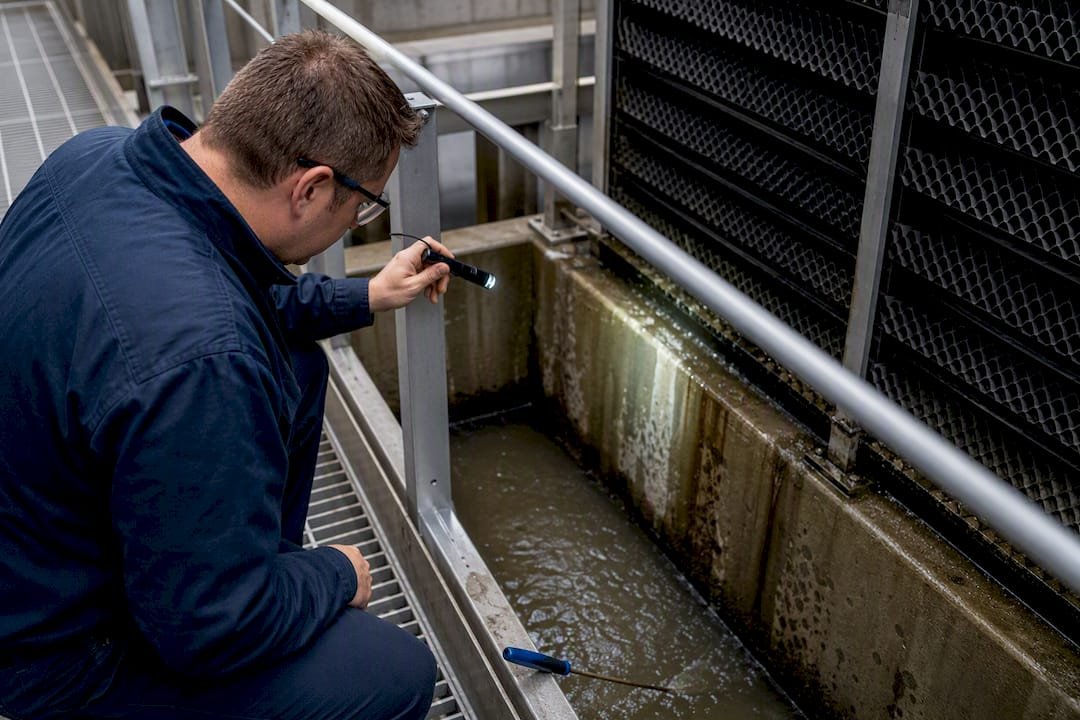
Boilers and commercial refrigeration carry their own tight tolerances: combustion analysis and flue checks on boilers, and door seal integrity plus defrost cycle verification on walk-in coolers, where a 2 to 3 degree drift matters far more than it would on a comfort-cooling zone.
How Do You Build a PM Program That Actually Gets Followed?
A checklist that lives in a binder gets ignored. A checklist tied to a CMMS with required fields gets done, because incomplete work orders are visible to a supervisor instead of buried in a filing cabinet.
- Set frequencies per asset class (AHU, RTU, chiller, tower, boiler) and record baseline readings on day one, so every future reading has something real to compare against.
- Require these fields on every task: asset ID, technician name and certification number, numeric readings, photo evidence for Action/Critical items, and severity rating.
- Route refrigerant handling, combustion testing, and live electrical diagnostics to certified contractors only, never to general maintenance staff.
- Build an escalation rule: any Critical finding triggers a work order within 24 to 48 hours, not “next visit.”
| CMMS field | Why it’s required |
|---|---|
| Asset ID | Ties every reading to a specific unit’s history |
| Technician ID/certification | Confirms EPA or equivalent credential for refrigerant work |
| Numeric reading | Creates trendable data instead of a checkbox |
| Photo evidence | Backs Action/Critical findings for warranty and audit |
| Severity rating | Drives escalation timing |
What Should You Look for in a Commercial HVAC Service Agreement?
Most providers offer four contract structures: full-coverage (parts and labor bundled), full-labor (you supply parts), preventive-only (inspections and tune-ups, no repairs), and inspection-only. Trane and other major providers note that preventive coverage tends to cut both repair costs and downtime compared to reactive, break-fix arrangements.
Whatever structure you sign, require these in writing:
- A defined SLA with response-time guarantees for Critical findings.
- Documentation delivered per visit, not per year, including refrigerant quantities added or recovered.
- Pricing broken out by labor rate, parts markup, and any after-hours premium.
- Named, credentialed technicians, not “a technician from our pool.”
Red flags worth walking away from: no refrigerant reporting, vague “as needed” pricing with no rate sheet, and any contractor unwilling to show a sample completed work order before you sign.
Which HVAC Prime Resources Support a PM Program?
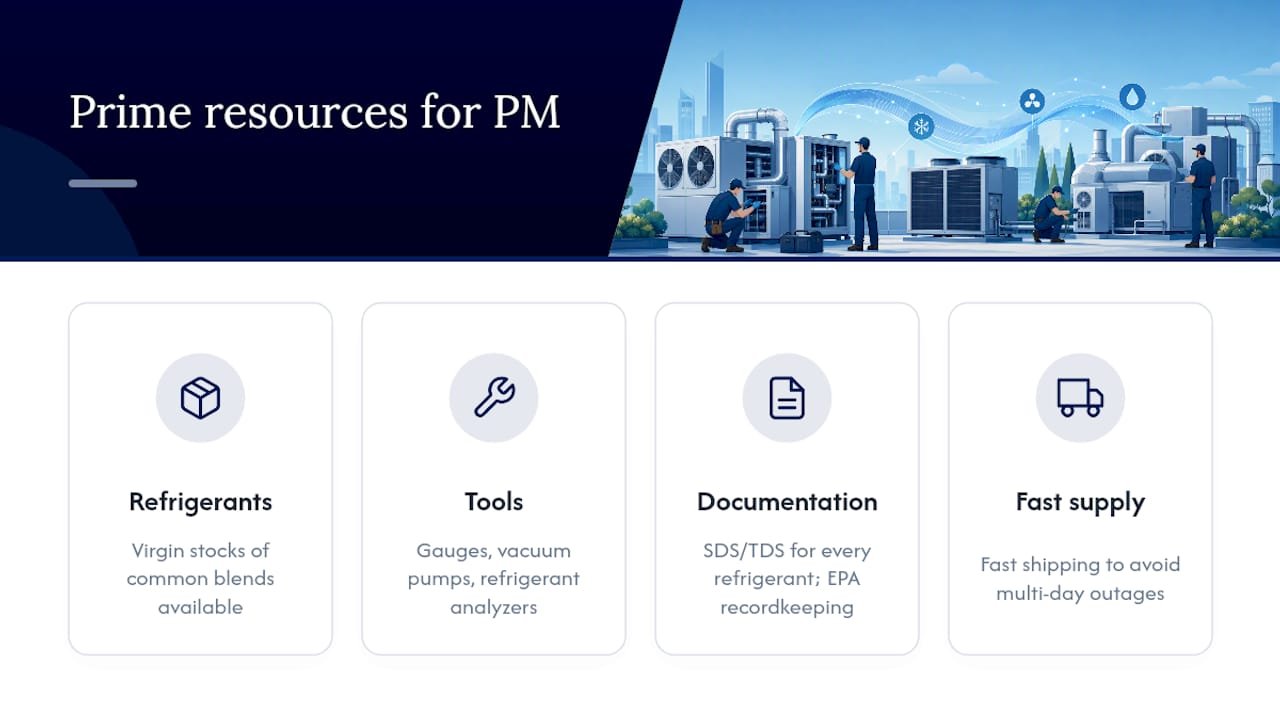
Running the checklist above depends on having refrigerant and tools on hand when a reading falls out of range, not three days later. A source stocks virgin refrigerants including various common blends alongside gauges, vacuum pumps, and refrigerant analyzers, with fast shipping built to keep a Critical finding from turning into a multi-day outage.
Hvac-prime’s downloadable PM checklist gives technicians the same asset-ID and severity-rating structure described above, ready to drop into a CMMS. SDS and TDS documentation for every refrigerant sold supports the recordkeeping the EPA’s short-form checklist calls for, and the professional-grade tool lineup maps directly onto quarterly and annual acceptance-criteria checks: gauges for pressure verification, vacuum pumps for post-repair evacuation, analyzers for refrigerant purity.
Why Measured Readings Beat Checkbox Audits
A checkbox that says “coil inspected” tells you nothing a year later. A photo showing dP at 0.9 inches water column, timestamped, with a technician ID attached, tells you exactly when a filter crossed the line, and it’s the kind of record that turns a warranty dispute into a five-minute resolution instead of a finger-pointing exercise. The single next step: pull your last three PM reports and check whether they contain actual numbers or just signatures.
— Planet
Where Can You Find Primary Guidance on HVAC Compliance?
For deeper reference, start with the EPA’s HVAC short-form checklist for refrigerant handling rules, the DOE Better Buildings preventive maintenance guidance for program benefits, and the PNNL technical report on HVAC reliability for the engineering case behind condition-based monitoring.
Sources
- HVAC Checklist (EPA short-form)
- Preventative Maintenance for Commercial HVAC Equipment
- PNNL technical report on HVAC reliability and PM
- Ultimate HVAC Preventive Maintenance Checklist (OxMaint)
- Commercial HVAC Service Agreement (Trane)




 HVAC
HVAC Automotive
 Refrigerant Diagnostics Kit
 Water Heaters