
Avoid 7% CO2e Errors: Refrigerant GWP Comparison for Specifiers


High-GWP legacy HFCs like R-410A and R-404A sit in the thousands on the 100-year scale, R-32 and blends like R-454B land in the low hundreds to low thousands, and near-zero options like R-1234yf, CO2, and ammonia sit under 10. Reported figures shift depending on whether they’re pulled from AR5 or AR6, so any table needs to state its basis. The real lesson: picking a low-GWP refrigerant only pays off if you also protect system efficiency and run tight leak prevention.
TL;DR:
- Low-GWP refrigerants like R-1234yf and CO2 have GWPs under 10, making them environmentally preferable if system efficiency and leak prevention are maintained.
- GWP values differ significantly between AR5 and AR6 assessments, so confirming the calculation basis is essential for accurate emissions accounting.
- Regulations such as the AIM Act and SNAP list specify GWP limits and bans based on different assessment years, requiring careful compliance verification.
- Switching to lower-GWP refrigerants can involve trade-offs like flammability, increased pressure, or compatibility issues that impact system design and technician certification.
- Effective lifecycle management, including leak monitoring and proper reclamation, is crucial to maximizing climate benefits regardless of refrigerant GWP.
Table of Contents
- Refrigerant GWP Comparison Table: AR5 vs. AR6 Values
- How Do You Interpret Gwp R454B and Other GWP Numbers?
- Which Regulations Determine Refrigerant GWP Limits?
- Weighing Efficiency, Flammability, and Compatibility Trade-Offs
- Building a Lifecycle Refrigerant Management Program
- Beyond GWP: Ozone Depletion and Indirect Emissions
- Why Atmospheric Lifetime Changes the Climate Math
- Trends Reshaping Refrigerant GWP Limits
- Real-World Outcomes: What GWP Comparisons Look Like in Practice
- A Publisher’s Note on Supply, Compliance, and Real-World Reductions
- Sourcing Refrigerants and Documentation Through Hvac-prime
- Sources
Refrigerant GWP Comparison Table: AR5 vs. AR6 Values
Refrigerant selection hinges on knowing which number you’re actually looking at. The EPA’s GWP reference table and the AR6-based dataset from GreenCalculus don’t always agree, because the underlying IPCC assessment report changed how it calculates atmospheric forcing between AR5 and AR6.
Blend values like R-454B are mass-weighted averages of the component refrigerants, so a small shift in blend ratio can move the reported GWP by a noticeable margin. Always check the manufacturer’s technical data sheet rather than assuming a round number, and note whether it cites AR5 or AR6.
How Do You Interpret Gwp R454B and Other GWP Numbers?
GWP-100 measures how much warming a kilogram of gas causes over 100 years relative to a kilogram of CO2, which is set at 1. Emissions accounting multiplies leaked refrigerant mass by an appropriate GWP-100 factor for CO2 equivalent calculation.
AR6 update revised some refrigerant GWP values due to updated atmospheric chemistry and radiative forcing models, causing differences from AR5 values. The AIM Act and most current EPA compliance frameworks still reference AR5-based numbers, while corporate sustainability reporting increasingly favors AR6, per the GreenCalculus dataset. Mixing bases in the same inventory is a common and avoidable error.
Here’s a worked example using AR6 figures:
- A 10 lb (4.5 kg) leak of R-410A at an AR6 GWP of 2,256 equals roughly 10,152 kg CO2e.
- That same leak using the AR5 figure of 2,088 comes out to about 9,396 kg CO2e, a 7% difference from basis alone.
Statistic Callout: R-1234yf carries an AR6 GWP under 1, making it functionally comparable to CO2 on a per-kilogram warming basis, according to the GreenCalculus AR6 dataset.
Document which basis you used in any spec sheet or emissions report. A number without its assessment year attached is not verifiable.
Which Regulations Determine Refrigerant GWP Limits?
The Kigali Amendment set the international framework for phasing down HFC production and consumption, and the U.S. implemented it domestically through the American Innovation and Manufacturing (AIM) Act. The AIM Act regulation references AR4/AR5-based GWP values for equipment eligibility and phasedown compliance.
EPA’s Significant New Alternatives Policy (SNAP) program lists which refrigerants are acceptable for specific end uses and prohibits others outright in sectors like new light-duty vehicle AC, where R-1234yf has effectively replaced R-134a.
Pro Tip: Before specifying a refrigerant for a regulated application, confirm both the GWP basis your compliance program requires and whether that refrigerant is SNAP-listed for that specific end use, not just generally acceptable.
A short procurement checklist for regulated jobs:
- Confirm the GWP basis (AR5 or AR6) your reporting or compliance framework requires.
- Verify SNAP listing status for the specific end use, not just the refrigerant class.
- Require current SDS and TDS documentation from the supplier before purchase.
- Confirm the refrigerant is compatible with existing recovery and reclamation infrastructure.
- Plan technician certification and training if switching to A2L or A3 class refrigerants.
Full compliance detail is worth bookmarking in HVAC Prime’s EPA regulations guide for procurement teams handling multiple jurisdictions.
Weighing Efficiency, Flammability, and Compatibility Trade-Offs
GWP is one variable in a bigger equation. Direct emissions come from refrigerant leaks; indirect emissions come from the electricity a system consumes over its operating life, and indirect emissions often dominate the total footprint. A refrigerant swap that drops direct GWP but costs even a few points of coefficient of performance (COP) can erase the climate benefit, since a 5% efficiency loss can negate much of the direct GWP benefit of moving to a lower-GWP option.
A2L refrigerants like R-32 and R-454B carry mild flammability, which changes design requirements. ASHRAE’s position is direct: there’s no universal refrigerant, and adopting A2L or hydrocarbon options requires real changes, not just a part swap.
- Charge limits and ventilation requirements shift under ASHRAE Standards 15 and 15.2 for flammable refrigerants.
- Lubricant compatibility often changes with refrigerant class, and mixing lubricants can cause premature compressor failure.
- Retrofits require checking elastomer seals and gaskets, since some materials degrade with certain refrigerant/lubricant combinations.
- Technician certification for A2L handling is now a practical prerequisite, not an optional upgrade.
Compare specific system implications in HVAC Prime’s R454B vs. R32 breakdown before committing to a platform.
Building a Lifecycle Refrigerant Management Program
Switching to a lower-GWP refrigerant only delivers its promised benefit if the refrigerant stays in the system. Lifecycle Refrigerant Management (LRM) programs focus on keeping refrigerant contained and reclaiming it properly at end of service, and the IIASA sustainability research on LRM found that certified recovery and documented reclamation chains reduce pressure on virgin HFC supply during the phasedown period.
- Run a scheduled leak monitoring program on high-charge systems, not just annual spot checks.
- Require certified recovery equipment on every service call involving refrigerant removal.
- Build reclamation clauses into service contracts, specifying chain-of-custody documentation for recovered gas.
- Track cylinder-level inventory so shrinkage gets flagged before it becomes a compliance problem.
Pro Tip: Ask your refrigerant supplier for documented reclamation chain-of-custody paperwork, not just a purchase invoice. Regulators and some corporate ESG audits are starting to ask for it.
Pair any equipment decision with a documentation trail. Keep current SDS and TDS records on file for every refrigerant in active inventory.
Beyond GWP: Ozone Depletion and Indirect Emissions
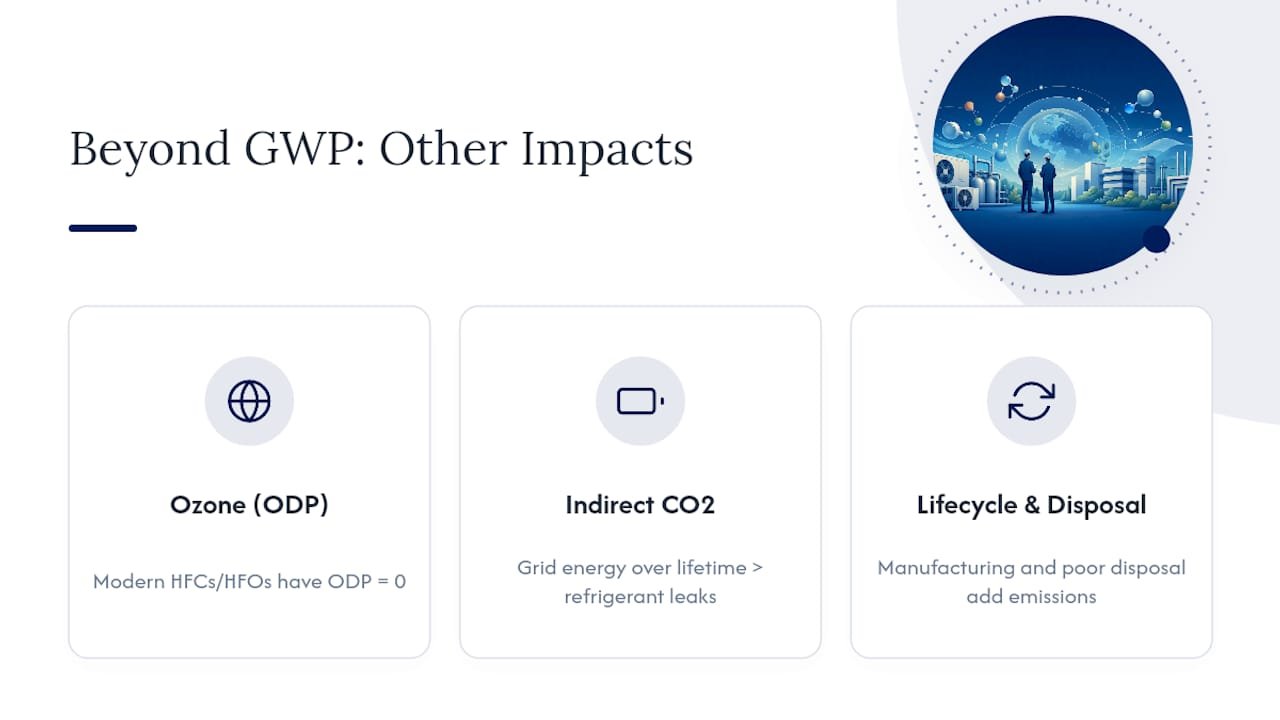
GWP tells only part of the environmental story. Ozone depletion potential (ODP) measures a separate mechanism entirely, how much a substance breaks down stratospheric ozone. Modern HFCs and HFOs, including R-410A, R-32, R-1234yf, and R-454B, all carry an ODP of zero, since the chlorine and bromine compounds responsible for ozone damage were phased out under the Montreal Protocol decades ago. That’s a real success story separate from the current climate-driven phasedown.
Indirect emissions come from the power a refrigeration or AC system draws over its operating life, and in most systems, that dwarfs the direct warming effect of refrigerant leaks. A commercial chiller running for 15 years on grid electricity generates far more CO2 through energy consumption than through refrigerant loss, unless leak rates are unusually high. That’s why efficiency ratings and part-load performance deserve equal billing with the refrigerant’s GWP number when specifying new equipment.
There’s also a supply-chain dimension rarely discussed: manufacturing fluorinated refrigerants generates its own emissions footprint, and end-of-life disposal, if handled poorly, can release the full charge back into the atmosphere in one event rather than through gradual leakage. Responsible disposal of retired cooling equipment, similar to the practices covered in guidance on handling end-of-life appliances, matters as much as the refrigerant choice made at installation.
Treating GWP as the only metric in a specification misses ozone impact, grid-driven indirect emissions, and disposal risk, three factors that can outweigh the headline number.
Why Atmospheric Lifetime Changes the Climate Math
GWP and atmospheric lifetime are related but distinct. Lifetime measures how long a molecule persists before breaking down; GWP measures the cumulative warming effect over a defined window, usually 100 years, factoring in both potency and persistence.
R-1234yf breaks down in the atmosphere within about 11 days, which is why its GWP sits under 1 despite being a fluorinated compound. Compare that to R-410A’s HFC components, which persist for years to decades, giving them time to accumulate warming effect across the full 100-year window. Ammonia and CO2 sit at opposite ends of a different scale: ammonia reacts and washes out of the atmosphere quickly, while CO2 persists for centuries but exerts comparatively weak warming per molecule.
This is also why the 20-year GWP window (GWP-20) tells a different story than GWP-100 for short-lived, high-potency gases. A refrigerant with a short atmospheric lifetime but high initial radiative efficiency can look far worse on a 20-year basis than on a 100-year basis, since most of its warming happens early and then drops off. Regulatory frameworks almost universally use GWP-100 for consistency, but engineers modeling near-term climate risk sometimes reference GWP-20 for a more conservative near-term picture. Knowing which window a cited number uses matters as much as knowing which IPCC assessment report it came from.
Trends Reshaping Refrigerant GWP Limits
The regulatory trend line points in one direction: lower ceilings, faster timelines. The AIM Act’s phasedown schedule tightens allowable production and consumption allowances in stages through the early 2030s, and manufacturers are already designing new residential and light commercial equipment around R-454B and R-32 rather than R-410A.
Automotive has largely finished its transition, with R-1234yf now standard in new vehicle AC systems across the industry. Commercial refrigeration is moving faster toward CO2 (R-744) for supermarket and cold-storage applications, driven partly by regulatory pressure and partly by CO2’s negligible GWP and stable long-term regulatory status, since natural refrigerants sit outside the HFC phasedown entirely.
Expect continued movement toward A2L adoption in residential and light commercial equipment, expanded use of ammonia in industrial and large commercial cold storage where B2L handling infrastructure already exists, and incremental refinement of HFO blends targeting even lower GWP without sacrificing capacity or efficiency. The next wave of refrigerant development is less about finding one universal replacement and more about matching refrigerant chemistry to application, balancing charge size, ventilation feasibility, and technician training against the GWP ceiling each sector faces.
Real-World Outcomes: What GWP Comparisons Look Like in Practice
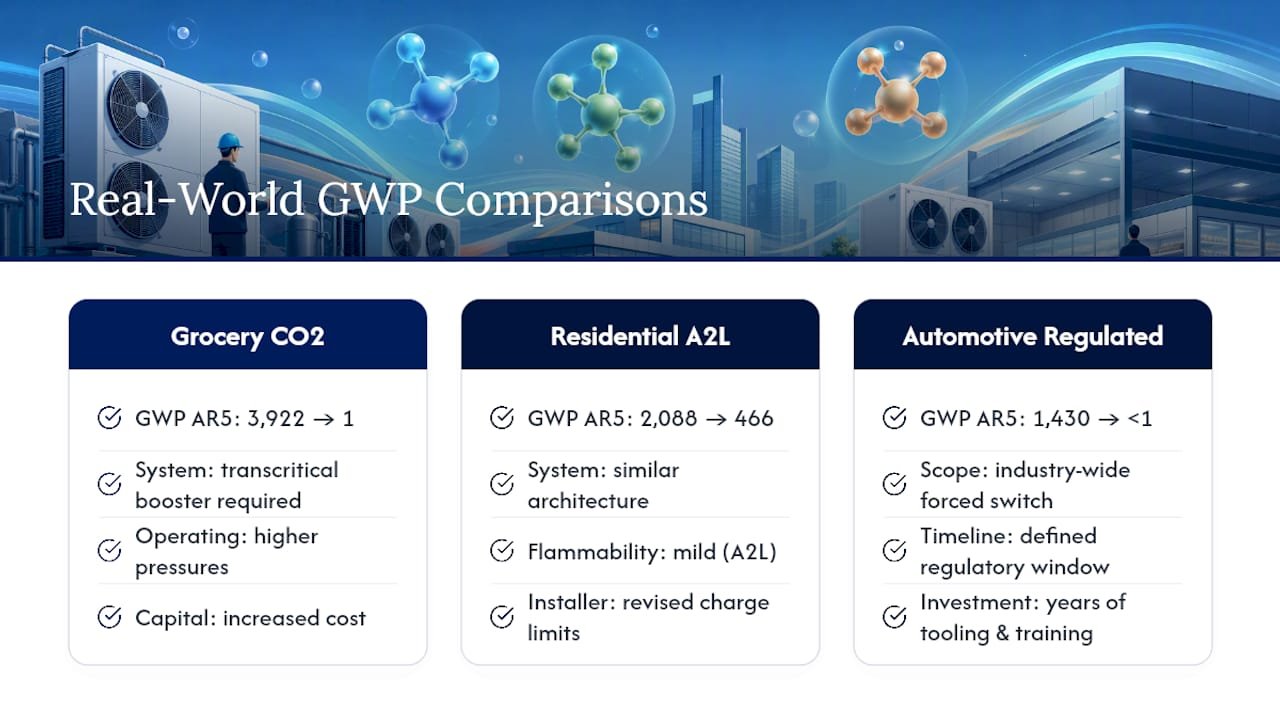
A mid-size grocery chain converting from R-404A commercial refrigeration racks to R-744 (CO2) systems illustrates the trade-off clearly. The direct GWP drops from roughly 3,922 (AR5) to 1, essentially eliminating the direct warming contribution from leaks. But CO2 systems run at higher operating pressures and often need transcritical booster designs in warmer climates, which changes both capital cost and technician training requirements.
A residential HVAC manufacturer switching production from R-410A to R-454B tells a different story. The GWP drop is substantial, from roughly 2,088 to 466 on an AR5 basis, without requiring a fundamentally different system architecture. The trade-off shows up in mild flammability classification (A2L), meaning technicians need updated certification and installers need to follow revised charge limits, but the equipment footprint and service approach stay recognizable.
Automotive’s shift from R-134a to R-1234yf shows what happens when regulation forces a near-complete industry transition on a fixed timeline. GWP dropped from roughly 1,430 to under 1, and the entire supply chain, from OEM production lines to independent repair shops, adapted within a defined regulatory window. That transition took years of tooling and training investment across an entire industry, a reminder that even a clearly beneficial GWP swap carries real operational cost during the changeover period.
A Publisher’s Note on Supply, Compliance, and Real-World Reductions
The GWP number on a data sheet is only useful if the supply behind it is reliable and the paperwork holds up under audit. Hvac-prime’s role is making sure contractors get documented, verifiable refrigerant, not just a low number on a label. Choosing low-GWP refrigerant matters, but pairing it with efficient system design and disciplined leak management is what actually moves the needle.
— Planet
Sourcing Refrigerants and Documentation Through Hvac-prime
Specialized suppliers can provide compliant, documented refrigerant more efficiently than distributors who may not confirm SNAP status or provide current SDS on request. The catalog covers refrigerants across common SKUs, including current low-GWP options like R-32 and R-454B alongside legacy stock for service work still running on older charges.
Every order ships with the documentation procurement teams actually need. Pull SDS and TDS records directly for compliance files, check refrigerant tag pages for stock across categories, or browse HVAC tools and accessories for recovery and diagnostic equipment that supports a real lifecycle management program. Competitive pricing and efficient shipping help contractors avoid delays caused by stock shortages.
For bulk orders or regulated procurement requiring custom documentation, contact the supplier’s sales team directly to confirm availability and paperwork before committing to a job timeline.
Sources
- Technology transitions: GWP reference table | EPA
- Refrigerant & F-Gas GWP Values (IPCC AR6) | GreenCalculus
- Critical Literature Review of Low Global Warming Potential (GWP) Refrigerants and their Environmental Impact
- ASHRAE refrigeration resources and position documents




 HVAC
HVAC Automotive
 Refrigerant Diagnostics Kit
 Water Heaters