
When VRF Beats Rooftop Units for Facility Managers, 20–40% Savings


For simple, single-zone or low-rise buildings, packaged rooftop units usually win on first cost and ease of service. For multi-zone buildings with mixed heating and cooling loads, tight comfort demands, or electrification goals, VRF typically wins on lifecycle cost. The right call depends on your zone count, occupancy pattern, and how long you plan to hold the building. Jump to the how-to-choose checklist if you need to move fast.
TL;DR:
- VRF systems cost more initially but offer 20 to 40 percent energy savings over older RTUs, especially in buildings with varied heating and cooling zones.
- RTUs are simpler to install, maintain, and typically serve single zones, making them suitable for retail, light industrial, and small low-rise buildings.
- Proper ventilation for VRF requires a dedicated outdoor air system, particularly in humid climates, to prevent indoor moisture and comfort issues.
- Hybrid setups combining RTUs and VRF are common in retrofit projects, balancing cost and comfort based on zone complexity and usage patterns.
- Contractors should accurately assess load profiles, ventilation needs, roof capacity, and refrigerant safety standards before selecting and bidding on either system.
Table of Contents
- VRF vs Rooftop Units: The Quick Comparison
- How Do VRF and Rooftop Systems Compare on Energy Efficiency?
- Which System Handles Zoning and Comfort Better?
- Why Does VRF Usually Need a Separate Ventilation System?
- What Do VRF and RTU Systems Actually Cost Over Time?
- How Do Installation Timelines and Maintenance Needs Differ?
- Why Does Refrigerant Charge Matter for System Selection?
- Which Building Types Favor RTU, VRF, or a Hybrid?
- A Checklist for Choosing Between VRF and Rooftop Units
- How HVAC Prime Supports Field Teams on Either System
- A Field-Level Read on VRF vs Rooftop Units
- Get the Refrigerant and Tools Your Next Job Needs
- Sources
VRF vs Rooftop Units: The Quick Comparison
Before you get into design details, here’s how the two architectures stack up on the factors that actually drive a purchase decision.
- Upfront cost: RTUs generally have lower installed cost per ton; VRF involves higher initial investment for outdoor units, indoor heads, and refrigerant piping.
- Part-load efficiency: VRF’s inverter compressors track load closely; standard RTUs cycle on/off and lose efficiency at partial load.
- Zoning: VRF supports many independently controlled zones from one outdoor bank; RTUs typically serve one zone or a few with added ductwork.
- Ventilation: RTUs bring built-in economizers and outdoor air intake; VRF usually needs a separate dedicated outdoor air system for ventilation.
- Maintenance: RTUs use widely available parts and generalist techs; VRF needs specialized manufacturer-trained service and tighter documentation.
- Best for: RTUs suit single-tenant retail and light industrial; VRF suits offices, hotels, and multifamily with varied zone loads.
Many buildings don’t need a binary choice. A hybrid approach—RTUs on warehouse space paired with a rooftop VRF outdoor cabinet serving office build-out—is common in retrofit and expansion projects.
How Do VRF and Rooftop Systems Compare on Energy Efficiency?
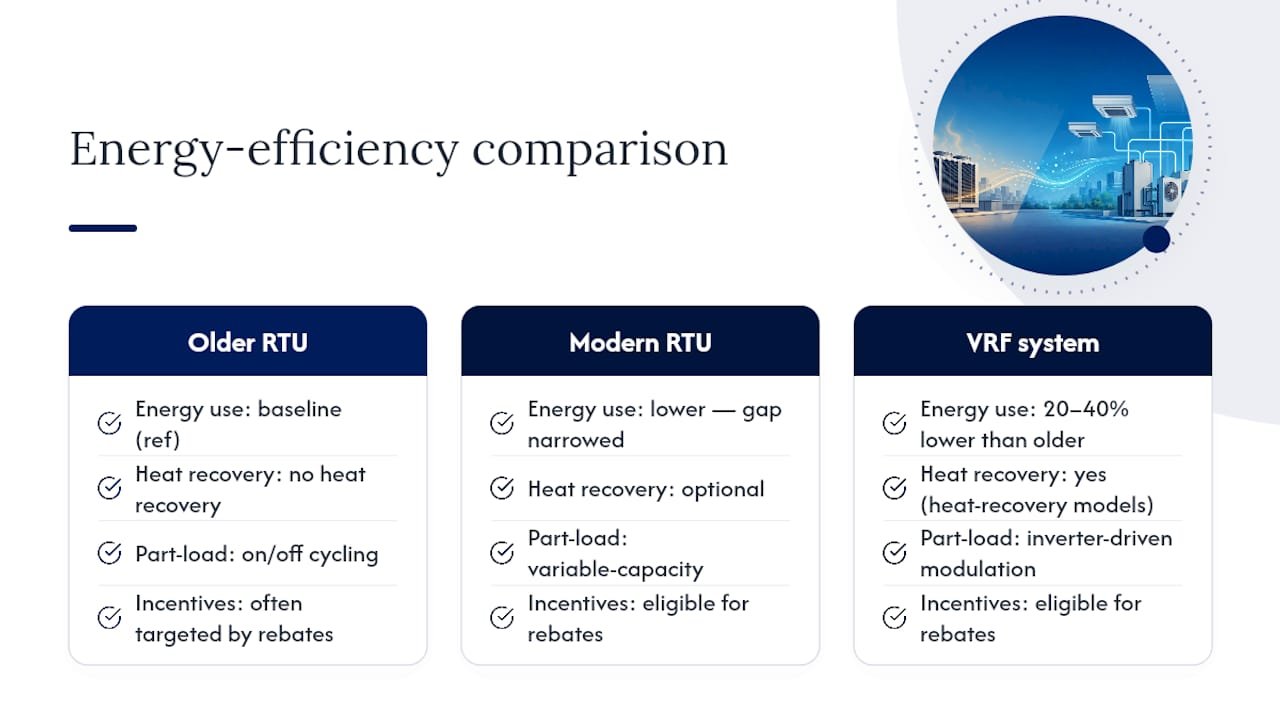
VRF systems use inverter-driven compressors that ramp output up or down to match real-time load, instead of the blunt on/off cycling that defines most conventional RTUs. Heat-recovery VRF models take it further: one zone can reject heat while an adjacent zone absorbs it, recycling energy that a standalone RTU would simply vent outside.
That difference shows up in the numbers. VRF systems commonly deliver 20 to 40 percent energy savings compared with older RTUs in buildings with mixed heating and cooling loads, largely from part-load matching and heat recovery. But don’t extrapolate that gap onto every RTU quote you get. Modern variable-capacity rooftop units have narrowed the efficiency difference considerably, and older single-stage RTU performance data doesn’t reflect current products. Utility rebate programs frequently target high-efficiency RTUs and heat-recovery VRF alike, so check local incentive thresholds before assuming either system pencils out on efficiency alone.
Which System Handles Zoning and Comfort Better?
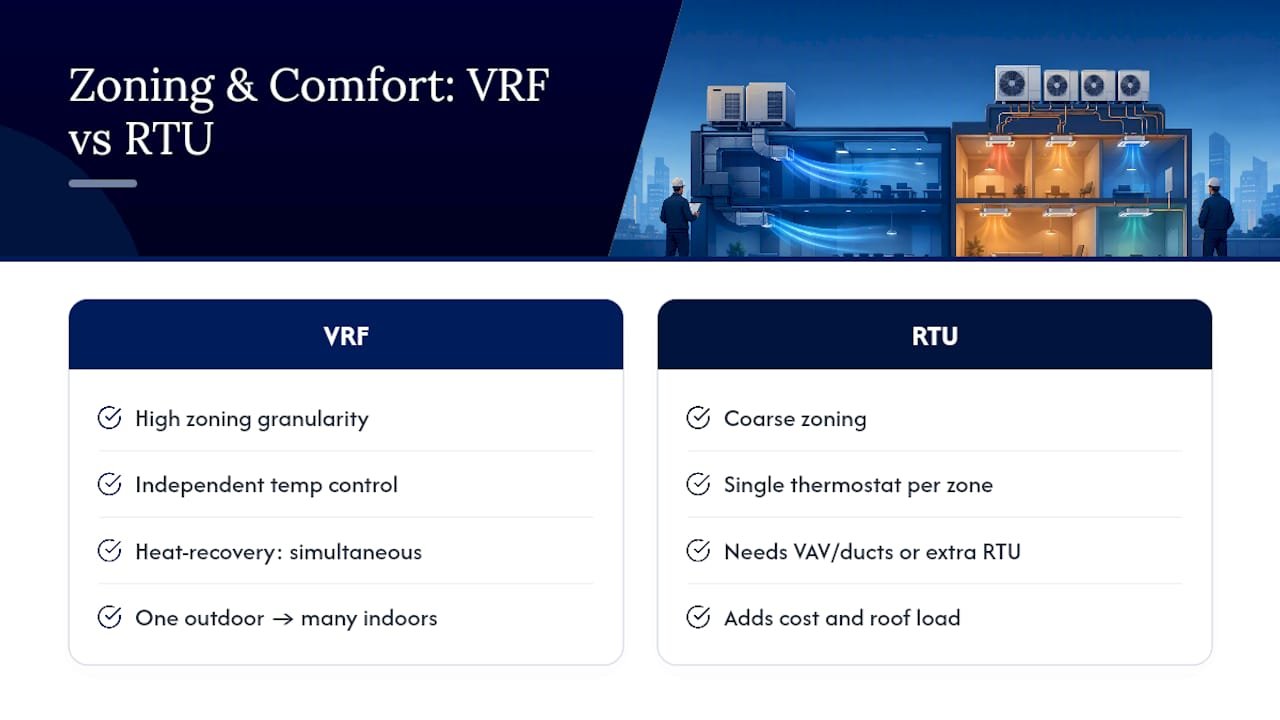
VRF’s real advantage is granularity. A single outdoor unit bank can feed dozens of indoor units, each with independent temperature control, and heat-recovery configurations let one zone heat while another cools at the same time. That matters in buildings where a west-facing conference room overheats while the north office still needs heat.
RTUs zone coarsely by comparison. Adding finer control usually means VAV boxes, additional ductwork, or a second rooftop unit, which adds cost and roof loading fast. In practice, this is where tenant complaints cluster: single-zone RTUs in multi-tenant spaces generate more comfort calls than VRF layouts do, simply because one thermostat is speaking for too many rooms.
Why Does VRF Usually Need a Separate Ventilation System?
RTUs bring their own answer to fresh air: built-in economizers and outdoor air intake dampers handle ventilation as part of the package. VRF indoor units mostly recirculate room air, so VRF installations typically require a dedicated outdoor air system (DOAS) to meet ventilation codes and manage humidity.
Skipping the DOAS is a common design mistake. In humid climates, leaving ventilation and dehumidification out of a VRF scope undermines comfort and invites moisture problems indoors, regardless of how well the VRF handles temperature. Size the DOAS to the space’s actual outdoor air requirement, not as an afterthought bolted onto a VRF budget late in design.
What Do VRF and RTU Systems Actually Cost Over Time?
RTUs generally install for less per ton than VRF, largely because VRF pricing includes refrigerant piping runs, multiple indoor units, and controls integration that a packaged RTU skips entirely. That gap narrows once you run the numbers past year one.
Here’s a simplified payback approach worth running on any project:
- Estimate annual kWh consumption for both systems using your load calc and expected run hours.
- Apply your utility rate to get annual operating cost for each option.
- Subtract to find annual savings, then divide the VRF cost premium by that savings figure for simple payback in years.
A rough example: if VRF costs $15,000 more to install but saves 25,000 kWh a year at $0.14/kWh, that’s $3,500 in annual savings, roughly a 4.3 year simple payback. Where VRF captures 20 to 40 percent savings over older RTUs, payback often lands within a reasonable hold period. On short hold periods or tight capital budgets, RTU’s lower first cost usually wins regardless of the efficiency math.
How Do Installation Timelines and Maintenance Needs Differ?
RTU installation is fast and disruptive in a good way: a crane sets the new unit, techs make electrical and duct connections, and the building’s back in service within a day or two. VRF installation runs longer and touches more trades: refrigerant piping, condensate routing, controls wiring, and multiple indoor unit placements across floors.
Serviceability follows the same pattern. RTU parts are common and most HVAC techs can troubleshoot them without specialty training. VRF service costs run higher, and facility teams should plan on manufacturer-trained technicians and stricter commissioning documentation for VRF, since undocumented refrigerant circuits create expensive guesswork years later.
Why Does Refrigerant Charge Matter for System Selection?
VRF systems distribute refrigerant across long piping runs to multiple indoor units, which means higher total refrigerant charge than a typical packaged RTU. That charge volume brings ASHRAE 34 and 15 safety classifications into the design conversation, particularly around leak detection and ventilation requirements for occupied spaces.
Routing outdoor units to the roof and keeping indoor refrigerant runs as short as practical limits the quantity present in occupied zones. Check your jurisdiction’s adoption of current ASHRAE standards before finalizing indoor unit placement in dense floor plans.
Which Building Types Favor RTU, VRF, or a Hybrid?
- Warehouses and light industrial: RTUs win almost every time, single-zone loads and low ceiling heights favor simple packaged units.
- Multi-tenant office buildings: VRF usually fits better once you’re past a handful of zones with different exposures and schedules.
- Hotels and multifamily: VRF’s per-room control and heat recovery suit varied occupancy and simultaneous heating/cooling needs well.
- Historic retrofits: VRF’s small line sets and ductless heads often avoid the structural changes a new RTU curb and ductwork would require.
- Big-box retail with office build-out: a hybrid, RTU for the sales floor, VRF for back-of-house offices, splits the difference on cost and comfort.
Square footage alone won’t tell you the answer. Zone count and occupancy variability matter more than raw size.
A Checklist for Choosing Between VRF and Rooftop Units
Start with a proper load calculation, an honest occupancy profile, your actual utility rate structure, and your realistic hold period for the building. Skipping any of these skews the comparison before you even get bids.
- Map every zone and its heating/cooling profile across the day and season.
- Confirm ventilation strategy and whether a DOAS is needed.
- Check roof structural capacity, ductwork condition, and available electrical capacity.
- Verify local code adoption for refrigerant safety classifications.
- Screen contractors for VRF-specific commissioning experience, not just RTU familiarity.
When bids come back, ask each contractor how they’ll document refrigerant circuits and what warranty covers parts versus labor.
Pro Tip: Require commissioning reports and a parts-supply guarantee in writing before signing, not as a verbal promise during the walkthrough.
How HVAC Prime Supports Field Teams on Either System
Whichever architecture you land on, the job runs on having the right refrigerant and tools on hand. HVAC Prime’s tool inventory covers gauges, vacuum pumps, and diagnostics kits for RTU swaps and VRF commissioning alike. For staged VRF retrofits, matching refrigerant charge to manufacturer spec floor by floor keeps safety data sheet documentation clean and pressure testing accurate from the first outdoor unit online.
A Field-Level Read on VRF vs Rooftop Units
VRF tends to justify its higher cost in buildings where zone-by-zone comfort and heat recovery are important and properly implemented, not just specified on paper. The most common mistake isn’t picking the wrong system, it’s picking VRF for the comfort story and then skipping the DOAS or shorting the commissioning budget, which reduces system performance. If your building is one zone and one load profile, don’t overthink it. Run the checklist, then decide.
— Planet
Get the Refrigerant and Tools Your Next Job Needs
Whether you’re swapping out an RTU this week or staging a multi-floor VRF retrofit, the job stalls without the right refrigerant charge and diagnostic gear on the truck. HVAC Prime stocks virgin refrigerants across the common commercial blends alongside gauges, vacuum pumps, and diagnostics kits, priced to support contractors buying in volume.
Browse the refrigerants catalog to match charge to your system spec before the crew shows up on-site, or check the HVAC tools lineup for commissioning and leak-detection gear. For bulk orders or phased shipments tied to a multi-floor VRF schedule, reach out to place a staged order that lands when each phase actually needs it.
Sources
For deeper technical grounding, the NYC Accelerator VRF tech primer covers VRF’s electrification pathway, while CoolSys’s system comparison breaks down RTU and chilled-water tradeoffs. Refrigerant safety context comes from Trane’s commercial HVAC technical literature, and rebate-eligible RTU specs are detailed at the Better Buildings Solution Center.
- Rooftop unit vs. VRF vs. Chilled Water systems | CoolSys
- High-efficiency RTU specification | Better Buildings Solution Center




 HVAC
HVAC Automotive
 Refrigerant Diagnostics Kit
 Water Heaters