
US HVAC Techs: Verify Section 16 Date with a Downloadable SDS Library


Yes, refrigerants meeting hazard criteria require an OSHA-format Safety Data Sheet, and if you can’t produce one for every refrigerant on your truck or in your shop right now, you have a compliance gap to close today. Suppliers must issue current SDSs, employers must keep them accessible, and everyone needs a working emergency contact number and a legible revision date. If any sheet is missing, outdated, or unreadable, request a replacement from your supplier before that cylinder gets used on another job.
TL;DR:
- OSHA requires current, accessible SDSs for all refrigerants meeting hazard criteria, with specific information on hazard classification, composition, and revision date.
- Repackaging or importing refrigerants shifts SDS responsibilities to the company, making compliance in these cases more complex and often overlooked.
- Flammability classifications like A1 and A2L significantly influence handling procedures, especially regarding ventilation and ignition control, in line with SDS guidance.
- SDSs must be updated promptly if formulations, toxicity data, or regulatory classifications change, with revision dates tracked and verified at each shipment.
- A centralized, verified SDS library and regular staff training ensure compliance and quick response during emergencies or inspections.
Table of Contents
- Who Has To Provide Refrigerant SDS Compliance Documents
- What OSHA’s 16-Section SDS Format Requires
- Reading Refrigerant Hazard Data: Toxicity, Flammability, and A2L Classifications
- When Suppliers Must Update Refrigerant Safety Data Sheets
- Do State OSHA Plans Add Requirements For Your Business?
- Building A Practical SDS Management Workflow
- Using SDS Data During A Refrigerant Emergency
- Quick Compliance Audit: What To Check On Every Refrigerant SDS
- HVAC Prime’s SDS And TDS Downloads For Faster Compliance Checks
- What Actually Reduces Risk On The Job
- Source Refrigerants And SDS Documentation Through HVAC Prime
- Sources
Who Has To Provide Refrigerant SDS Compliance Documents
Under OSHA’s Hazard Communication Standard, chemical manufacturers, importers, and distributors carry the legal duty to produce a Safety Data Sheet for any hazardous chemical they sell, including refrigerants that meet flammability or toxicity thresholds. That obligation sits with whoever puts the product into commerce first. If you buy sealed cylinders from a wholesale supplier, that supplier’s job is to hand you a current SDS, either at time of sale or through an accessible online library.
The chain shifts when you change the product. If your company repackages bulk refrigerant into smaller cylinders, relabels drums, or imports refrigerant directly from overseas, you inherit the manufacturer’s SDS obligations. That’s a detail a lot of smaller HVAC operations miss until an inspector asks who prepared the sheet on file.
Employers carry a separate, ongoing set of duties regardless of who wrote the original sheet:
- Keep SDSs accessible to every employee who might handle or be exposed to the refrigerant, during every shift, with no barrier like a locked office or a password-only portal.
- Provide hazard information in a language employees understand, which for most US shops means English but may require translation where crews are not fluent in it.
- Train workers on how to read and locate SDSs as part of hazard communication training, not as a one-time hire-in formality.
- Maintain records showing training happened and when, since inspectors will ask for dates, not just assurances.
Practically, that means three things happen this week if they haven’t already: confirm which supplier is the SDS source of record for every refrigerant type you stock, request copies of anything missing, and log the date you received each one. A simple spreadsheet with product name, CAS number, revision date, and receipt date solves most of this in an afternoon.
What OSHA’s 16-Section SDS Format Requires
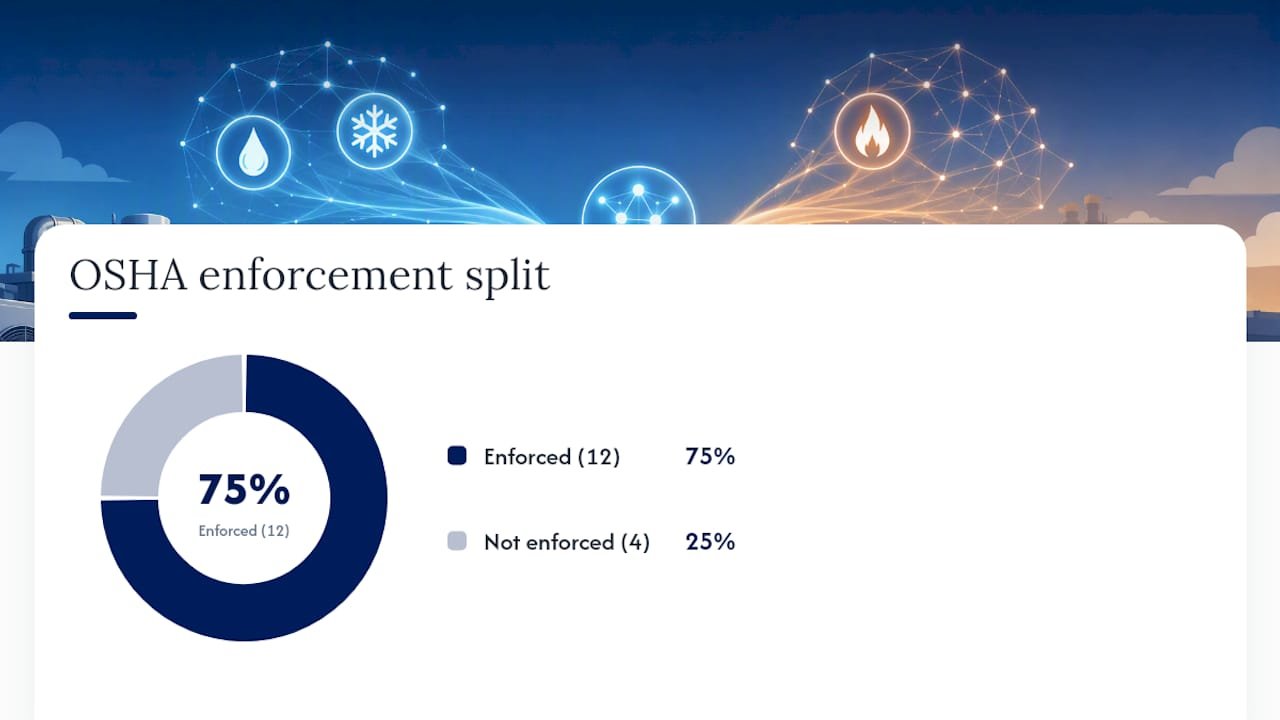
Every compliant refrigerant SDS follows the same 16-section skeleton, and OSHA’s Appendix D specifies minimum content for Sections 1 through 11 and Section 16. Sections 12 through 15 are a different story, and knowing which sections OSHA actually enforces saves you from chasing details that don’t affect your compliance status.
Here’s the section-by-section rundown that matters for an audit:
- Section 1, Identification. Product identifier, recommended use, and the supplier’s US address and emergency phone number. If that phone number rings to a disconnected line or a company that no longer exists, treat the SDS as invalid.
- Section 2, Hazard Identification. GHS classification, signal word (“Warning” or “Danger”), hazard statements, and pictograms. For refrigerants this is where flammability and asphyxiation risk show up first.
- Section 3, Composition/Ingredients. Chemical name, CAS number, and concentration ranges. Blended refrigerants often list multiple CAS numbers, and you’ll want all of them logged for cross-referencing.
- Section 4, First-Aid Measures. Symptom-specific response for inhalation, skin contact, eye contact, and ingestion.
- Section 5, Fire-Fighting Measures. Suitable extinguishing media and specific hazards from combustion products.
- Section 6, Accidental Release Measures. Containment and cleanup steps, including personal precautions.
- Section 7, Handling and Storage. Temperature limits, ventilation needs, and incompatible storage conditions.
- Section 8, Exposure Controls/PPE. Occupational exposure limits and recommended personal protective equipment.
- Section 9, Physical and Chemical Properties. Boiling point, flammability limits, vapor pressure, and similar data.
- Section 10, Stability and Reactivity. Conditions to avoid and incompatible materials.
- Section 11, Toxicological Information. Routes of exposure and symptoms from acute and chronic exposure.
- Section 16, Other Information. Date of preparation or last revision, which is the single field you should check first on every sheet.
Statistic Callout: OSHA’s own guidance is specific about gaps in the data: if a preparer has no relevant information for a required subheading, the SDS must say so explicitly rather than leaving the field blank. A blank field is a red flag, not a shrug.
Sections 12 through 15, covering ecological information, disposal, transport, and regulatory information, are commonly included but not enforced by OSHA. Manufacturers add them anyway because transport and environmental agencies use the same 16-section template internationally, and HVAC crews should still read them for disposal guidance even though an OSHA inspector won’t cite you for what’s written there.
Reading Refrigerant Hazard Data: Toxicity, Flammability, and A2L Classifications
This is the section that changes what you actually do on the job, not just what paperwork you keep. Section 11 covers toxicological information, and for most refrigerants you’ll find asphyxiation risk (from displacing oxygen in a confined space) listed well before any acute toxicity concern. Some refrigerants also break down into hydrofluoric acid when exposed to open flame, which is why Section 5 fire-fighting language deserves more attention than techs usually give it.
Exposure limits are where things get murky. Many refrigerants don’t have an OSHA Permissible Exposure Limit at all, and you’ll often see an ACGIH Threshold Limit Value cited instead, or occasionally neither. EPA’s refrigerant safety guidance points to this gap directly: when no PEL exists, ventilation and monitoring practices should default to the most conservative guidance available on the sheet, not to the absence of a number as an all-clear.
Flammability is where refrigerant SDSs diverge sharply from most other chemical sheets, and it’s the section most likely to trip up a tech used to older refrigerant lines:
- Lower and Upper Flammability Limits (LFL/UFL) define the concentration range in air where the refrigerant can ignite. A tight range means less margin for error in a leak scenario.
- Flash point, when applicable, tells you the minimum temperature at which vapors can ignite near an open flame.
- ASHRAE safety classification (A1, A2L, A2, or A3) is the shorthand that tells you how seriously to take that flammability data. A1 refrigerants carry no flame propagation; A3 refrigerants like propane blends are fully flammable.
A2L refrigerants deserve their own callout because they’re becoming the default for new residential and light commercial systems, and the SDS language around them looks different from the A1 refrigerants most veteran techs grew up servicing. EPA guidance notes that newer low-GWP refrigerants often shift the flammability profile compared to the refrigerants they replace, which means the handling instructions on the SDS aren’t boilerplate carried over from an older product line.
Pro Tip: When an SDS lists an A2L classification, treat any hot work near an open system, brazing, soldering, or grinding, as a ventilation-first task. Confirm mechanical ventilation is running and check for ignition sources within the labeled hazard zone before you strike an arc or light a torch, not after.
Practically, three lines on an SDS should change your field procedure the moment you see them: an A2L or A2 classification (increase ventilation, control ignition sources), a listed LFL below typical ambient leak concentrations (treat any confined-space entry as a monitored entry), and a Section 8 PPE recommendation calling for supplied-air or specific eye protection beyond standard safety glasses. If none of those three lines are present or legible, that’s itself a reason to flag the sheet for supplier follow-up.
When Suppliers Must Update Refrigerant Safety Data Sheets
SDSs aren’t static documents you file once and forget. Suppliers are obligated to update a Safety Data Sheet without delay when they learn of new hazard information, whether that comes from new toxicity testing, a formulation change, or a shift in how the chemical is classified for flammability.
A handful of triggers should put you on alert for an update:
- Reformulation. A refrigerant blend changes its ratio of component gases, which can shift both the flammability classification and the exposure limits.
- New toxicity or exposure data. Updated research on chronic exposure effects gets folded into Section 11 and sometimes Section 8’s exposure limits.
- Reclassification. A refrigerant previously listed as A1 gets reclassified as A2L, or vice versa, based on updated testing.
- Regulatory changes. Shifts in EPA’s SNAP program or updated ASHRAE standards can prompt a supplier-side SDS revision even without a chemical change.
Verification on your end doesn’t need to be complicated, but it does need to be consistent. Check the Section 16 revision date every time a new shipment arrives, not just when you first stock a product. If a date has moved forward since your last delivery, request written confirmation from the supplier explaining what changed. Keep a simple change log, product name, old revision date, new revision date, and what prompted it, so you have a defensible paper trail if an inspector or an insurance auditor asks how you’re tracking updates.
Do State OSHA Plans Add Requirements For Your Business?
Federal OSHA sets the floor, not necessarily the ceiling. States running their own OSHA-approved plans can impose additional or more stringent requirements for chemical safety management, and SDS documentation is one area where that variation shows up.
The fastest way to know where you stand is to check OSHA’s state plans directory directly and contact your state’s workplace safety office if your state runs its own program rather than deferring to federal OSHA. Roughly half the states operate approved state plans, and each one can layer on its own recordkeeping or training documentation rules.

Statistic Callout: State plans covering both private and public sector employment exist in a large minority of US states, and each is legally permitted to exceed federal requirements, never fall below them. That asymmetry means a compliance checklist built for federal OSHA alone can leave you short in a state-plan state.
Watch for these common state-level additions when you check your state’s program:
- Extended language-access requirements beyond federal English-language defaults, particularly in states with large non-English-speaking workforces.
- Shorter recordkeeping retention windows or more frequent audit cycles for hazard communication files.
- Additional documented training frequency requirements, sometimes annual refreshers rather than one-time onboarding.
If your shop operates across state lines, this isn’t a check-it-once task. Build it into your annual compliance calendar the same way you’d track license renewals.
Building A Practical SDS Management Workflow
Getting SDSs onto a shelf somewhere isn’t the same as having a usable safety program. The workflow that actually holds up under inspection starts with sourcing and ends with training records that prove people know how to use what you’ve collected.
- Source from authoritative locations first. Go directly to the manufacturer’s website or a distributor’s official SDS/TDS download page rather than a random forum PDF, and confirm the URL belongs to the actual supplier before you trust the revision date on it.
- Build a centralized digital library with offline access. Cloud folders are fine until a jobsite has no signal; keep a downloaded, offline-accessible copy on tablets or laptops that travel with crews.
- Stock printed copies in every service vehicle. A laminated binder organized by product name and CAS number takes minutes to build and saves confusion during an emergency when someone’s phone battery is dead.
- Index site binders by product and CAS number, not by supplier name, since techs searching under pressure will remember the refrigerant, not the vendor.
- Set a refresher training cadence. Annual refreshers on hazard communication, tied to any new refrigerant your shop starts stocking, keep training current rather than stale from a hire-date-only session.
- Record every training session with date, attendee names, and topics covered, since this record is what an inspector will ask for first.
- Cross-link SDSs into your job hazard analyses and emergency procedures, so the hazard data isn’t sitting in isolation from the actual work plan for a job involving that refrigerant.
Pro Tip: Tie your SDS binder directly to your permit-to-work process for any job involving brazing or hot work near refrigerant lines. If the tech can’t produce the SDS for the refrigerant in that system before the permit gets signed, the job doesn’t start.
Using SDS Data During A Refrigerant Emergency
When something goes wrong, an SDS stops being paperwork and becomes the fastest source of truth you have. Section 4, First-Aid Measures, tells you exactly what to do in the first sixty seconds, whether that’s moving someone to fresh air for inhalation exposure or flushing eyes for a set number of minutes. Section 6, Accidental Release Measures, tells you how to contain a leak safely, including whether ventilation alone is sufficient or whether the area needs to be evacuated first.
If paramedics or fire crews respond to a serious incident, hand them the SDS or read them three things directly from it: the product identifier and CAS number; the specific hazard, for instance hydrofluoric acid formation risk if the refrigerant contacted an open flame; and the PPE recommendation from Section 8 so responders know what protection level they need before entering the space. That thirty-second briefing can change how fast a response team moves and what gear they grab first.
Larger releases can trigger regulatory reporting obligations. EPA guidance ties reportable release thresholds to the specific chemical and quantity involved, so check whether your release meets a notification threshold for EPA or your state environmental agency rather than assuming a spill is purely an internal safety matter. For disposal after a release, follow the guidance in Sections 12 through 15 on the sheet itself; hazardous waste handling procedures, even when documented for a different market like Australia’s hazardous waste removal guidelines, illustrate the same core principle US crews should follow: contained, documented disposal beats improvised cleanup every time.
Quick Compliance Audit: What To Check On Every Refrigerant SDS
Run this checklist against every SDS in your library before your next inspection, not after one gets scheduled.
| Audit Item | Where To Find It | Action If Missing Or Outdated |
|---|---|---|
| Revision date | Section 16 | Request updated SDS from supplier immediately |
| Supplier emergency contact | Section 1 | Call to verify the number is active; flag if disconnected |
| Hazard classification (signal word, pictograms) | Section 2 | Reject sheet as incomplete; request replacement |
| PEL/TLV or note that none applies | Section 8 | Confirm with supplier whether a limit exists or is genuinely absent |
| LFL/UFL and flash point (flammable products) | Section 9 | Escalate to safety officer before further handling |
| PPE recommendations | Section 8 | Update jobsite PPE requirements to match |
| ASHRAE safety classification | Section 2 or 9 | Cross-check against product label for consistency |
Any single “missing” answer on this table is a same-day task, not a someday task. A missing revision date or a disconnected emergency number is the kind of gap an inspector finds in the first five minutes.
HVAC Prime’s SDS And TDS Downloads For Faster Compliance Checks
HVAC Prime maintains a centralized library of SDS and TDS downloads covering the refrigerants it sells, organized by product name with supplier contact information included on each sheet. That setup saves the time a safety officer would otherwise spend hunting down documentation across a dozen different manufacturer websites.
Treat these downloads as a starting point, not the final word. Cross-check the CAS numbers listed against what’s printed on your cylinder, and compare the revision date on HVAC Prime’s copy against the manufacturer’s own published version when you have any doubt. If the two don’t match, request the current version directly from the manufacturer rather than assuming the more convenient copy is the current one.
Used this way, a centralized download page speeds up audits considerably. It cuts the search time from “where do I even find this” to “let me confirm this matches,” which is the difference between an audit that takes an afternoon and one that takes a week.
What Actually Reduces Risk On The Job
Most SDS compliance failures I’ve seen traced back aren’t about ignorance of the regulation. They’re about the sheet sitting in a folder nobody opens until an inspector or an incident forces the issue. The fix isn’t more paperwork; it’s making two checks, revision date and emergency contact number, part of the same pre-job routine as checking gauges and PPE.
Proactive supplier contact beats reactive scrambling every time. If you notice a sheet hasn’t been revised in years for a refrigerant that’s had recent reclassification news, call the supplier and ask directly rather than waiting for them to push an update your way. And consolidate. One verified SDS library that the whole team trusts beats five partial ones scattered across trucks, email inboxes, and a drawer in the shop office. Compliance built on a single source of truth is compliance that survives an actual audit.
— Planet
Source Refrigerants And SDS Documentation Through HVAC Prime
Once you’ve flagged the gaps in your SDS library, the next problem is usually sourcing, getting the right refrigerant in stock fast without paying inflated last-minute prices. HVAC Prime sells wholesale virgin refrigerants across the common lines HVAC contractors actually stock, R410A, R134A, R404A, R32, R454B, and more, at pricing built for contractors who order regularly rather than one cylinder at a time.
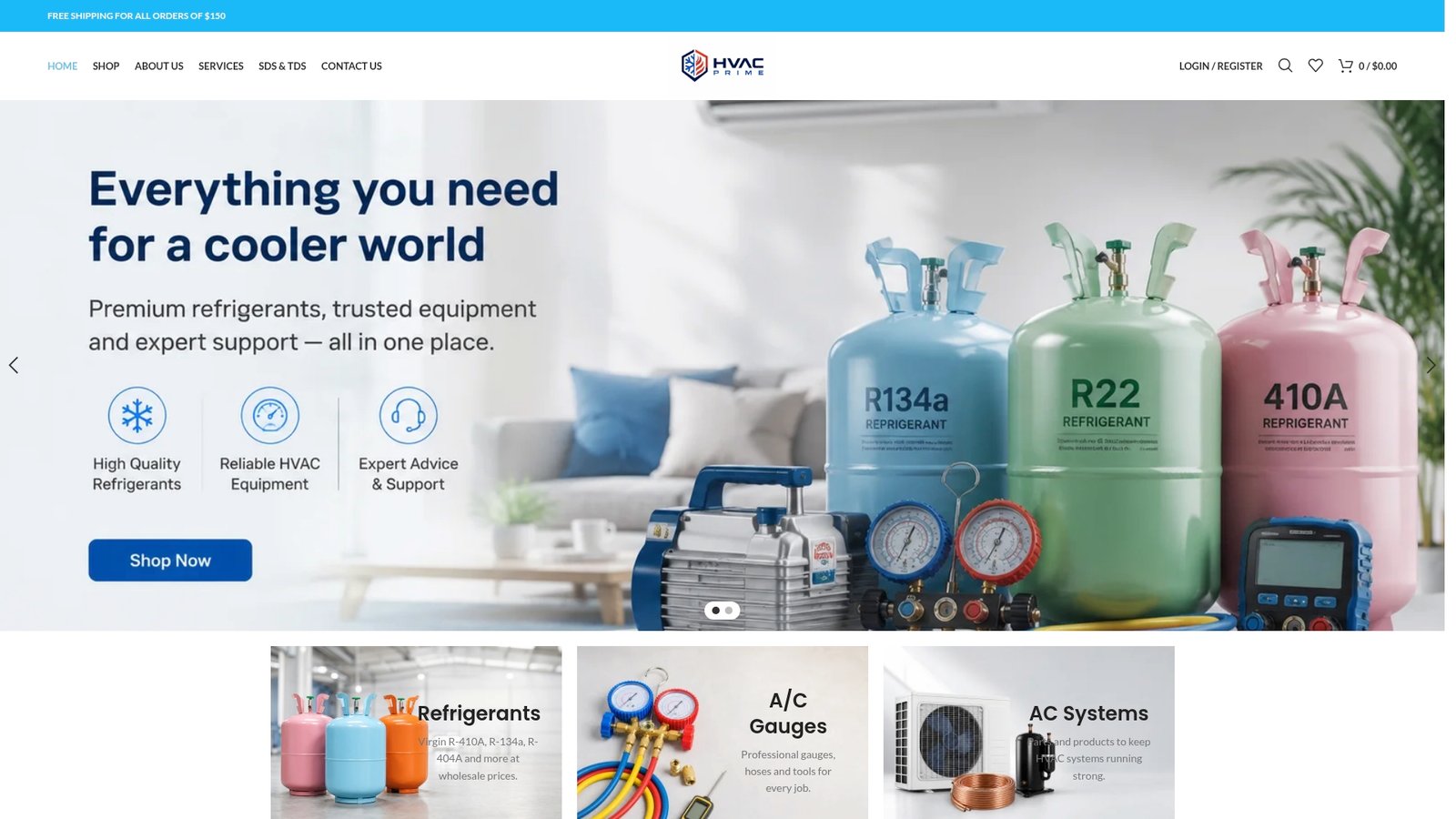
Every refrigerant purchase pairs with documentation you can actually use. HVAC Prime’s SDS and TDS download library keeps current sheets attached to the products it ships, so you’re not chasing down paperwork separately from the order itself. If you find a gap in your current SDS records while running the audit checklist above, that’s the moment to check whether your existing supplier still has a current sheet on file, and if they don’t, source your next cylinder somewhere that does. Browse the refrigerant catalog to compare what’s in stock, or head straight to the SDS downloads page to pull documentation for a product you already have on the shelf.




 HVAC
HVAC Automotive
 Refrigerant Diagnostics Kit
 Water Heaters