
R32 vs R410A: The Field Tech’s 2026 Comparison

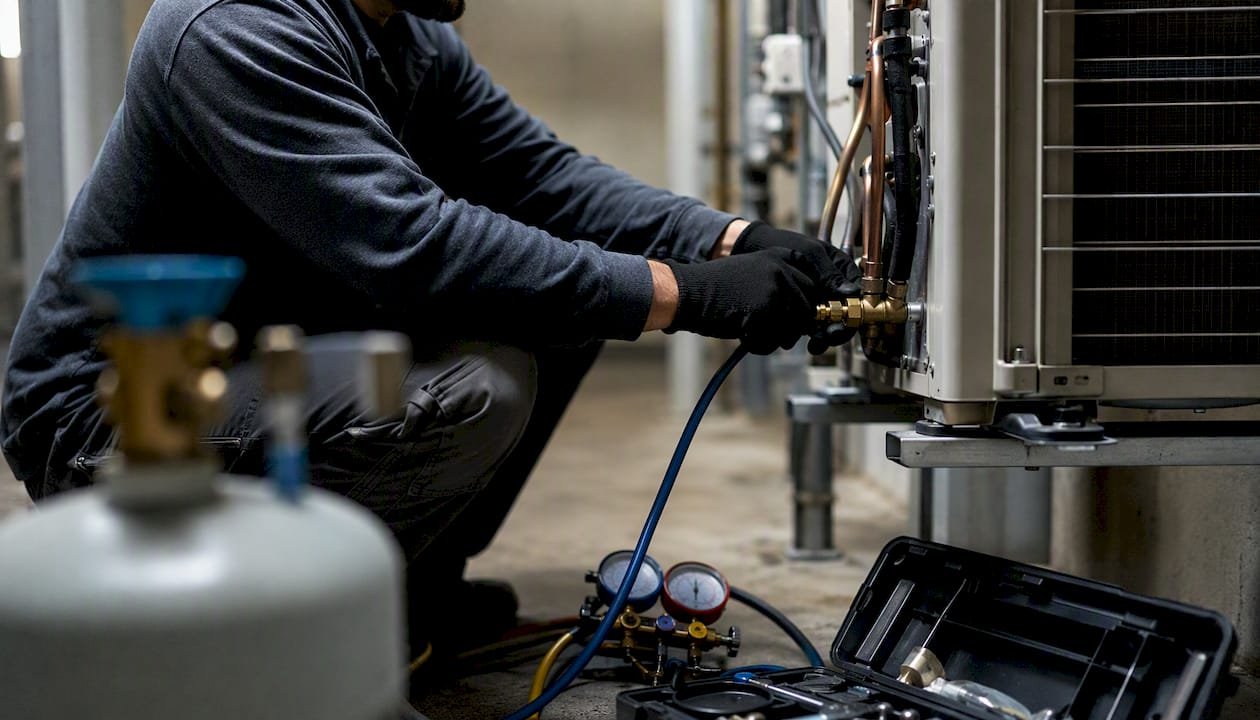
R-32 is the refrigerant you’ll find in virtually every new ductless mini-split and VRF system rolling off the line today; R-410A is what you’re servicing on legacy equipment that was manufactured before January 1, 2025. For new mini-split installs, spec R-32 and plan for A2L handling. For ducted unitary replacements, expect R-454B or R-452B, not R-32. See our R410A vs R454B and R454B vs R32 comparisons for that transition. For any existing R-410A system still under warranty or within its service life, keep servicing it with R-410A — a refrigerant swap is not an option.
- Regulatory bottom line: The AIM Act and EPA’s sub-700 GWP threshold ended new R-410A residential split system manufacturing after January 1, 2025. R-32 carries a 100-year GWP of 675 versus R-410A’s 2,088 — roughly a 68% reduction — which is why it clears the threshold and R-410A does not.
- Safety bottom line: R-32 is classified A2L (mildly flammable) under ASHRAE Standard 34; R-410A is A1 (nonflammable). That single difference changes your equipment requirements, brazing procedure, and leak detection protocol on every R-32 job.
- Service action today: Weigh in every R-32 charge using the nameplate factory charge plus the OEM’s ounces-per-foot line-set adder. Never retrofit R-410A equipment to R-32.
Key Takeaways
R-32 is the standard refrigerant for new mini-splits and VRF systems, requires A2L handling, and must be charged by weight — R-410A remains serviceable on existing equipment but cannot be retrofitted with R-32.
| Point | Details |
|---|---|
| GWP difference | R-32 GWP is 675 vs R-410A’s 2,088 — a 68% reduction that clears the EPA’s 700 GWP threshold. |
| A2L safety class | R-32 is A2L (mildly flammable); use A2L-rated recovery gear, no open flames, and ventilate the work area. |
| No retrofit allowed | R-32 is not a drop-in for R-410A — different safety class, higher discharge temps, and equipment listing requirements block any swap. |
| Charge by weight | R-32 mini-splits are critically charged; use nameplate factory charge plus OEM ounces-per-foot line-set correction. |
| Hvac-prime supply | Hvac-prime stocks virgin R-32 and R-410A cylinders with fast shipping and SDS/TDS downloads for A2L-ready service. |
Table of Contents
- How R32 and R410A compare: specs at a glance
- Thermodynamics and field performance: capacity, efficiency, and sizing
- Flammability, A2L handling, and what U.S. codes require from you
- How charging, oil, recovery, and service differ between R-32 and R-410A
- Where you’ll see R-32 vs R-410A in the field in 2026
- Is R-32 a drop-in for R-410A? The retrofit question answered
- Practical troubleshooting: reading pressures and temperatures on R-32 systems
- U.S. regulatory status and what it means for your service fleet
- Field decision checklist: which refrigerant to expect and what to do about it
- Hvac-prime has the refrigerants and tools you need for R-32 and R-410A service
- The part of the R-32 transition most techs are getting wrong
- Stock the right refrigerants before your next A2L call
- Sources
How R32 and R410A compare: specs at a glance
The table below covers the properties you actually need on the truck. Pressures are representative saturated values — always verify against the manufacturer’s PT chart for the specific unit.
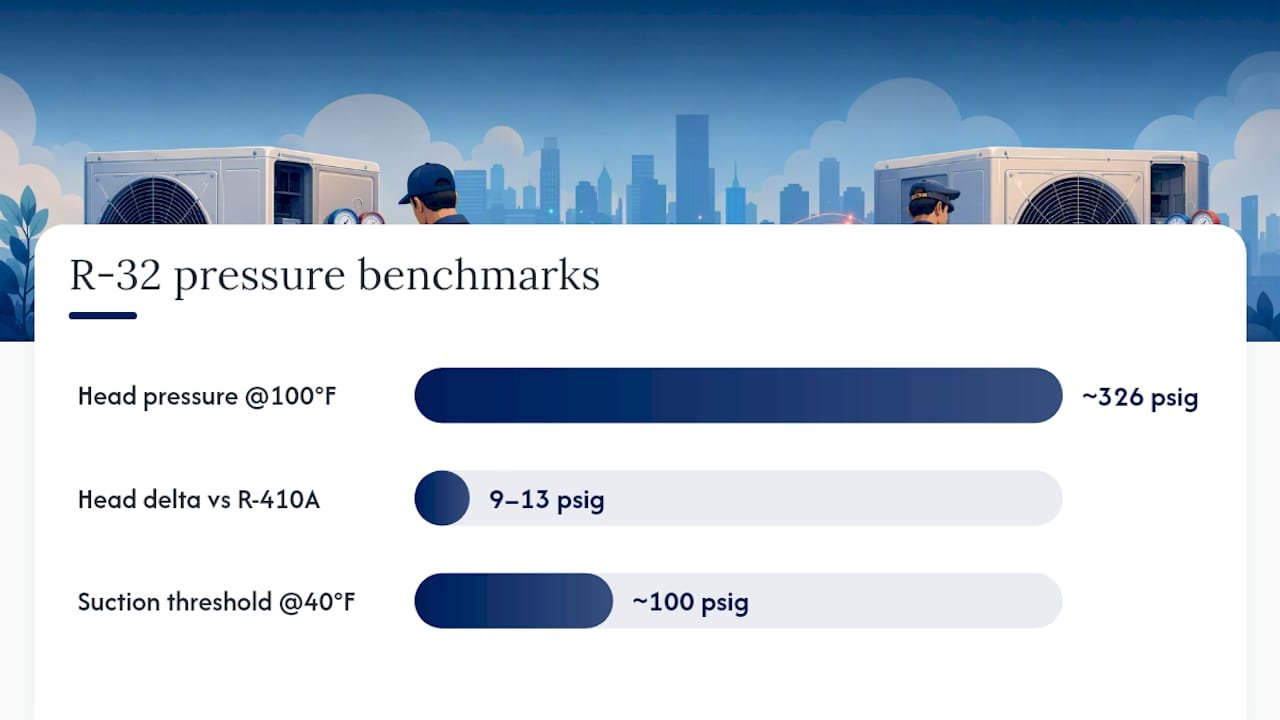
Suction pressure runs about 3 psig higher and head pressure about 9–13 psig higher on a healthy R-32 system compared to R-410A at the same operating conditions. That gap is normal. If you’re reading an R-32 system against R-410A baselines, you will misdiagnose it as overcharged or running hot — more on that in the diagnostics section.
The discharge temperature delta deserves its own callout. R-32’s higher heat of compression means compressor discharge routinely runs 15–30°F above what you’d see on a comparable R-410A unit. Manufacturers account for this with inverter discharge limits and sometimes vapor/liquid injection, so a hot discharge reading is not automatically a condemned compressor. Check the OEM protection thresholds first.
Thermodynamics and field performance: capacity, efficiency, and sizing
R-32 is a single-component refrigerant, which gives it a higher volumetric refrigerating capacity than R-410A at the same displacement. In practical terms, a compressor sized for R-410A can deliver more cooling capacity when running R-32 — or the same capacity from a physically smaller compressor. That’s why mini-split manufacturers have been able to shrink outdoor units while maintaining or improving rated capacity.
When equipment is designed specifically for R-32, SEER and COP gains typically translate to measurable lifecycle energy savings in the 10–20% range compared to equivalent R-410A systems. That’s not a drop-in improvement — it requires the system to be engineered for R-32 from the ground up, with matched heat exchangers, expansion devices, and compressor protection maps.
Field implications worth knowing:
- Higher volumetric capacity helps in high-ambient conditions where R-410A systems lose capacity faster. R-32 systems tend to hold capacity better at elevated outdoor temperatures, which matters in the South and Southwest.
- Inverter-driven compressors largely offset the discharge temperature concern by modulating speed before hitting protection limits. On fixed-speed compressors, discharge temp management is more critical.
- In extreme cold, both refrigerants face similar low-suction-pressure challenges, but R-32’s higher latent heat gives it a slight edge in heat pump heating mode.
- A system optimized for R-410A running R-32 as a “drop-in” will not deliver these efficiency gains and may trigger high-discharge protection trips. The efficiency advantage belongs to purpose-built R-32 equipment only.
Consider two otherwise identical 18,000 BTU mini-splits — one factory-charged with R-32, one with R-410A. Over a typical U.S. cooling season, the R-32 unit in an optimized design is likely to consume less energy, with the gap widening in high-ambient climates. The R-410A unit isn’t inefficient; it’s just running on a refrigerant whose thermodynamic properties weren’t the design target.
Flammability, A2L handling, and what U.S. codes require from you
“Mildly flammable” sounds like a minor footnote. It isn’t. ASHRAE Standard 34’s A2L classification means R-32 has a lower flammability limit and a maximum burning velocity under 10 cm/s — it won’t ignite easily, but it can under the right conditions. That classification drives equipment listing requirements, installation codes, and your on-site procedures.
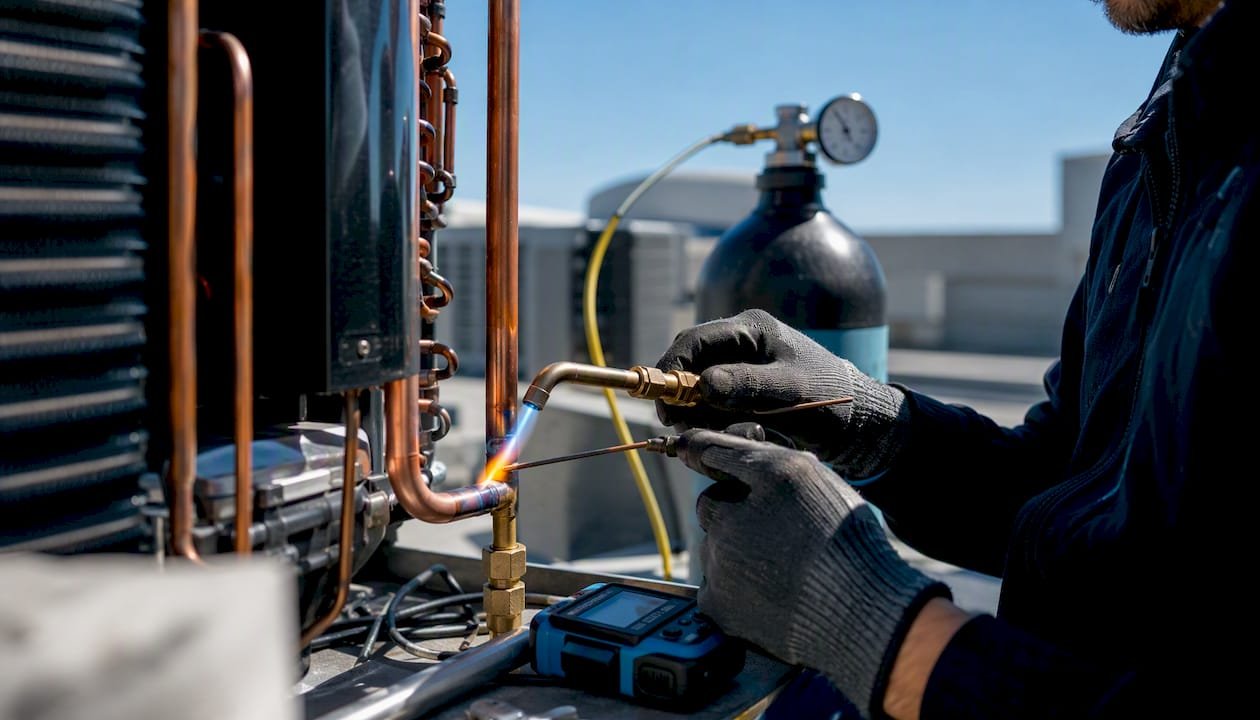
Under current U.S. standards, A2L refrigerants require equipment that is specifically listed and labeled for A2L use. UL and other listing bodies have updated their standards accordingly, and the EPA’s AIM Act regulatory framework has pushed this transition forward. You cannot install R-32 in equipment that was designed and listed only for A1 refrigerants.
On-site safety checklist for A2L work:
- Verify the equipment nameplate confirms A2L listing before beginning any service.
- Use only A2L-rated recovery cylinders and recovery machines — standard R-410A recovery equipment may not meet the rating.
- No open flames near the work area during leak testing or pressurization. Use nitrogen for pressure testing, not refrigerant.
- When brazing: recover the charge fully, evacuate the system, and purge with dry nitrogen before applying heat. Never braze on a pressurized or refrigerant-containing system.
- Use a combustible gas leak detector rated for A2L refrigerants. Standard halide torches are not appropriate.
- Place leak sensors low — R-32 is slightly heavier than air and will pool at floor level in an enclosed space.
- Ventilate the work area before and during service. A rule of thumb from industry guidance: ensure air changes adequate to prevent accumulation above the lower flammability limit, which for R-32 is approximately 14.4% by volume.
Pro Tip: Download the SDS for R-32 before the job and keep it accessible on site. The SDS contains the LFL, ventilation requirements, and first-aid procedures specific to R-32 — information that matters if something goes wrong.
For line-set routing through walls and floors, proper penetration sealing is part of A2L compliance. Refrigerant line penetrations through occupied spaces need to be sealed to prevent accumulation in the event of a leak — a consideration that also affects ductwork and air-duct penetration planning on multi-floor installations.
How charging, oil, recovery, and service differ between R-32 and R-410A
The biggest practical difference between servicing R-32 and R-410A equipment is how you charge it. R-32 mini-splits are critically charged — the factory charge is precisely calculated for the unit’s internal volume, and the line-set length adds a small correction. Superheat and subcooling readings are verification tools, not the primary charging method.
Step-by-step R-32 leak repair and recharge workflow:
- Confirm the refrigerant type on the nameplate. Never assume.
- Recover the full charge into an A2L-rated recovery cylinder using A2L-compatible recovery equipment.
- Locate and repair the leak. Replace the filter-drier.
- Pressure-test with dry nitrogen to the OEM’s specified test pressure.
- Evacuate to 500 microns or lower, holding for at least 15 minutes to confirm no moisture or leak.
- Weigh in the factory charge from the nameplate, then add the OEM’s ounces-per-foot correction for the actual line-set length.
- Verify in the manufacturer’s test/service mode — most R-32 mini-splits have a diagnostic mode that confirms operating parameters.
- Check discharge temperature and suction pressure against the OEM PT chart, not an R-410A chart.
Key service differences to keep in mind:
- Both R-32 and R-410A use POE oil, so an oil change between these two refrigerants is rarely required. Follow OEM guidance — some manufacturers specify a flush if the system has been contaminated or if the compressor was replaced.
- Filter-drier ratings matter. Confirm the replacement drier is rated for A2L service and the correct refrigerant.
- R-32 is a single-component refrigerant with zero temperature glide, which means you read one column on the PT chart — no bubble/dew distinction. R-410A is near-azeotropic and also reads as a single column in practice, but blended A2L alternatives like R-454B require separate bubble and dew point readings. Get comfortable with that distinction now.
- Blended refrigerants like R-454B must be charged as a liquid to prevent fractionation. R-32, being single-component, does not fractionate — vapor charging for minor top-offs is technically permissible, though weigh-in remains the standard practice for critically charged systems.
- Never vent refrigerant. A2L or not, venting is a federal violation under Section 608 of the Clean Air Act.
Where you’ll see R-32 vs R-410A in the field in 2026
The split is fairly clean by equipment category. Ductless mini-splits and multi-zone VRF systems — both residential and light commercial — have moved almost entirely to R-32. If you’re pulling a mini-split job today, assume R-32 unless the nameplate says otherwise. Older units installed before 2023 or so may still be R-410A, but new stock from virtually every major manufacturer is R-32.
Ducted unitary equipment — central air conditioners, heat pumps, packaged rooftop units — tells a different story. U.S. manufacturers largely chose R-454B and R-452B for this category, partly because those blends work better with existing compressor and heat exchanger designs optimized for R-410A pressures. R-32 is less common in ducted unitary equipment sold in the U.S., even though it dominates globally.
Field inventory and nameplate advice:
- Always read the nameplate before opening the service valves. The refrigerant type, factory charge weight, and line-set correction factor are all there.
- Check the manufacture date. Equipment made before January 2025 is almost certainly R-410A for ducted systems; mini-splits from 2022 onward are increasingly R-32.
- Stock R-32 cylinders and R-410A cylinders separately and clearly labeled. Mixing them up on a job is a serious mistake.
- For VRF service, check the system controller or outdoor unit nameplate — multi-zone systems often carry a larger total charge and the line-set correction can be significant.
- Warranty implications: using the wrong refrigerant voids the OEM warranty immediately and can damage the compressor within hours.
Is R-32 a drop-in for R-410A? The retrofit question answered
No. R-32 is not a drop-in replacement for R-410A, and attempting a retrofit creates real safety and performance problems.
The reasons are layered. First, R-32 is A2L — equipment listed only for A1 refrigerants is not approved for R-32 service, full stop. Second, R-32’s higher discharge temperature will push an R-410A-designed compressor beyond its protection limits, causing repeated trips or premature failure. Third, the system’s expansion device, metering orifice, and refrigerant circuit were sized for R-410A’s specific thermodynamic properties. Running R-32 through that circuit changes capacity, pressures, and oil return in ways the OEM did not validate.
Decision criteria for replacement vs. continued R-410A service:
- Equipment under 10 years old with a repairable leak and no compressor damage: continue R-410A service. R-410A remains legal for servicing existing equipment with no current end date.
- Equipment over 15 years old, or with a failed compressor, or where the repair cost exceeds 50% of replacement: recommend full system replacement with new A2L-listed equipment.
- Equipment between 10–15 years: factor in the owner’s plans, energy costs, and whether the system is a central unit or a mini-split. A mini-split in that age range may still have useful life; a central system approaching end-of-life is a stronger replacement candidate.
- Any system where the owner asks about “upgrading to R-32”: explain that this requires replacing the entire system, not just the refrigerant.
Other replacement refrigerants to know:
- R-454B is the dominant choice for new ducted unitary equipment in the U.S. It’s a blend (A2L), requires liquid charging to avoid fractionation, and has a GWP of approximately 466. When comparing r32 vs r454b, R-32 has simpler charging (no fractionation risk) but R-454B is more common in ducted applications.
- R-452B is used by some manufacturers in unitary equipment and has similar handling requirements to R-454B.
- Never mix refrigerants. A cylinder or system with mixed refrigerants is a contaminated charge — it cannot be identified, cannot be properly charged, and must be recovered and disposed of properly.
Practical troubleshooting: reading pressures and temperatures on R-32 systems
The most common misdiagnosis on R-32 equipment is calling a normal system “overcharged” or “running hot” because the tech compared readings to R-410A baselines. Elevated head pressure is a normal characteristic of a healthy R-32 system — head pressure runs about 9–13 psig higher than R-410A at the same condensing temperature, and discharge temperature runs 15–30°F hotter.
Diagnostic checklist for common R-32 symptoms:
- High head pressure complaint: First confirm you’re reading the R-32 PT chart. At 100°F condensing, ~326 psig is normal for R-32. If head exceeds that by more than 10–15 psig, look for airflow restriction, dirty condenser coil, or non-condensables.
- High discharge temperature trip: Check the OEM’s protection threshold — many R-32 inverter units protect at 230–250°F discharge. A trip near that threshold on a hot day with a clean system may be a normal protection event, not a compressor fault. Verify ambient conditions and airflow before condemning the compressor.
- Low capacity complaint: Check suction pressure against the R-32 PT chart at the actual coil temperature. Low suction on R-32 (~below 100 psig at a 40°F coil) suggests undercharge or airflow restriction — same diagnostic logic as R-410A, just different numbers.
- Apparent undercharge after recent service: Confirm the weigh-in was done correctly with the line-set correction applied. A 1-pound error on a critically charged mini-split causes significant capacity loss.
PT chart reading for R-32 vs blends:
R-32 is single-component with zero glide, so the PT chart has one column — saturated temperature maps directly to pressure. This simplifies superheat and subcooling calculations compared to blends that require separate bubble and dew point readings. For R-454B or R-452B, you need the correct column (bubble for liquid line, dew for suction line) — using the wrong column gives you a false superheat reading.
Pro Tip: Use a clamp-on discharge temperature probe on the compressor discharge line, within 6 inches of the compressor outlet, and compare to the OEM’s published protection threshold. If the system is tripping on high discharge but the reading is within 10°F of the threshold on a 95°F+ ambient day, the protection system is doing its job. Log the ambient temp, suction pressure, and discharge temp together — that data set tells the story.
U.S. regulatory status and what it means for your service fleet
The AIM Act gave the EPA authority to phase down HFC refrigerants based on GWP, and the practical result for the HVAC industry is a hard line at 700 GWP for new residential split system manufacturing. New R-410A split systems stopped being manufactured for the U.S. market after January 1, 2025. Servicing existing R-410A equipment with reclaimed or virgin R-410A remains legal with no announced end date — but supply will tighten as production winds down and reclaim becomes the primary source.
R-32’s GWP of 675 clears the 700 threshold; R-410A’s 2,088 does not. That single number explains the entire manufacturer migration. The EPA’s GWP framework uses 100-year global warming potential values to set these thresholds, and the industry has been building toward this transition since the AIM Act passed in 2020.
Regulatory and stocking bullets for service fleets:
- R-410A is still legal to purchase, sell, and use for servicing existing equipment. Stock it, but recognize that supply will become less predictable over the next several years as production declines.
- New equipment you install today will be R-32 (mini-splits/VRF) or R-454B/R-452B (ducted unitary). Your recovery and service gear must be A2L-rated for all of these.
- Prioritize purchasing A2L-rated recovery machines and cylinders now. Lead times on specialty equipment can stretch during high-demand periods.
- Keep a working inventory of HFC refrigerants for legacy service, but build your A2L toolkit in parallel.
- Recovery cylinders for A2L refrigerants must be specifically rated for flammable refrigerants — standard DOT cylinders used for R-410A are not always acceptable. Verify before use.
A practical stocking rule for 2026: maintain enough R-410A for your current service contract load, but don’t over-buy. Prioritize A2L recovery gear, A2L-rated leak detectors, and a working inventory of R-32 cylinders for mini-split work. Emergency delays on new-refrigerant jobs are avoidable with modest forward stocking.
Field decision checklist: which refrigerant to expect and what to do about it
Use this sequence on every job before you open a valve or pull a gauge.
Step-by-step decision process:
- Read the nameplate. Refrigerant type, factory charge weight, and line-set correction are all there. If the nameplate is missing or illegible, get the model number and pull the OEM service manual before proceeding.
- Identify the equipment category. Mini-split or VRF? Expect R-32 on anything manufactured after 2022. Ducted split or packaged unit? Expect R-410A on pre-2025 equipment, R-454B or R-452B on new.
- Confirm A2L or A1 status. If the nameplate or service manual says A2L, your A2L safety protocol is active from this point forward — ventilation, no open flames, A2L recovery gear.
- Check warranty and age. Equipment under 10 years old with a repairable fault: service it with the correct refrigerant. Equipment over 15 years old or with a failed compressor: present the replacement case to the owner.
- Assess regulatory forward-compatibility. If the owner is considering a system upgrade, new equipment will be A2L regardless of category. Factor that into the conversation.
- Make the call. Service with correct refrigerant, or recommend replacement with A2L-listed equipment.
Cylinder and gauge inventory for the truck:
- Carry R-32 and R-410A cylinders separately, clearly labeled, in compliant storage.
- A2L-rated manifold gauges or digital gauge sets — verify they are rated for A2L refrigerants before using on R-32 systems.
- A2L-rated recovery machine and dedicated recovery cylinders for R-32.
- Combustible gas leak detector rated for A2L refrigerants.
- A calibrated scale accurate to ±0.1 oz for weigh-in charging.
For customer conversations on R-410A systems:
- Continued service is appropriate when the system is functional, within service life, and the repair is cost-effective.
- Recommend replacement when the repair cost is high, the system is aging, or the owner wants improved efficiency — new A2L equipment will deliver better SEER ratings and lower GWP.
- Be clear that “switching to R-32” means a full system replacement, not a refrigerant swap. Set that expectation early.
Hvac-prime has the refrigerants and tools you need for R-32 and R-410A service
Hvac-prime stocks virgin R-32, R-410A, and other refrigerants at wholesale prices, with fast shipping to HVAC contractors and service businesses across the United States. Whether you’re stocking up for a mini-split season or maintaining a legacy R-410A service load, you can order the right cylinders without the markup or the wait.
Beyond refrigerant cylinders, Hvac-prime carries professional HVAC tools including gauges, vacuum pumps, and refrigerant diagnostics kits suited for both A1 and A2L service work. Safety documentation is available directly: download SDS and TDS files for R-32, R-410A, and other refrigerants before your next job.
Products relevant to this article:
- Virgin R-32 cylinders (mini-split and VRF service)
- Virgin R-410A cylinders (legacy equipment service)
- A2L-rated recovery cylinders and service tools
- Manifold gauge sets and digital gauges
- Vacuum pumps and refrigerant diagnostics kits
Place your order at Hvac-prime and get the refrigerants and tools on the truck before the next call comes in.
The part of the R-32 transition most techs are getting wrong
The refrigerant transition conversation in the U.S. has been dominated by GWP numbers and regulatory deadlines, and that framing has left a lot of technicians underprepared for what actually changes on the job. The number that matters most isn’t the GWP — it’s the A2L classification, and specifically what it demands from your recovery equipment, your brazing procedure, and your leak detection setup.
Most of the field mistakes happening right now aren’t about charging the wrong amount. They’re about techs using R-410A recovery cylinders on R-32 systems, brazing without a full nitrogen purge, or diagnosing a healthy R-32 system as overcharged because the head pressure looks high against an R-410A baseline. Those are process failures, not knowledge failures — the information is available, but the habits haven’t caught up.
The other thing worth saying plainly: the efficiency advantage of R-32 is real, but it belongs to purpose-built equipment. A tech who tells a customer their new mini-split will be dramatically more efficient than their old R-410A unit is telling the truth — but only because the new unit was engineered for R-32 from the compressor up. The refrigerant itself isn’t magic. The engineering around it is what delivers the SEER improvement.
For service fleets, the practical priority right now is tooling, not refrigerant inventory. Get the A2L-rated recovery machine. Get the combustible gas detector. Get comfortable reading R-32 PT charts before you’re standing in front of a system you’ve never serviced. The refrigerant transition is already here — the equipment is in the field, and the next call might be an R-32 job whether you’re ready or not.
Stock the right refrigerants before your next A2L call
Sourcing R-32 and R-410A at the last minute costs you time and margin. Hvac-prime gives HVAC contractors direct access to wholesale-priced virgin refrigerant cylinders — R-32 for mini-split and VRF work, R-410A for legacy service calls — with fast shipping across the United States.
The product range covers what A2L service actually requires: virgin R-32 cylinders, R-410A cylinders, and professional-grade HVAC tools including gauges and vacuum pumps rated for A2L work. Safety documentation is one click away — download SDS and TDS files for any refrigerant before the job starts.
Browse the full refrigerant catalog at Hvac-prime and place your order today — so the right cylinder is on the truck when the call comes in.
Sources
Primary sources worth bookmarking for PT tables, regulatory text, and OEM guidance:




 HVAC
HVAC Automotive
 Refrigerant Diagnostics Kit
 Water Heaters