
Vacuum Pump Sizing: How to Pick the Right CFM and Stage

For most HVAC service work, pick a two-stage vacuum pump rated at 4 to 8 CFM and pull the system to 500 microns, tightening that to 250 to 500 microns on humid days or on POE-oil systems that grab moisture fast. Step up to a 10 to 12+ CFM pump, or run two pumps in tandem, when your route is heavy with large commercial jobs rather than residential splits and mini-splits. If you’re stocking a truck right now, the Bolton 7 CFM Dual-Stage HVAC Vacuum Pump sold through Hvac-prime sits right in that sweet spot.
- CFM range: 4 to 8 CFM covers a large majority of residential and light commercial jobs.
- Pump stage: Two-stage, non-negotiable for anything beyond a rough vacuum.
- Target vacuum: 500 microns standard, 250 to 500 microns for humid or POE-oil systems.
- Step-up trigger: Frequent work above 15 tons or long line sets calls for 10 CFM or higher.
Key Takeaways
Correct vacuum pump sizing means matching CFM to system tonnage, requiring a two-stage design, and verifying dryness with a micron gauge and decay test rather than pump run time.
| Point | Details |
|---|---|
| Match CFM to tonnage | Use 2 to 4 CFM for small systems, 4 to 6 CFM for most residential and light commercial work, and 8 to 10+ CFM for large commercial jobs. |
| Two-stage pumps are required | Single-stage pumps rarely reach the deep vacuums HVAC evacuation demands under real field conditions. |
| Target 500 microns, tighten for humidity | Drop to 250 to 500 microns on humid days or POE-oil systems that absorb moisture quickly. |
| Verify with decay testing | Isolate the system and watch for rise over 10 to 15 minutes instead of trusting pump run time alone. |
| Bench-test pumps regularly | A healthy two-stage pump should pull below roughly 50 microns quickly on the inlet alone. |
| Source pumps and accessories together | Hvac-prime stocks the Bolton 7 CFM dual-stage pump along with the gauges, hoses, and CRTs needed to make it perform. |
Table of Contents
- Vacuum Pump Sizing Guidelines By System Tonnage
- Which Pump Features Actually Matter On The Job
- Best Practices For A Verified Dry Evacuation
- How Do You Tell A Pump Problem From A Leak?
- What A Contractor’s Vacuum Pump Kit Should Actually Look Like
- Where To Get The Pump And Accessories You Just Sized
- Sources
Vacuum Pump Sizing Guidelines By System Tonnage
Sizing a pump isn’t guesswork once you match it to the tonnage or line-set volume you’re actually pulling on. Use these bands as your starting point, then adjust for line length and how wet the system is.
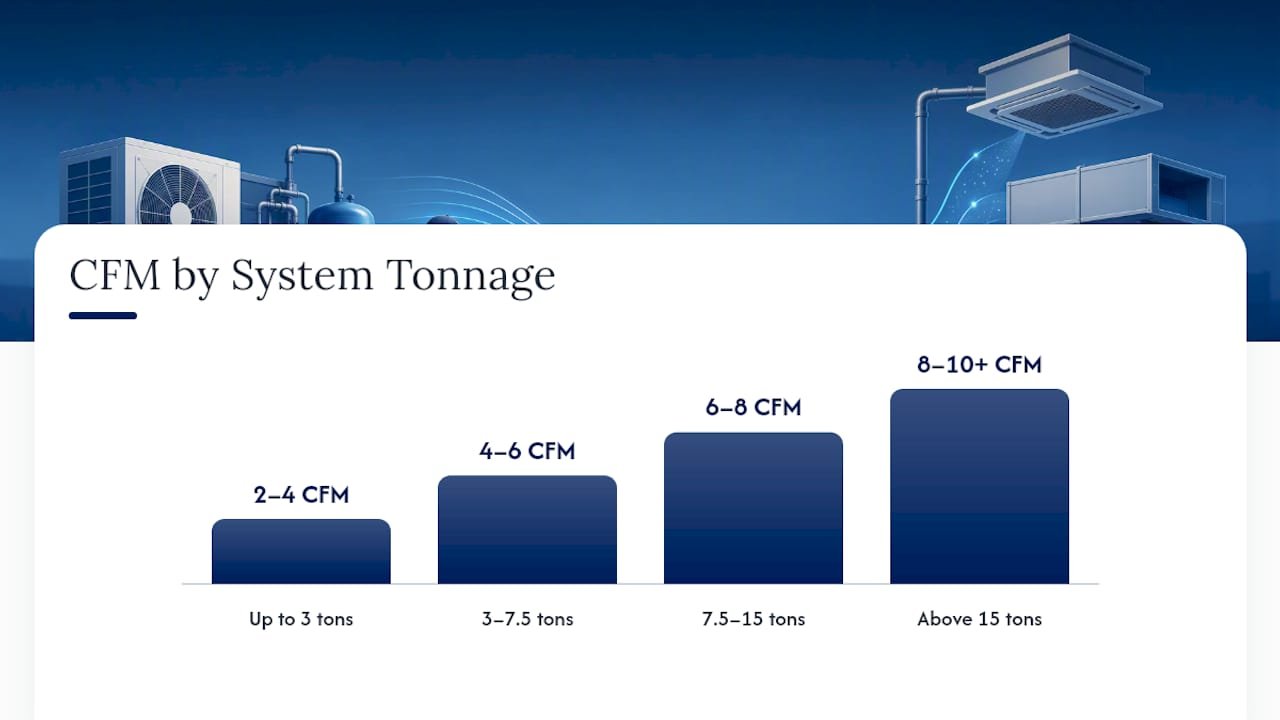
- Up to 3 tons: 2 to 4 CFM handles most residential splits and window units.
- 3 to 7.5 tons: 4 to 6 CFM is the versatile choice contractors reach for across mixed residential and light commercial calls, a range HVAC OLink’s guidance calls the practical sweet spot for this segment.
- 7.5 to 15 tons: 6 to 8 CFM keeps pump-down times reasonable on rooftop units and larger split systems.
- Above 15 tons: 8 to 10+ CFM, or a second pump running in parallel, prevents all-day evacuations on large commercial systems.
Pro Tip: Evacuation time roughly follows the formula: circuit volume divided by pump flow rate, multiplied by an evacuation factor of 3 to 5 to account for moisture and geometry, according to evacuation testing guidance from 3G Electric. A 5-ton system with a 6 CFM pump might pull down in 30 to 45 minutes on a dry, well-sealed system, but stretch to 60 to 90 minutes if there’s residual moisture or a long line set.
Oversizing costs you twice: a bulky 10 CFM pump you drag to every mini-split job adds weight to the van and money to the invoice for capacity you never use. Undersizing costs you differently, in billable hours lost to pumps straining to reach 500 microns on a 12-ton rooftop unit. When your book of business skews heavily toward larger commercial refrigeration work, running two pumps or a single higher-CFM unit pays for itself within a few jobs.
Which Pump Features Actually Matter On The Job
CFM gets the attention, but the features around it decide whether a pump earns its keep on a service truck for years or gets replaced after one bad season.
- Two-stage design: Reaches deeper ultimate vacuum and pulls down faster than single-stage units, which often stall out at a rough vacuum in field conditions rather than the lab-tested depths manufacturers advertise, per ARC’s evacuation standards guidance.
- Gas ballast: Opens a controlled air bleed into the pump to protect oil from water contamination during wet, moisture-heavy jobs. Use it on the initial rough pull, then close it for the final deep vacuum stage.
- Anti-suck-back valve: Stops oil from getting pulled backward into the refrigerant lines when the pump shuts off, protecting the system you just cleaned out.
- Oil sight glass: Lets you check oil color and level without opening the pump, which matters more than most technicians assume.
Pro Tip: Battery-powered pumps trade some runtime and CFM for freedom from generator hassle on rooftop and crawlspace jobs with no outlet nearby. If your route includes those sites, the convenience often outweighs the lighter output.
Best Practices For A Verified Dry Evacuation
Hardware only gets you halfway. The workflow around it determines whether the system actually comes out dry, and this is where most callbacks originate.
- Connect direct, not through the manifold. Manifold gauge sets restrict flow and give inaccurate readings, so run short, large-diameter vacuum-rated hoses straight from the pump to the system, as recommended in ACHR News’s evacuation procedure guide.
- Pull the Schrader cores. Core removal tools (CRTs) eliminate the single biggest flow restriction in a standard service port, cutting evacuation time significantly on tight schedules.
- Choose deep vacuum or triple evacuation based on the job. A clean new install with dry nitrogen purge during brazing usually only needs a single deep pull to 500 microns. A wet system, an old compressor burnout, or anything opened to atmosphere for more than a few minutes calls for triple evacuation: pull down, break with dry nitrogen, pull down again, twice more.
- Read the micron gauge correctly. Connect it directly to the system, not the pump outlet, and watch the rate of descent as much as the final number. A system that stalls at 1,500 microns for 20 minutes has moisture or a leak, not a pump problem.
- Run the decay test. Isolate the system by closing the valve to the pump, shut the pump off, and watch the rise over 10 to 15 minutes. Evacuation quality is verified through this standing vacuum check, not by how long the pump ran, a point Compressors Unlimited makes central to commercial evacuation work.
A rise to under 500 microns and holding steady means you’re dry. A slow, steady climb past that into the thousands usually points to moisture still boiling off; a fast climb points to a leak. Humidity swings these numbers more than most technicians expect, which is exactly why the 500-micron standard tightens to 250 to 500 microns on humid days or POE-oil systems.
How Do You Tell A Pump Problem From A Leak?
Slow pull-downs aren’t always the pump’s fault, and guessing wrong wastes a truck roll. A quick bench test settles it before you blame the wrong component.
- Isolate the pump alone and connect a micron gauge directly to its inlet. A healthy two-stage pump should pull below about 50 microns quickly.
- If it stalls well above that, suspect contaminated oil, an open gas ballast valve left on by mistake, or worn internal seals.
- Cloudy, milky, or dark oil is your first visual clue. Change it before the next job, not after three more slow pull-downs.
- If the system itself shows a slow rise during decay testing after the pump checks out clean, the problem is moisture or a leak, not the equipment, and calls for triple evacuation or a line-drier rather than a bigger pump.
Pro Tip: Bench-test every pump before it goes back in the truck, not just when a job goes sideways. Five minutes with a micron gauge on the inlet catches a failing pump before it costs you a callback.
Pumps that consistently fail this bench test, even after an oil change, are worth replacing rather than servicing again. A rebuild kit on a pump already several years into daily use rarely restores the deep vacuum performance you’re paying for.

What A Contractor’s Vacuum Pump Kit Should Actually Look Like
If your work mixes residential splits with the occasional light commercial job, a two-stage 4 to 6 CFM pump covers nearly everything you’ll touch, and it’s light enough that you won’t dread hauling it up a ladder. Add a second, higher-CFM pump only once commercial calls become a real chunk of your schedule rather than an occasional exception. Spend more of your budget on the micron gauge and hoses than the pump itself. That’s usually where slow, inaccurate evacuations actually come from. A battery model earns its place on any route with crawlspaces or rooftops lacking outlets. Hvac-prime keeps pumps, gauges, and refrigerant in stock together, which matters when a bad evacuation eats into your afternoon and you can’t afford a parts run.
— Planet
Where To Get The Pump And Accessories You Just Sized
Once you’ve settled on a CFM band, the next question is whether you can actually get that pump, the right hose, and a working micron gauge before your next job starts. Hvac-prime stocks professional two-stage pumps including the Bolton 7 CFM Dual-Stage HVAC Vacuum Pump, alongside the micron gauges, 3/8-inch vacuum-rated hoses, and core removal tools that determine whether that pump actually performs in the field.
A sensible starting bundle for a technician building or replenishing a kit: a two-stage pump sized to your typical tonnage, a micron gauge, a short large-diameter vacuum hose, a CRT, and a bottle of vacuum pump oil for the changes a busy season demands. Browse the full lineup of professional HVAC tools for the gauges and hoses that round out the kit, or check HVAC tools for replacement parts and accessories. When the evacuation is done and it’s time to recharge, Hvac-prime’s refrigerant catalog ships fast enough that a dry, verified system doesn’t sit idle waiting on product. Place your pump and accessory order today and have your kit complete before your next scheduled job.
Sources
- Why evacuation quality matters more than vacuum time in commercial HVAC systems (Compressors Unlimited)
- How to properly evacuate refrigerant (ACHR News)
- How to choose the perfect HVAC vacuum pump (HVAC OLink guidance)




 HVAC
HVAC Automotive
 Refrigerant Diagnostics Kit
 Water Heaters