
Stop Fill Line Failures: DOT Cylinder Requalification for Propane Pros

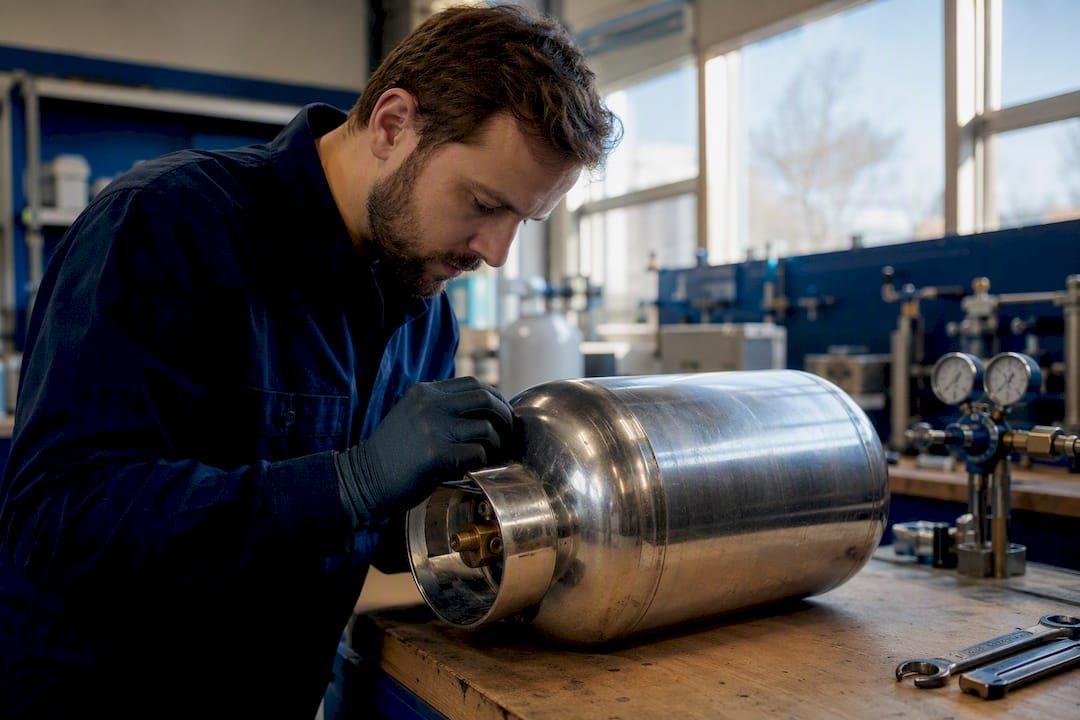
DOT-specification cylinders used in commerce must be periodically requalified under 49 CFR Part 180, with intervals set by §180.209 and tied to the cylinder’s specification marking. The main authority is PHMSA, and inspection methods must follow CGA and ISO standards. Before you fill or offer any cylinder, check the stamped date and RIN, confirm it against the PHMSA RIN locator, and hold anything past its documented due month.
TL;DR:
- Most cylinders require requalification every five to twelve years, depending on the DOT specification and whether hydrostatic testing or visual inspection is used.
- Requalification must be performed by an PHMSA-approved facility with a unique RIN, and all records, including requalification date and method, must be maintained diligently.
- Visual-only inspection requires registration and compliance with CGA standards, with follow-up inspections every five years, unlike hydrostatic testing schedules.
- Cylinders with expired requalification stamps must not be filled or transported and should be routed immediately to an approved requalifier for testing.
- Proper marking, recordkeeping, and chain of custody are essential to ensure safety and compliance, preventing liability from incorrect cylinder requalifications.
Table of Contents
- What DOT Cylinder Requalification Actually Requires Right Now
- Authorized Requalification Methods And The Standards Behind Them
- Who Can Legally Requalify A Cylinder
- How Often Cylinders Need Requalification And How To Mark Them
- What Happens When A Cylinder Fails Requalification
- Finding An Approved Requalifier And Applying For A RIN
- Field Habits That Keep Requalification Programs Clean
- What Rigorous Requalification Actually Protects
- Keeping Your Fill Station Stocked While Cylinders Cycle Through Testing
- Sources
What DOT Cylinder Requalification Actually Requires Right Now
Compliance staff need a fast way to sort compliant cylinders from ones that need attention before they touch a filling line. Run through this before every batch:
- Check the cylinder’s stamped date, Requalification Identification Number (RIN), and DOT spec marking before connecting it to anything.
- Match the cylinder against its service history to determine whether it’s due for hydrostatic testing, visual-only inspection, or another authorized method.
- If the stamp shows an expired interval, stop. Do not fill it or offer it for transport. Route it to an approved requalifier immediately.
- Log chain of custody the moment a cylinder leaves your site for testing, including who shipped it, when, and to which RIN holder.
Pro Tip: Keep a printed or laminated marking reference near the fill station. Techs under time pressure misread stamped dates more often than you’d expect, especially on older cylinders with worn or overlapping markings.
Authorized Requalification Methods And The Standards Behind Them
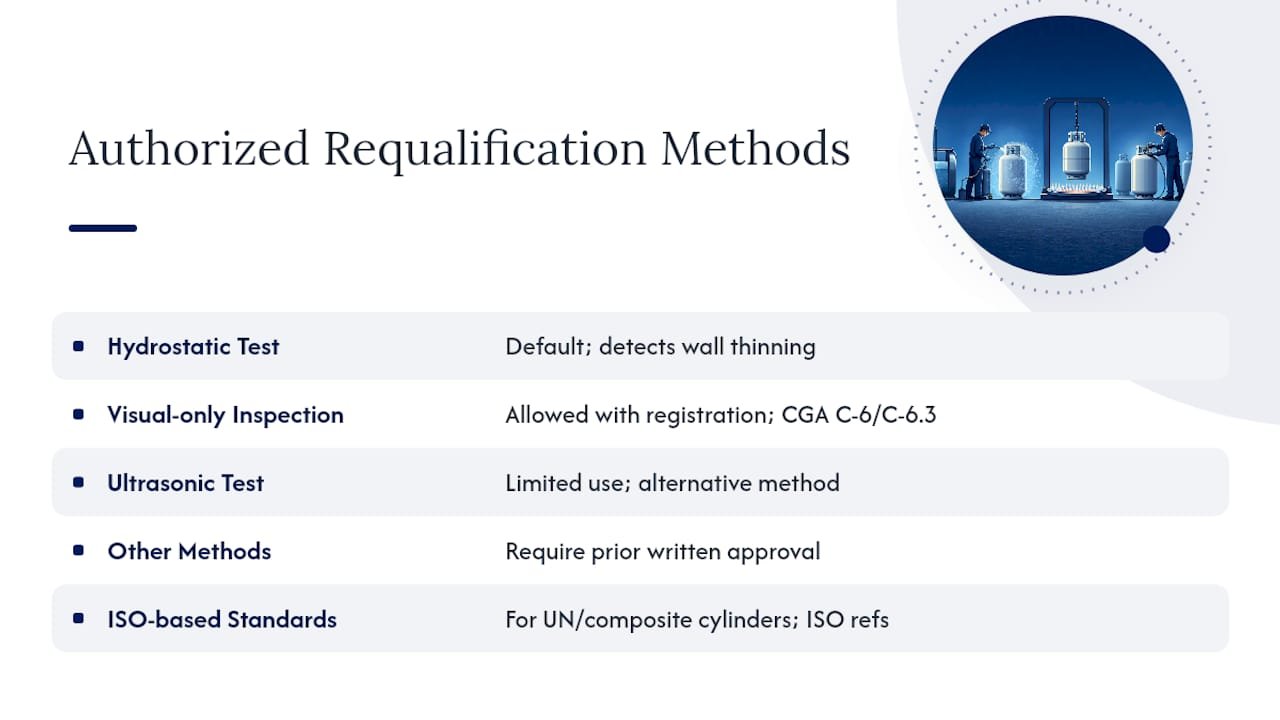
DOT recognizes a handful of test methods, and which one applies depends on the cylinder’s specification, size, and service history. Getting this wrong isn’t a paperwork problem. It’s a pressure-vessel safety problem.
Hydrostatic (volumetric expansion) testing remains the default method for most DOT cylinders. It measures permanent expansion under pressure, typically at test pressures well above service pressure, and it catches wall thinning or stress damage that a visual check can miss.
External visual-only inspection is allowed as a substitute in specific cases, but it’s not an informal shortcut. Facilities need Visual Inspection Registration, and the inspection itself has to conform to CGA C-6 or CGA C-6.3. When visual-only replaces a hydrostatic cycle, the cylinder needs a follow-up inspection every five years after that.
Ultrasonic examination and other alternative methods exist but see limited use. Any method outside the standard hydrostatic or visual-only path generally requires prior written approval before a facility can rely on it.
If you’re working with UN pressure receptacles or composite cylinders rather than DOT-spec steel, the rules shift toward ISO-based standards like ISO 6406, ISO 11623, and ISO 11513. Compliance teams working across both cylinder types should keep CGA C-6, C-6.1, C-6.3, and CGA C-1 on hand alongside the relevant ISO documents, since inspectors will expect familiarity with whichever standard applies to the cylinder in front of them.
Who Can Legally Requalify A Cylinder
Requalification isn’t something any shop can start doing because they bought a hydro test rig. PHMSA has to approve the facility first.
- Get a RIN tied to your specific facility. A Requalification Identification Number applies to one physical location. If you run two shops, you need two RINs. Mobile units generally need separate approval or must operate under a hosting facility’s RIN, with chain-of-custody records for any cylinder tested offsite.
- Arrange an independent inspection agency audit. PHMSA requires applicants to submit an audit and inspection report from a qualified third-party agency, not a self-assessment. This is where most applications stall, since agencies need to see documented procedures and calibrated equipment before they’ll sign off.
- Maintain records at every inspection location. Once approved, the RIN holder is on the hook for §180.215 recordkeeping and for making sure every marking applied under that RIN is accurate.
- Budget for the audit yourself. The applicant pays the third-party inspection agency, not PHMSA, and that cost is recurring if you ever need to requalify your own facility approval.
RIN holders carry the accountability for the whole chain. If a marking turns out wrong, the RIN traces straight back to a specific facility, which is exactly why PHMSA requires independent verification before handing out approval in the first place.
How Often Cylinders Need Requalification And How To Mark Them
The requalification clock starts at the manufacture date stamped on the cylinder, and the interval depends on the DOT specification marking. §180.209 lays out the interval table and test pressures that determine whether a given spec runs on a 5, 10, or 12-year cycle.
- Most common propane and industrial gas cylinders fall on a multi-year cycle when using hydrostatic testing, with some specifications requiring more frequent testing depending on service and construction.
- Small cylinders, cylinders in noncorrosive gas service, and cylinders used for anhydrous ammonia carry specific exceptions worth checking against the actual spec number rather than assuming a default.
- Visual-only inspection used in place of hydrostatic testing shifts the follow-up schedule to every five years, regardless of what the original hydro interval would have been.
After a cylinder passes, it needs to be marked with the RIN and the month/year of requalification under §180.213. PHMSA’s propane cylinder guidance shows exactly what these stamps look like in practice, which is worth reviewing if your team has never seen a properly marked cylinder side by side with an improperly marked one.
Local records should capture the requalification date, DOT spec number, serial number, tare weight, what conditions were checked, and the final disposition, whether that’s passed, repaired, or condemned.
What Happens When A Cylinder Fails Requalification
A failed cylinder has three paths: repair, rebuild, or condemnation. None of them are optional paperwork exercises.
- Repairs and rebuilds fall under separate CFR provisions and often require the original manufacturer’s approval or a documented special procedure, particularly for structural repairs like valve boss replacement.
- Cosmetic issues (surface rust, minor dents within tolerance) may clear inspection without repair, but anything affecting wall integrity typically doesn’t get a second chance.
- Condemned cylinders need to be permanently marked or mutilated so they can’t reenter service, and that disposition has to be recorded, not just assumed.
- Build a physical hold area for failed cylinders separate from your ready-to-fill stock. Mixing them is how condemned cylinders end up back on a truck.
Finding An Approved Requalifier And Applying For A RIN
If you’re shipping cylinders out for testing rather than doing it in-house, start with PHMSA’s Cylinder Requalifiers page and its RIN locator tool.
- Search the locator by city, state, or ZIP code to pull a list of approved facilities near you, and check that the RIN status is active before shipping anything.
- If you’re applying for your own RIN instead, prepare your independent inspection agency report, written procedures, an equipment list, and training documentation for staff before you submit.
- Expect the third-party audit to be the longest step in the timeline, and budget for that agency’s fee yourself since PHMSA doesn’t cover it.
- Remember that a RIN covers one physical location. Multi-site operators need a separate application per site, and mobile requalification units need their own approval path.
Field Habits That Keep Requalification Programs Clean
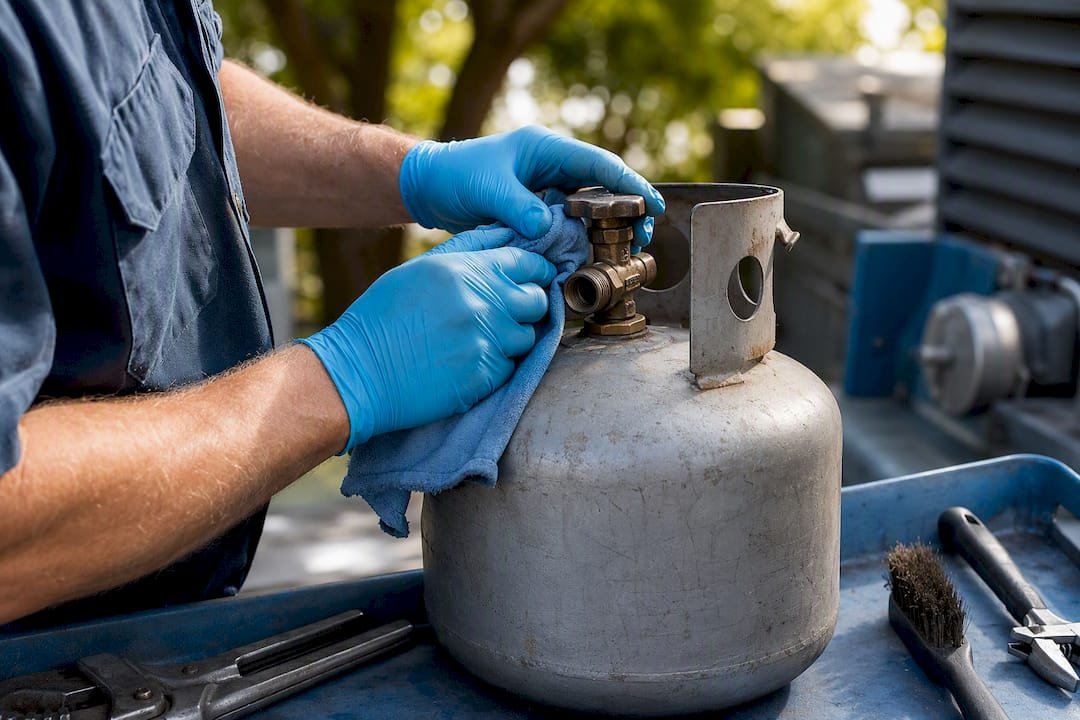
Asset tags paired with a digital reminder system catch expired cylinders before they reach the fill line, which matters more than any single inspection step. Treat visual-only inspection as a formal, trained procedure governed by CGA guidance, not a quick glance. Before hydrostatic testing, clean cylinders, check valves, and verify tare weight so avoidable prep issues don’t register as false failures. Keep a living requalification log and update tare weights whenever a valve or fitting changes.
What Rigorous Requalification Actually Protects
Compliance staff who treat requalification as a formality end up carrying the liability when a stamp turns out wrong. Rigorous programs protect customers first, but they also protect fill schedules: a cylinder pulled at the door costs more time than one flagged a week earlier. Procurement matters here too. Having replacement cylinders and calibrated tools on hand keeps a condemned unit from turning into a service gap.
— Planet
Keeping Your Fill Station Stocked While Cylinders Cycle Through Testing
When a cylinder gets pulled for requalification or condemned outright, your fill station doesn’t get to pause. Hvac-prime stocks the tools and supplies that keep operations moving while cylinders are in the requalification pipeline, without acting as a requalifier itself.
Gauges, nitrogen regulators, and refrigerant analyzers help you run the pre-test checks that catch avoidable failures before a cylinder ever reaches a hydro rig, and Hvac-prime carries the regulators and diagnostic tools contractors use for leak checks and contamination screening. When a cylinder gets condemned, you need a replacement fast, not a week from now, and Hvac-prime’s refrigerant inventory ships quickly so a compliance hold doesn’t turn into a lost job. SDS and TDS documentation is available on every product page, which matters when you’re closing out records on a cylinder pulled from service. Browse the HVAC tools lineup and place an order today to keep your fill schedule intact.



 HVAC
HVAC Automotive
 Refrigerant Diagnostics Kit
 Water Heaters