
8 Step Flush for Automotive AC Oil Compatibility


R-12 systems run on mineral oil, R-134a runs on PAG or POE depending on the compressor, and R-1234yf needs its own specialized PAG-YF or ND oil, none of which are interchangeable without consequences. Mixing oil families is the fastest way to strand a customer with a seized compressor. The rule that saves you a comeback: flush the system any time you change oil family, compressor brand, or refrigerant type, and never run conductive PAG in a hybrid or electric compressor unless the OEM explicitly signs off on it.
TL;DR:
- Mixing different oil families or refrigerants without flushing the system can cause compressor seizure and premature failure; always flush when changing major components or oil types.
- Compatibility hinges on more than viscosity, with additive chemistry, miscibility, and critical solubility temperature playing key roles in oil performance and compressor health.
- Use OEM-specified oils and viscosities for each compressor type, and replace pre-filled compressors with the correct oil to prevent overfilling and system issues.
- Conduct thorough inspections of drained oil for contamination, discoloration, or odor before refilling, especially on hybrid systems where conductivity is critical.
- Always verify oil compatibility and required flushing procedures with manufacturer data to avoid costly compressor damage and ensure warranty compliance.
Table of Contents
- Automotive AC Oil Compatibility at a Glance
- Why Isn’t There One Universal AC Oil?
- Can I Mix AC Oils? Service Rules That Prevent Comebacks
- Which Oil Viscosity Does Your Compressor Need?
- Seals, Plastics, and Hybrid Compressor Warnings
- Spotting an Oil Incompatibility Problem Before It Wrecks a Compressor
- What Twenty Years of Compressor Failures Teach About Oil Choices
- Get the Right Oil and Refrigerant Without the Guesswork
- Where Technicians Verify These Specs
- Sources
Automotive AC Oil Compatibility at a Glance
Match the oil to the refrigerant and the compressor, not just the can label. Here’s the quick reference most shops keep taped inside the tool cabinet.
| Refrigerant | Compatible oil family | Common viscosity | Typical charge |
|---|---|---|---|
| R-12 | Mineral oil | Single grade, non PAG | 4–8 oz |
| R-134a | PAG 46/100/150, POE, or ND-Oil 8 | Varies by compressor | 4–8 oz |
| R-1234yf | PAG-YF (46/100), ND-Oil 11 or 12, POE in some designs | Compressor-specific | 4–6 oz |
| — | POE | High viscosity POE | N/A for auto |
DENSO’s technical bulletin breaks the ND-oil family down further: ND-Oil 8 works in R-134a piston and rotary compressors, ND-Oil 11 is built for electric scrolls, and ND-Oil 12 straddles both R-1234yf and R-134a. ND-Oil 8 cannot be substituted into an R-1234yf system, full stop.
Most passenger vehicle AC systems hold between 4 and 8 ounces of oil, though the exact number depends heavily on system size and compressor design. A few things worth flagging before you crack a system open:
- New compressors usually arrive pre-filled from the factory with the full system charge, so adding more on installation often overfills the system.
- Most of the oil charge lives in the compressor itself, not floating loose in the lines or condenser.
- Some MAHLE technical documents list PAO 68 as an accepted substitute in specific R-134a and R-1234yf compressor variants, but only where the compressor manufacturer approves it.
Why Isn’t There One Universal AC Oil?
Oil compatibility isn’t just about matching a viscosity number. Two PAG 46 oils from different manufacturers can carry different additive packages, and additive chemistry drives compressor wear resistance, foaming behavior, and seal swell more than the base viscosity grade ever will.
Miscibility is the real gatekeeper here. Refrigerant and oil have to stay blended as they circulate, and every oil has a Critical Solubility Temperature, the point at which it can separate out of the refrigerant stream instead of returning to the compressor with it. Drop below that threshold and you get oil pooling in the evaporator or condenser instead of lubricating the compressor, which is a slow way to kill a compressor that looked fine on the bench.
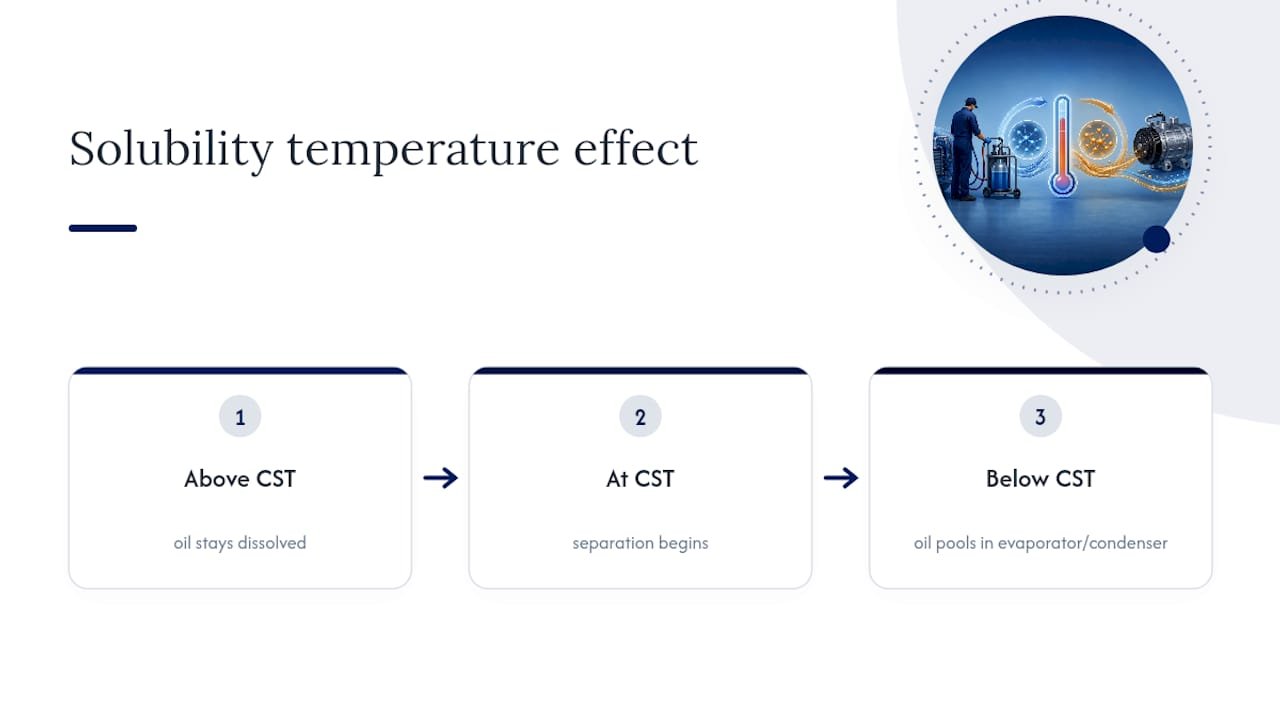
PAG oils are also hygroscopic, meaning they pull moisture from the air aggressively. That moisture reacts with refrigerant to form acids that eat away at seals and metal internals over time, which is part of why an opened PAG bottle has a short shelf life once exposed. POE oils absorb moisture too, but PAG oils carry electrical conductivity that POE does not, a distinction that becomes critical the moment you’re working on an electric compressor.

Pro Tip: Never leave a PAG bottle open on the bench longer than necessary. It starts absorbing atmospheric moisture within minutes, and that moisture ends up in the customer’s system.
Can I Mix AC Oils? Service Rules That Prevent Comebacks
Topping off is fine in narrow situations. Adding a small amount of the same oil family, same brand, into a system that’s already running that oil is standard practice after a minor repair like a hose replacement. The moment you cross oil families, brands, or refrigerant types, topping off turns into gambling with the customer’s compressor.
The hard line: flush the entire system whenever you change compressor brand, oil family, or refrigerant family. Automotive Tech Info’s lubricant pairing documentation confirms that swapping compressor brands without flushing is a frequent, preventable root cause of premature failure. R-134a to R-1234yf retrofits fall into this category too, unless you’re using an ND oil rated for both refrigerants.
A flush that actually protects the warranty looks like this:
- Recover the refrigerant charge fully and log the amount.
- Remove the compressor, condenser, and any component holding residual oil.
- Flush the reservoir, lines, and condenser with a solvent rated for the oil family being removed.
- Inspect the drained oil for metal particles, discoloration, or a burnt smell.
- Refill with the OEM-specified oil at the correct quantity.
- Pull a deep vacuum and hold it to confirm the system is dry and sealed.
- Leak test before final refrigerant charge.
- Document every step, including oil type and quantity, for warranty records.
Pro Tip: Photograph the drained oil before you dispose of it. If a compressor fails again in six months, that photo is your evidence the original service was done correctly.
Which Oil Viscosity Does Your Compressor Need?
PAG 46 tends to show up in newer, high-efficiency compressors designed for tighter tolerances. PAG 100 covers a wide swath of mid-2000s to late-2010s vehicles. PAG 150 shows up in older or higher-displacement systems where the oil needs more film strength at higher operating temperatures. None of these are interchangeable just because they’re all labeled PAG.
Read the compressor label or tag before you touch the reservoir. Incorrect oil viscosity is one of the most common causes of new compressor failure, and manufacturers engineer their compressors around a specific formulation, not just a viscosity number.
A few practical notes worth keeping on the wall:
- Replacement compressors typically ship pre-filled with the OEM-specified oil charge, so topping off on install usually overfills the system.
- Swapping between compressor makes, say a Sanden unit for a Denso replacement, calls for a full flush because their PAG formulations often aren’t miscible with each other.
- When the label is missing or unreadable, cross-reference the compressor part number against OEM service data rather than guessing.
Seals, Plastics, and Hybrid Compressor Warnings
Polar base oils like PAG can be aggressive toward certain elastomers and plastics, particularly older nitrile seals and some nylon fittings not rated for polyglycol exposure. Base-oil compatibility references show which combinations are generally safe, but edge cases still need physical immersion testing before you commit a customer’s system to an unfamiliar oil.
Hybrid and electric compressors raise the stakes considerably. Conductive PAG oil in an electrically driven compressor can create a path for high voltage fault current, a genuine shock and fire risk, not just a warranty issue.
- Use only OEM-approved non-conductive oils in hybrid/EV compressors, typically POE, PAO, or specialized non-conductive PAG-YF formulations.
- Never substitute standard conductive PAG into an electric compressor “because it’s close enough.”
- When a compressor’s electrical rating isn’t clearly marked, treat it as conductive-sensitive until proven otherwise.
Pro Tip: Keep hybrid-rated oil bottles physically separated from standard PAG stock in the shop. A grab-the-wrong-bottle mistake here isn’t a comeback, it’s a liability claim.
Spotting an Oil Incompatibility Problem Before It Wrecks a Compressor
Watch for clutch chatter, weak cooling that doesn’t match the refrigerant charge level, or a compressor that runs noticeably hotter than expected. Oil that’s gone dark, smells burnt, or shows a varnish-like film on a dipstick sample points to acid formation or thermal breakdown, not just normal wear.
- Pull a small oil sample and check clarity, color, and smell against a known-good reference.
- Inspect for metal shavings or debris in the sample, a sign the compressor is already grinding internally.
- On hybrid systems, test the oil’s conductivity before returning the vehicle to service.
- If contamination is confirmed, isolate the system, document what you found with photos, and quote the customer for a full flush and refill rather than a quick top-off.
A compressor replacement that follows from a missed incompatibility issue runs $590 to $1,360 on average, which makes the extra ten minutes of oil inspection an easy sell to a skeptical customer.
What Twenty Years of Compressor Failures Teach About Oil Choices
The industry’s biggest blind spot is treating viscosity as the whole story. A tech grabs PAG 100 because the last job used PAG 100, without checking whether this compressor’s manufacturer formulated a different additive package under the same number on the label. That habit, more than any single wrong refrigerant choice, is what fills bins with cracked compressors that “should have worked fine.”
The single move that prevents most of these failures is boring and unglamorous: check the OEM oil spec before you open the reservoir, and flush the system any time you’re changing oil family, compressor brand, or refrigerant type. Hvac-prime backs that discipline with the paperwork technicians actually need, safety data sheets and technical data sheets on the refrigerants and oils it stocks, so a spec check doesn’t turn into a guessing game between calls.
— Planet
Get the Right Oil and Refrigerant Without the Guesswork
Hvac-prime stocks the automotive refrigerants and compatible compressor oils technicians need to do a flush-and-refill job right the first time, without waiting days for a supplier to restock.
Every product page links out to SDS and TDS documentation so you can verify oil formulation and safety handling before you order, not after the job’s already on the lift. Browse the refrigerants category for R-134a and R-1234yf options, including the Honeywell R-1234yf 8 oz can built for retrofit and OEM-spec jobs, or grab high-purity R-134a for standard service work. Need flush kits, vacuum pumps, or gauges to round out the job? Check the HVAC tools lineup and place your order with fast shipping built in.
Where Technicians Verify These Specs
For vehicle-specific oil viscosity, quantity, and compressor compatibility, cross-check with DENSO’s compressor oil bulletins, MAHLE’s PAG/PAO/POE technical brochure, AA1Car’s compressor oil reference, and SKF’s base-oil compatibility charts, or pull the OEM service manual for the exact vehicle in the bay.
Sources
- Lubricant and Refrigerant Pairing (Volkswagen / Automotive Tech Info)
- A/C compressor oil application chart (AA1Car)
- SKF grease and base-oil compatibility reference




 HVAC
HVAC Automotive
 Refrigerant Diagnostics Kit
 Water Heaters