
R134a vs R1234yf: What Technicians Need to Know


R-1234yf is the mandated refrigerant for new light-duty vehicles from model year 2021 onward, and it has effectively replaced R-134a in the automotive service bay. If you’re still stocking both, the rule is simple: never charge an R-1234yf system with R-134a, and never service either refrigerant without the dedicated equipment built for it.
The numbers explain the mandate. R-134a carries a global warming potential of roughly 1,430, while R-1234yf sits below 4, a reduction of about 99.7%. R-134a is ASHRAE class A1 (nonflammable); R-1234yf is A2L, mildly flammable, which changes how you leak-test, recover, and store it.
- R-1234yf: mandatory for new light-duty vehicles, model year 2021+
- R-134a: legacy refrigerant, still common in the vehicle parc through the mid-2030s
- Cross-charging is not just wrong. It’s a contamination event that can force disposal of the entire charge
Key Takeaways
R-1234yf’s near-zero GWP and mandatory status for new vehicles make it the refrigerant every shop must be equipped to service correctly, without ever cross-charging it with R-134a.
| Point | Details |
|---|---|
| GWP gap drives the mandate | R-1234yf’s GWP under 4 versus R-134a’s ~1,430 is why EPA SNAP requires it in new light-duty vehicles from model year 2021 on. |
| A2L safety is manageable, not scary | Standard engineering controls and dedicated recovery equipment make R-1234yf’s mild flammability a low real-world risk. |
| Moisture control matters more with R-1234yf | Air and water contamination accelerate oil breakdown and raise acid levels faster than in R-134a systems. |
| Expect a modest performance gap | Cooling capacity commonly runs 5 to 11% lower on R-1234yf, narrower with an internal heat exchanger installed. |
| Stock both refrigerants correctly | HVAC Prime supplies virgin R-134a and R-1234yf cylinders, matched lubricants, and SDS/TDS downloads for compliant, contamination-free service. |
Table of Contents
- R134a vs R1234yf: Technical Specs at a Glance
- Why the Industry Moved From R134a to R1234yf
- Is R1234yf Safe to Handle in the Shop?
- Do R134a and R1234yf Systems Use the Same Fittings?
- R1234yf vs R134a Performance: What the Data Actually Shows
- What Refrigerant Costs Should Shops Expect
- Step-by-Step: Servicing an R134a or R1234yf System
- The Research Behind the R134a to R1234yf Transition
- Why the “Just Top It Off” Mentality Is Dying
- Where to Source Refrigerant and Equipment for Either System
- Sources
R134a vs R1234yf: Technical Specs at a Glance
Pull up next to a system you don’t recognize and the spec sheet tells you almost everything you need before you connect a hose. Both refrigerants share a similar boiling point and vapor pressure curve, which is why gauge readings look deceptively alike, but the safety and lubricant requirements diverge sharply.
The lower flammability limit near 6.2% sounds alarming until you realize it takes a fairly narrow concentration band plus an ignition source to matter in practice. Lubricant swap matters more day to day: PAG YF is formulated differently than standard PAG, and OEMs are explicit that you don’t substitute one for the other during a top-off.
Why the Industry Moved From R134a to R1234yf
The switch wasn’t a style preference. The EPA’s SNAP program phased out R-134a in new vehicle air conditioning systems, mandating R-1234yf for model year 2021 and later light-duty vehicles, with many automakers moving earlier under global emissions pressure.
Automakers get emissions credit for lower-GWP refrigerants under federal fuel economy rules, and fleets that still run R-134a aren’t in violation, but a certified R-1234yf system cannot legally be serviced with R-134a as a substitute.
- EPA SNAP: R-1234yf required for new light-duty vehicles, MY2021+
- Refrigerant substitution in a certified system violates the system’s design certification
- Retrofitting older R-134a vehicles to R-1234yf is possible in some cases but requires OEM-approved kits, not a simple recharge swap
Is R1234yf Safe to Handle in the Shop?
A2L classification worries technicians who’ve spent a career around nonflammable A1 refrigerants, but the real-world risk profile is narrower than the label suggests. SAE’s CRP 1234 testing program and EPA’s technical review concluded R-1234yf can be handled safely in OEM systems when technicians follow standard engineering controls, because the ignition energy required is high and typical leak scenarios don’t create a sustained flammable concentration.
That doesn’t mean treat it casually.
- Use recovery equipment built to SAE J2843/J2851 standards, not repurposed R-134a machines
- Ventilate the bay; don’t work in an enclosed pit without airflow
- Watch for decomposition byproducts (including hydrogen fluoride) if the refrigerant contacts an open flame or hot surface
- Store cylinders away from ignition sources per the same rules you’d apply to any flammable gas
Pro Tip: Keep your R-1234yf recovery machine’s internal filters and seals on the manufacturer’s replacement schedule. A worn seal doesn’t just leak refrigerant. It creates the exact low-level vapor accumulation that A2L handling protocols are designed to prevent.
Do R134a and R1234yf Systems Use the Same Fittings?
They don’t, and that’s intentional. SAE-standardized keyed service ports differ between the two refrigerants specifically to prevent an R-134a hose from connecting to an R-1234yf port, or vice versa. If you’re facing an unlabeled system, check the port geometry and the door-jamb or underhood label before you assume anything.
- Confirm refrigerant type first. Check the system label, then verify with port shape. Never rely on memory or “it’s an older car so it must be R-134a.”
- Match the lubricant. PAG YF is not interchangeable with standard PAG. Draining and refilling with the correct oil is not optional if you’ve opened the system.
- Never blend refrigerants. A mixed charge is difficult to separate in the field and typically requires certified reclaim or disposal rather than reuse.
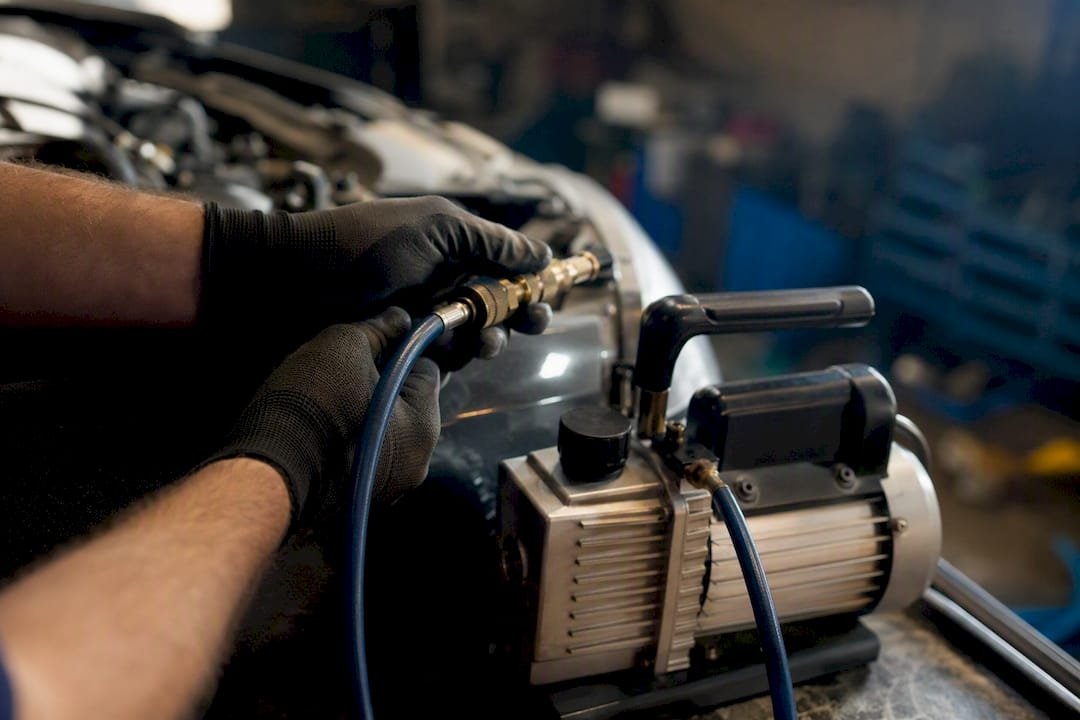
Moisture control matters more with R-1234yf than most techs assume. Purdue testing on lubricant compatibility found that when air and water are present, R-1234yf systems show faster oil breakdown and elevated acid numbers compared to R-134a under the same contamination. A rushed evacuation that would have been forgivable on an old R-134a system can shorten compressor life on an R-1234yf one.
Pro Tip: Pull vacuum longer than your gut says is necessary on any R-1234yf system that’s been open to atmosphere for more than a few minutes. The lubricant chemistry punishes shortcuts here more than R-134a ever did.
R1234yf vs R134a Performance: What the Data Actually Shows
Don’t promise a customer identical cooling performance and then get surprised at the vent thermometer. Peer-reviewed testing summarized in an IOP Conference Series comparison found R-1234yf systems commonly run 5 to 11% lower cooling capacity than equivalent R-134a systems, with COP differences ranging more widely depending on test setup, in some cases reported as high as 25 to 27% under specific conditions.
- Internal heat exchangers (IHX) narrow the gap significantly in OEM-designed R-1234yf systems
- Higher condensing temperatures (hot climate, stop-and-go traffic) tend to widen the performance gap
- Most drivers won’t notice the difference in daily use; it shows up more in extreme ambient heat or aggressive duty cycles
For diagnostics, this means don’t chase a “weak cooling” complaint on a properly charged R-1234yf system as if it were a R-134a fault. Some of that performance gap is baked into the refrigerant itself, not a sign of undercharge.
What Refrigerant Costs Should Shops Expect
R-1234yf costs more, and the reasons are structural, not artificial. Production requires more complex synthesis and safety validation, and supply has historically concentrated among a small number of manufacturers including Chemours’ Opteon YF line, which keeps upward pressure on price compared to the mature, multi-source R-134a market.
- Per-pound cost for virgin R-1234yf runs meaningfully higher than R-134a at wholesale
- Full professional recharges reflect that gap, plus the added cost of A2L-rated recovery equipment
- Shops that invest in dedicated R-1234yf machines amortize that cost across volume, which is why per-service pricing gaps often shrink at higher-throughput shops
Buying refrigerant in bulk from a wholesale refrigerant supplier rather than small retail cans is usually the fastest way to control that cost differential without cutting corners on quality.
Step-by-Step: Servicing an R134a or R1234yf System
- Identify before you connect anything. Check the underhood label and match port geometry. Don’t assume based on vehicle age alone.
- Select dedicated equipment. Use A2L-rated recovery machines for R-1234yf and standard equipment for R-134a. Confirm the correct lubricant, PAG YF versus standard PAG, before opening the system.
- Leak test, evacuate, recharge, verify. Pull vacuum to manufacturer-specified levels and hold it to confirm no leaks, recharge to spec by weight rather than pressure alone, then verify vent temperature and system pressures against OEM targets.
Pro Tip: Log the refrigerant type and lubricant used on every job in your shop management system. The next tech who opens that system, maybe you in eighteen months, shouldn’t have to guess.
The Research Behind the R134a to R1234yf Transition
The technical case for R-1234yf rests on a stack of documentation, not marketing claims. EPA’s SNAP program sets the GWP baseline and mandate timeline that started this whole transition. Opteon YF bulletins detail the flammability profile and required handling standards. Independent testing published through IOP’s conference series backs up the real-world performance gap technicians should expect.
- EPA SNAP: GWP figures and legal mandate context
- Opteon YF documentation: A2L classification, LFL/UFL, service equipment standards
- IOP / conference-published testing: cooling capacity and COP differences under load
For safety data sheets and technical data sheets on either refrigerant, HVAC Prime maintains an SDS and TDS download library so you’re not hunting for documentation mid-job.
Why the “Just Top It Off” Mentality Is Dying
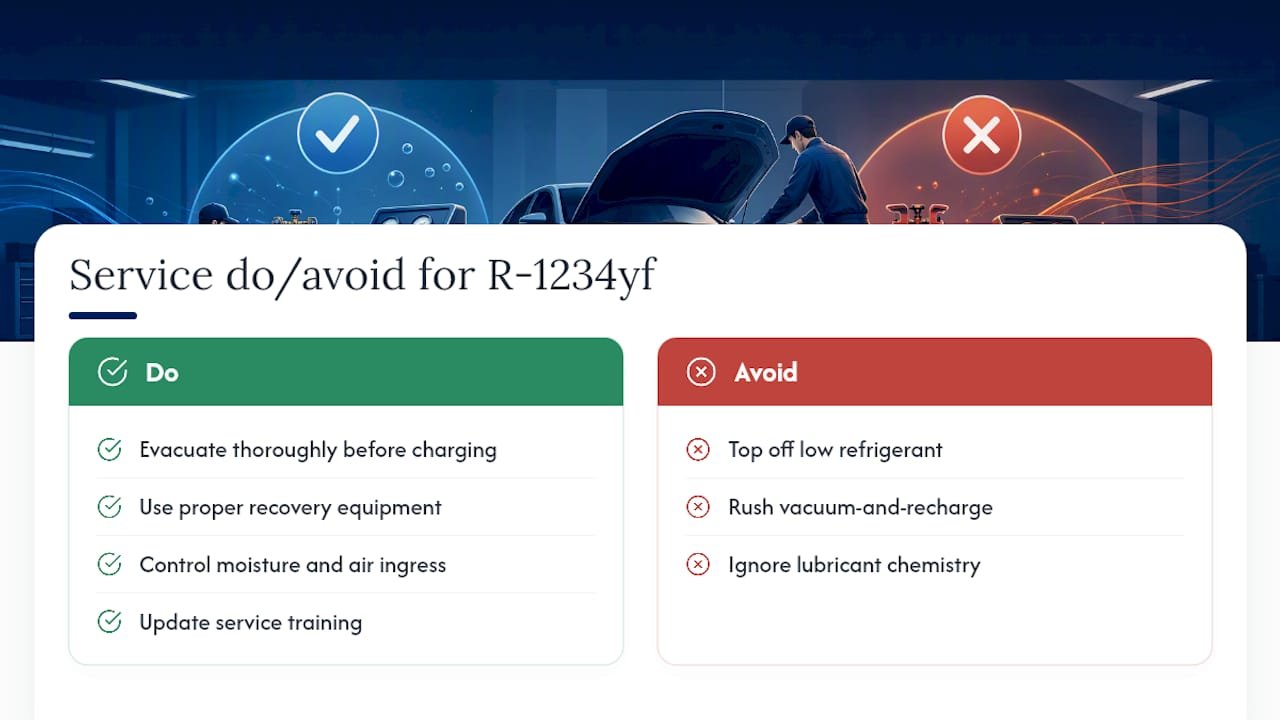
The conventional shop wisdom on refrigerants for the last thirty years was simple: if it’s low, add more of the same. That instinct doesn’t survive contact with A2L refrigerants and keyed service ports, and technicians who haven’t updated their mental model are the ones most likely to create a mixed-charge disposal problem or damage a compressor through moisture contamination.
What gets underrated in most training is the lubricant chemistry, not the flammability. Every tech gets briefed on A2L handling. Fewer get briefed on why air and moisture accelerate oil breakdown specifically in R-1234yf systems, which is the detail that actually shortens compressor life on jobs that looked clean at the time.
If there’s one place to prioritize effort, it’s evacuation discipline, not refrigerant fear. The flammability risk on a properly maintained R-1234yf system is low when standard engineering controls are followed. The moisture risk is real, immediate, and almost entirely under the technician’s control. Shops that treat R-1234yf with the same rushed vacuum-and-recharge habits they used on R-134a for two decades are the ones who’ll see comeback compressor failures, not the ones who invested in better recovery equipment.
Where to Source Refrigerant and Equipment for Either System
Stocking both refrigerants correctly means more than buying cylinders. It means having the right lubricants, the right recovery equipment, and the documentation on hand before a job starts, not after a customer’s already in the waiting room.
HVAC Prime supplies virgin R-1234yf and R-134a cylinders side by side, along with compatible PAG YF and standard PAG oils and certified recharge kits built for each refrigerant’s service requirements. That matters because mismatched lubricant is one of the most common, and most preventable, causes of comeback compressor failures on R-1234yf jobs. Fast shipping keeps a bad stocking day from turning into a canceled appointment, and every product page links out to SDS and TDS documentation so you’re never scrambling for paperwork during a safety audit. If you’re restocking for the season or outfitting a bay for A2L work, browse the refrigerant category to compare cylinder sizes and kit options, and pull the safety documentation you need before the truck leaves the lot.
Sources
- Opteon™ YF product information bulletin
- R1234yf vs R134a in automotive air conditioning system (IOP conference paper)
- Compatibility of R1234yf and R134a and Lubricants used in Automotive Compressors (Purdue study)




 HVAC
HVAC Automotive
 Refrigerant Diagnostics Kit
 Water Heaters