
R404A Phaseout: What Contractors Need to Do Right Now

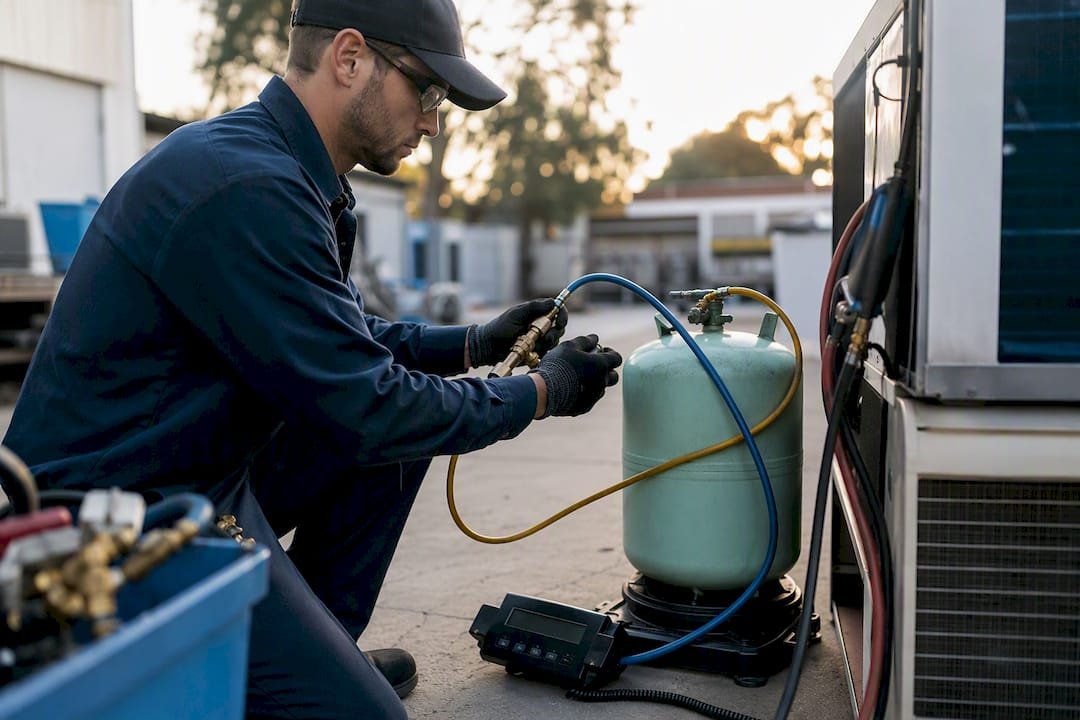
Virgin R-404A is being squeezed out of the US market under the AIM Act, and new equipment using it is already restricted in most refrigeration subsectors. Service on existing systems using reclaimed, recycled, or already-produced stock remains legal for now, but that supply is shrinking fast. The single most urgent move for any contractor or facility manager: audit every R-404A system you touch and rank it by risk before the next allowance step tightens supply further.
The EPA’s AIM Act phasedown, enforced through the Technology Transitions Program, is the legal backbone here, and NASRC has been pushing food retailers toward staged conversions for exactly this reason.
- Virgin R-404A production and import allowances are shrinking on a fixed schedule, not disappearing overnight.
- New equipment manufactured for many refrigeration applications can no longer use R-404A.
- Servicing existing systems with reclaimed or already-produced R-404A is still permitted.
Key Takeaways
The R404A phaseout is a staged supply squeeze under the AIM Act, not a single ban date, and no refrigerant is a universal drop-in for existing equipment.
| Point | Details |
|---|---|
| Phasedown runs through 2036 | AIM Act allowances step down at 2024, 2028, and 2029, reaching 15% of baseline by 2036. |
| Service on legacy systems continues | Reclaimed and recycled R-404A remains usable for repairs even after new-equipment restrictions apply. |
| No universal drop-in exists | Every retrofit needs compressor approval, oil compatibility, and discharge temperature checks first. |
| Triage systems before choosing refrigerant | Rank by charge size, age, and criticality; large-charge racks need attention before small sealed units. |
| Hvac-prime supplies both paths | Virgin and reclaimed refrigerants, SDS/TDS downloads, and retrofit tools are available with fast shipping. |
Table of Contents
- What Is the R404A Phaseout Timeline Under the AIM Act?
- How Does the R404A Ban Affect Existing Refrigeration Systems?
- What Are the Best R404A Replacement Refrigerants?
- How Should Contractors Plan Their R404A Transition?
- How Hvac-prime Supports Your R404A Transition
- Where the Conventional Advice on R404A Gets It Wrong
- Get the Refrigerants and Tools to Move Off R-404A Now
- Frequently Asked Questions
- Sources
What Is the R404A Phaseout Timeline Under the AIM Act?
The AIM Act doesn’t ban R-404A outright on one date. It works through an allowance system: EPA caps the total volume of high-GWP HFCs that producers and importers can bring to market, and that cap steps down at set intervals until it hits 15% of the historic baseline by 2036. R-404A, with a GWP around 3,922, sits near the top of the list EPA is squeezing hardest.
- 2024 — an early allowance reduction step, tightening virgin HFC volume available to the market.
- 2028 — a deeper cut, coinciding with several Technology Transitions sector deadlines for commercial refrigeration equipment.
- 2029 — another scheduled step-down before the steepest compliance requirements hit.
- 2036 — the final target, capping HFC production and consumption at 15% of baseline.
Layered on top of the allowance schedule, EPA’s Technology Transitions final rule sets GWP limits by equipment subsector, and several commercial refrigeration equipment classes fall into compliance windows spanning roughly 2024 through 2027. These are manufacture and import restrictions on new equipment, not blanket bans on the refrigerant itself.
That distinction matters for anyone servicing legacy racks. Manufacture/import restrictions stop new equipment built for R-404A. Sales and distribution restrictions follow a separate clock: EPA’s rule generally applies these three years after the manufacture date restriction takes effect, giving distributors and contractors a runway to sell through existing inventory. Service exceptions cover repair components for already-installed equipment, which stay available even after a subsector’s manufacture date passes. Reclaimed and recycled R-404A also gets special treatment; it isn’t subject to the same virgin-production allowance cuts, which is why reclaim programs matter more every year this phasedown progresses.
How Does the R404A Ban Affect Existing Refrigeration Systems?
The AIM Act’s allowance cuts don’t shut off R-404A. They make it scarcer and pricier, and that pressure lands unevenly across equipment types. RefrigerantTrack’s summary of the phasedown notes that virgin supply tightening pushes buyers toward reclaimed stock or a faster switch to alternatives, often both at once.
Some systems feel this harder than others:
- Central refrigeration racks in supermarkets carry large charges, so every pound of price increase multiplies fast.
- Display cases often run older compressors with narrow operating envelopes, limiting retrofit flexibility.
- Transport refrigeration units face tighter space and weight constraints that rule out some drop-in blends.
- Ice machines frequently use small hermetic compressors that are expensive or impossible to source once a manufacturer discontinues R-404A-rated parts.
Service itself gets harder before it gets impossible. Manufacturers stop stocking R-404A-specific expansion valves and gaskets for older platforms, and some equipment warranties assume the original refrigerant charge, so an unapproved retrofit can void coverage. Insurers reviewing commercial refrigeration risk are starting to ask about refrigerant compliance plans, too, particularly for large-charge systems.
Pro Tip: Lock in reclaimed R-404A supply for your highest-priority systems before your next scheduled service visit, not after a compressor fails. Reclaimed stock disappears fastest right when everyone else realizes the same thing.

What Are the Best R404A Replacement Refrigerants?
There’s no universal drop-in for R-404A, a point Danfoss makes repeatedly in its retrofit guidance: every swap depends on the specific compressor, oil, and operating envelope of the system in front of you. That said, four pathways cover most real-world retrofits and new installs.
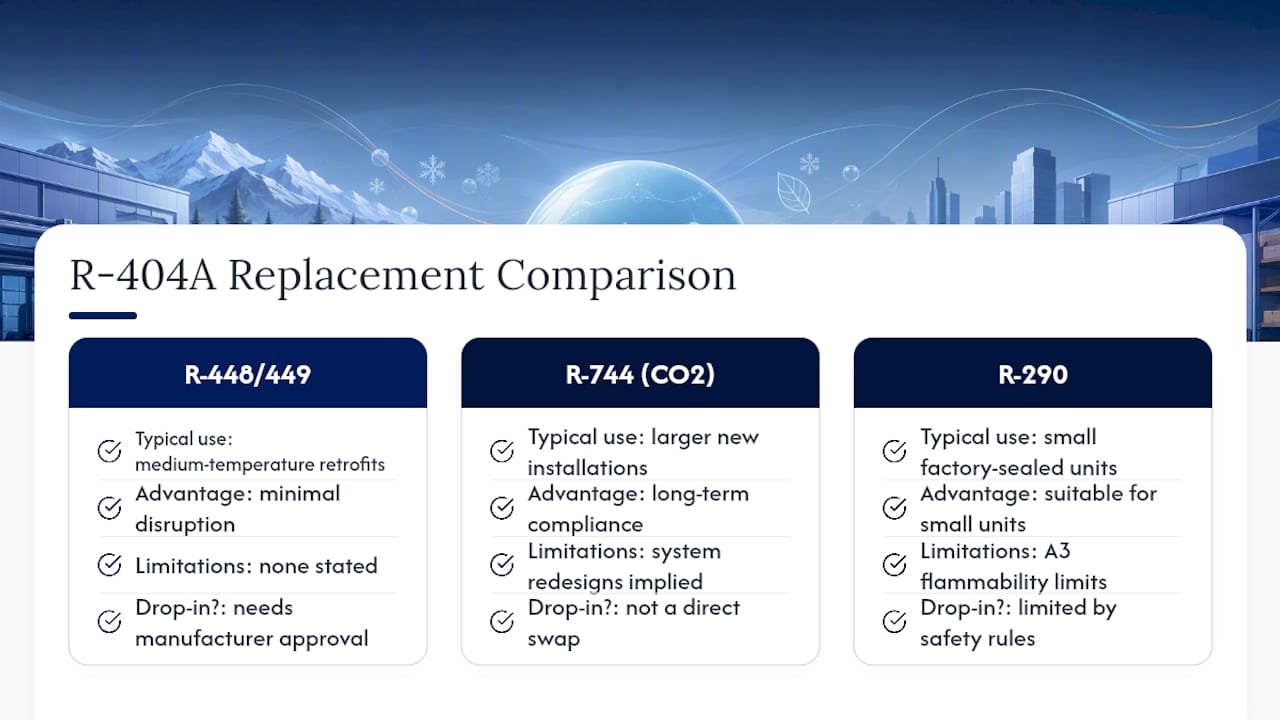
- R-448A — an A1 (non-flammable) blend with roughly one-third the GWP of R-404A, widely used as a like-for-like retrofit in medium-temperature racks and reach-in cases.
- R-449A — also A1, similar GWP profile to R-448A, often the alternative when R-448A isn’t specified by the compressor manufacturer.
- CO2 (R-744) — an A1 natural refrigerant with a GWP near 1, running transcritical in larger commercial racks; excellent long-term compliance but higher upfront system cost and specialized components.
- R-290 (propane) — an A3 flammable refrigerant, mostly used in small, factory-sealed self-contained units like reach-in coolers due to strict charge limits.
Before touching any of these, NASRC’s commercial refrigeration guidance recommends verifying compatibility against a short but unforgiving list:
- Compressor manufacturer approval for the specific replacement blend.
- POE oil compatibility, since a mismatch causes lubrication failure long before anyone notices a leak.
- Expansion device sizing, because most TXVs calibrated for R-404A won’t meter a different blend correctly.
- Discharge temperature increases, which can silently overheat compressors rated for R-404A’s cooler operating profile.
- Safety classification limits (A1 vs A2L vs A3), which dictate charge size, ventilation, and leak-detection requirements.
A1 blends like R-448A and R-449A retrofit with the least operational disruption, while A3 options like R-290 cut GWP to near zero but bring flammability rules that limit them to small, factory-charged systems. Retrofit is realistic when the manufacturer has published approval data for your exact compressor and oil combination. When that data doesn’t exist, or the discharge temperature math doesn’t work, replacement is the safer long-term call, even though it costs more upfront.
Pro Tip: Never treat a retrofit blend’s data sheet as a substitute for checking your compressor manufacturer’s actual approval list. Danfoss and other manufacturers publish these lists precisely because “similar” refrigerants can behave very differently under load.
How Should Contractors Plan Their R404A Transition?
A transition plan works best as a five-step sequence, run system by system rather than site by site.
- Inventory every R-404A system you service: charge size, age, compressor model, and criticality to the client’s operation.
- Triage by risk. Score each system on age, charge size, business criticality, and current efficiency; the systems scoring worst on all four go first.
- Choose retrofit or replace based on manufacturer approval data, not guesswork. If the compressor maker hasn’t published compatibility data for your target blend, lean toward replacement.
- Lock procurement early. Decide whether to reserve reclaimed R-404A for short-term service or commit to retrofit refrigerant purchases now, before allowance cuts push prices higher.
- Brief the client with a real timeline, a cost estimate, and the safety implications if the replacement involves an A2L or A3 refrigerant.
Retrofit costs for compatible equipment often run from the low thousands to mid-thousands of dollars per unit; full replacement of a commercial rack or rooftop system can run an order of magnitude higher, which is exactly why triage matters more than blanket policy. For multi-store operations, NASRC suggests splitting a centralized rack into remote condensing units as an incremental path, spreading capital cost over time while still cutting regulatory exposure now.
Client briefings should cover four things every time: the compliance timeline that applies to their equipment class, a realistic cost range for retrofit versus replacement, the safety profile of any flammable alternative under consideration, and a firm scheduling window before their highest-risk system fails unplanned.
How Hvac-prime Supports Your R404A Transition
Sourcing the right refrigerant fast is half the battle once you’ve triaged your system list. Hvac-prime stocks virgin and reclaimed refrigerants, including R-404A alternatives and current-generation blends, alongside the gauges, vacuum pumps, and diagnostic tools retrofit work demands.
- Fast shipping cuts the downtime between diagnosing a failing R-404A system and getting the replacement charge on site.
- SDS and TDS documents are available for download, which speeds up the compatibility paperwork most retrofit jobs require.
- Bulk and wholesale pricing supports contractors managing multiple triaged systems on tight budgets.
Where the Conventional Advice on R404A Gets It Wrong
Most guidance treats the R-404A phaseout like a single deadline to plan around. It isn’t. It’s a slow-motion supply squeeze with several pressure points, and the contractors getting caught off guard are the ones waiting for a hard ban that was never coming as one clean event.
The bigger mistake is treating retrofit blends as interchangeable commodities. R-448A and R-449A are close cousins, but “close” isn’t the same as compatible with a specific compressor’s oil charge and expansion valve. Danfoss’s own guidance is blunt about this: there’s no universal drop-in, full stop. Skipping the compressor approval check to save a service call is how you turn a $2,000 retrofit into a $15,000 compressor replacement.
What actually deserves priority right now isn’t picking the “best” alternative refrigerant. It’s triage. A ten-year-old ice machine with a small charge can wait. A supermarket rack with a large R-404A charge and no manufacturer-approved retrofit path cannot. Rank your systems honestly before you rank your refrigerant options.
Get the Refrigerants and Tools to Move Off R-404A Now
Hvac-prime exists for exactly the moment this article describes: you’ve triaged your systems, picked a retrofit path, and need product in hand before the next allowance cut tightens supply further. Rather than waiting on backordered distributor stock, contractors can order virgin and reclaimed refrigerants directly, with fast shipping built to keep a service call from turning into a multi-day delay.
Beyond refrigerant, Hvac-prime carries the professional-grade tools retrofit work actually requires: gauges, vacuum pumps, and diagnostic kits, plus SDS and TDS documentation to support the compatibility paperwork your compliance file needs. For contractors managing multiple systems on a triage schedule, wholesale pricing on bulk orders helps keep retrofit budgets predictable. Start by checking current stock on R-404A alternatives and get the next job scheduled before reclaimed supply tightens further.
Frequently Asked Questions
Is R-404A banned in the United States?
Not entirely. New equipment manufactured for many refrigeration applications can no longer use R-404A under EPA’s Technology Transitions rule, but servicing existing systems with reclaimed or already-produced stock remains legal.
What is the best R-404A replacement for commercial refrigeration?
R-448A and R-449A cover most medium-temperature retrofits with minimal disruption. CO2 (R-744) suits larger new installations aiming for long-term compliance, while R-290 fits only small, factory-sealed units due to A3 flammability limits.
Is R-448A a direct replacement for R-404A?
It’s the closest common match on GWP and safety class, but “direct” still requires manufacturer approval for your specific compressor and oil before you treat it as a drop-in.
How much does an R-404A retrofit typically cost?
Compatible-equipment retrofits often run from the low thousands to mid-thousands of dollars per unit, while full system replacement can cost an order of magnitude more.
Can I still buy virgin R-404A?
Yes, but supply is shrinking under AIM Act allowance caps, and pricing reflects that scarcity. Contractors increasingly rely on reclaimed stock to service legacy systems.
Sources
- Phasedown of Hydrofluorocarbons: Frequently Asked Questions
- NASRC Refrigerant Summary — Commercial Refrigeration
- Danfoss — Refrigerant guidance and retrofit recommendations




 HVAC
HVAC Automotive
 Refrigerant Diagnostics Kit
 Water Heaters